James
James
Ever find yourself staring at a blank content calendar, feeling the pressure to post something just to stay visible? That's the daily grind for most social media managers and marketers. Content automation is the answer to breaking that cycle.
So, what is it, really? Think of it less like a robot taking over your job and more like a super-efficient assistant who handles all the tedious, repetitive parts of content management. It’s the technology that creates, schedules, manages, and distributes your content, all with minimal hands-on effort from you.
This isn't about replacing human creativity; it's about amplifying it by freeing you from the mundane tasks that drain your time and energy.
Unlocking Efficiency With Content Automation
Let's use an analogy. Imagine your content strategy is a garden. To get it to flourish, you need to constantly water, weed, and tend to it. Doing this by hand, especially if you have gardens on X, LinkedIn, and Facebook, is exhausting and frankly, unsustainable.
Content automation is your smart irrigation system. It works quietly in the background, ensuring your garden gets exactly what it needs to thrive, right on schedule.
Instead of logging into five different platforms every single day to post updates, you can build a library of your best content and let an automated system handle the publishing. This simple shift moves you from being a button-pusher to a genuine strategist, giving you the breathing room to think about the bigger picture.
Manual vs Automated Content Management
To really see the difference, let's compare the old way with the new way.
| Aspect | Manual Approach | Automated Approach |
|---|---|---|
| Time Investment | High. Daily, hands-on effort required for every post. | Low. Set up your rules and library, then let it run. |
| Consistency | Inconsistent. Relies on human availability; prone to missed posts. | High. Posts go out at optimal times, every time. |
| Scalability | Poor. Managing more channels or content is a huge time sink. | Excellent. Easily add new channels or content without extra work. |
| Focus | On execution—the "doing" of posting. | On strategy—planning, creating, and analyzing. |
| Content Lifecycle | "One and done." Content is posted once and then forgotten. | "Always on." Evergreen content is recycled to maximize its value. |
The table makes it pretty clear. Automation doesn't just save you a bit of time; it fundamentally changes how you approach your entire content strategy for the better.
Escaping Content Shock
The demand for new content is relentless and growing. Between 2023 and 2025, the need for fresh material shot up by an incredible 93%, forcing marketing teams to find smarter ways to operate with the same (or fewer) resources.
This constant pressure to produce is what experts call "content shock," and it's precisely the problem that automation was built to solve. It’s not about just churning out more noise; it’s about getting the absolute most value out of every single piece of content you’ve ever created.
The big idea here is simple: automate the repetitive stuff so you can pour your human creativity into the strategic work that actually moves the needle. It’s about working smarter, not harder.
What Does Automation Actually Do?
So, what tasks are we handing over to the machines? Content automation isn’t a single button you press; it's a collection of processes. It's a close cousin to the broader idea of workflow automation, which is all about making business operations more efficient.
Here are a few of the most common tasks automation can take off your plate:
- Social Media Scheduling: Automatically publishing your posts to platforms like X (Twitter), LinkedIn, and Facebook at the best possible times.
- Content Recycling: Systematically resharing your best-performing evergreen articles and blog posts to reach new followers and stay top-of-mind.
- Email Nurturing: Sending targeted content to your email subscribers based on their behavior, like what they've clicked on or downloaded.
- Report Generation: Automatically pulling together key performance metrics and analytics without you having to manually export data and build spreadsheets.
By letting technology handle these jobs, you win back countless hours. That's more time to create amazing new content, have real conversations with your audience, and figure out what they really want from you.
Understanding the Core Types of Content Automation
Content automation isn't some single, magical button you press. It’s more like a Swiss Army knife for your content strategy, with different tools for different jobs. Getting a handle on these core types is the first step to figuring out where you can get the biggest bang for your buck and free up your time.
Think of it this way: you wouldn't use a sledgehammer to hang a picture frame. The same logic applies here. Each type of automation solves a specific problem, from keeping your social feeds alive and well to actually helping you create new stuff from scratch.
Let's break down the four main players in the automation game.
Content Scheduling
This is the one most people are familiar with. At its heart, content scheduling is like having a super-organized assistant who works 24/7. You front-load your posts into a tool, pick the exact dates and times you want them to go live, and the software takes care of the rest.
It’s a lifesaver for anyone trying to maintain a consistent online presence without being glued to their screen. A social media manager can block out a Monday morning to schedule an entire week's worth of content for LinkedIn, X (formerly Twitter), and Facebook. The platform then pushes everything out at the best times for engagement, whether that's at 8 PM on a Wednesday or over the weekend.
Content Generation
Okay, now we're moving beyond just posting. Content generation is where technology actually rolls up its sleeves and helps you create new material. This can be as simple as a template that pulls in data to create a report, or as complex as an AI that can write a blog post or whip up an image. This is all about breaking through that creative logjam.
The applications here are pretty wild. A real estate agent could use a template that automatically creates property listings from a simple spec sheet. An online store might use AI to generate hundreds of unique product descriptions in a fraction of the time it would take a human. It's not just text, either. Tools like an AI meme generator can spit out shareable, funny visuals with just a little bit of direction, which is a whole new world for quick, creative marketing.
Content Curation
Here’s a secret: not all the content you share has to be your own. Content curation is the process of automatically finding and sharing great, relevant content from other people and publications. Doing this helps you become a go-to resource in your niche and keeps your content calendar full.
For example, a marketing agency that wants to be known for staying on top of trends could set up an RSS feed automation. It would monitor their favorite marketing blogs, and anytime a new article drops, the tool would grab it and queue it up to be shared across their social channels. That saves someone hours of manual searching and sifting through articles every single day.
This approach builds trust by showing you're focused on providing value, not just promoting your own work. It keeps your audience engaged with a steady stream of high-quality information.
Content Recycling
Last but not least, we have content recycling. This is the art of squeezing every last drop of value out of your best-performing content. This type of automation takes your greatest hits—your evergreen blog posts, guides, and videos—and re-shares them on a schedule.
It ensures your most valuable assets don't just get posted once and then fade into obscurity. This is the ultimate "work smarter, not harder" play, letting you get way more mileage from the hard work you've already put in.
How a Content Automation Workflow Actually Works
It’s one thing to talk about automation in theory, but it really clicks when you see how the moving parts fit together. Let's walk through the process with a fictional marketing manager, Alex, who's setting up their first content automation system. This gives you a practical, step-by-step look at how it's done.
The whole thing starts with strategy, not software. Before Alex even thinks about logging into a tool, they take the time to figure out what their best content actually is. They dig into their analytics to find the blog posts that bring in steady traffic, pinpoint the customer testimonials that really resonate, and identify those quick-hitter tips that always get a ton of engagement.
Building a Content Library
With a clear strategy, Alex’s first practical step is to build a content library. Think of this less like a messy downloads folder and more like a well-organized digital pantry. Alex creates different "buckets," or categories, to sort everything neatly:
- Blog Posts: Links to their most popular, evergreen articles.
- Company News: Updates about the team, product launches, and milestones.
- Helpful Tips: Quick, actionable advice their audience can use right away.
- Testimonials: Powerful quotes and feedback from happy customers.
By categorizing content this way, Alex makes sure their social media feeds will always have a healthy mix of material. It's a simple way to prevent their channels from sounding like a broken record, constantly repeating the same type of post.
This flowchart breaks down the core actions you'll find in a typical automation workflow.
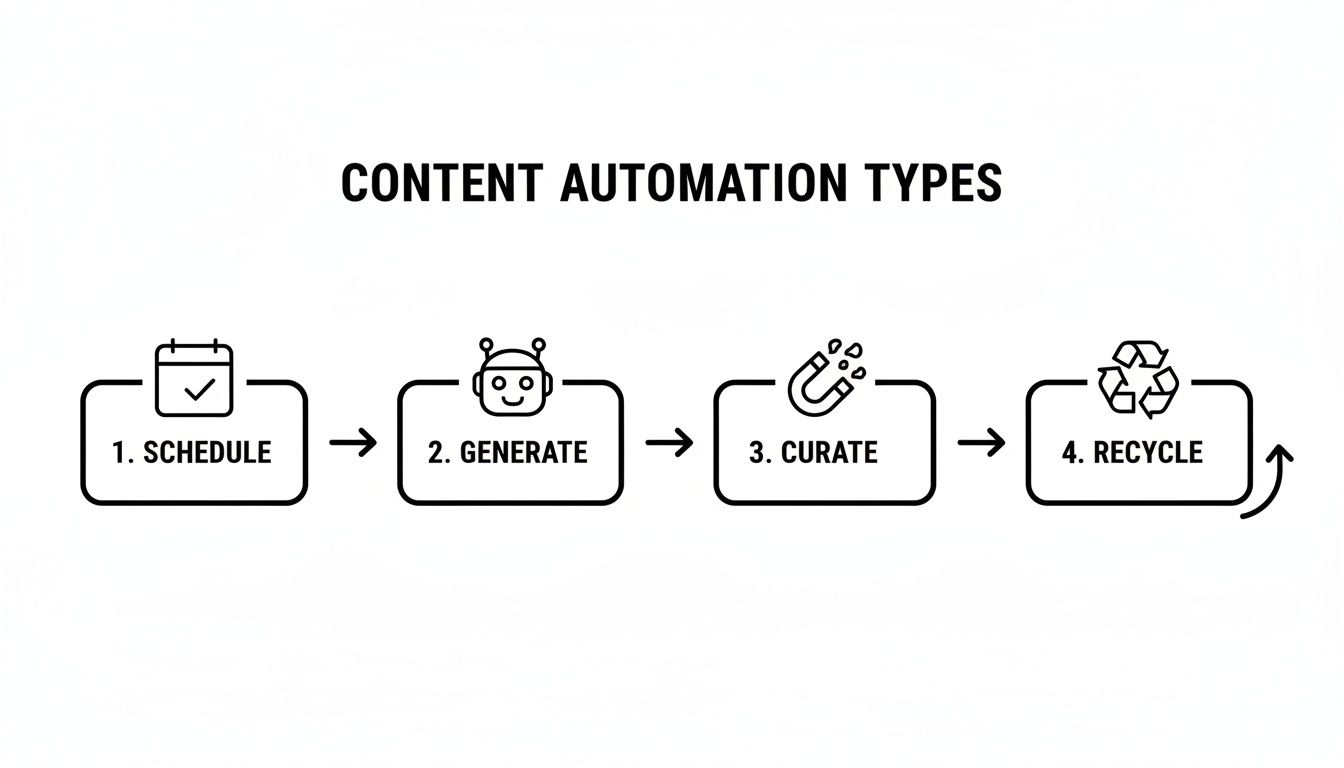
As you can see, the tools are designed to schedule, generate, curate, and recycle content, turning your static library into a self-sustaining engine.
Creating Smart Schedules
Now that the library is organized, Alex can create smart schedules. Instead of the old grind of manually picking a time for every single post, they set up simple rules for each content bucket.
For example, they might decide to:
- Share a Blog Post every Monday and Wednesday morning to catch people at the start of their day.
- Post a Helpful Tip every weekday afternoon for a quick, valuable scroll-break.
- Publish a Testimonial every Friday to wrap up the week with some positive social proof.
That’s it. The automation tool now knows what kind of content to post and when. Alex doesn’t have to think about it again. The system will pull a relevant piece of content from the correct bucket and publish it right on schedule. You can get a feel for the possibilities by exploring these marketing automation workflow examples and seeing how different rules can work.
A well-defined schedule is the engine of content automation. It ensures consistency and relevance without requiring daily manual intervention, turning your content library into an active asset.
Integrating Tools and Monitoring Performance
The last piece of the puzzle is integration. Alex connects their scheduling tool to their social media accounts like LinkedIn and X (formerly Twitter). This is usually a one-time setup that gives the platform permission to post on their behalf.
Once the system goes live, the job isn't completely over—it just changes. The final, ongoing step is monitoring performance. Alex makes a habit of checking their analytics every so often to see which content categories are hitting the mark. Are the tips getting more likes than the blog posts? This data creates a feedback loop. It allows them to fine-tune the content in their buckets and adjust their schedules, making their automated strategy smarter and more effective over time.
Of course. Here is the rewritten section, designed to sound completely human-written and natural.
The Real Payoff: How Automation Benefits Your Business
Sure, saving time is the most obvious win here, but the true impact of content automation runs much, much deeper. It’s about changing your capacity to grow and making sure your marketing efforts have the power of a much larger team. Think of it as the difference between tending to a small garden by hand and running a massive, automated farm that produces a predictable harvest, season after season.
The first thing you’ll notice is getting your time back. A lot of it. Instead of burning hours every week copying, pasting, and scheduling posts across a dozen different platforms, you can set that entire process on autopilot. This isn't just about being more efficient; it's about freeing up your brainpower for the high-level strategy that actually moves the needle.
That newfound freedom is what allows you to build a stronger, more recognizable brand.
Lock in Bulletproof Brand Consistency
When you’re juggling multiple channels manually, little mistakes are bound to happen. The tone might be slightly off in a tweet, a key post gets missed during a busy afternoon, or an old, off-brand image slips through. These small inconsistencies can weaken your message over time.
Content automation just erases those risks.
By setting up a library of pre-approved, on-brand content, you ensure every single post that goes out is perfect. This builds a professional, reliable presence that your audience learns to trust. Consistency stops being a daily struggle and becomes the default setting.
Once you have a solid system, you can scale your content output without having to scale your team. A smart automated workflow lets a single person manage the output of what would normally take a small agency, reaching more people with less cost.
Supercharge Your Growth and Lead Nurturing
Automation isn't just about scheduling; it’s about driving real, measurable results. And the numbers don't lie. A staggering 91% of businesses globally are using content marketing, and the ones who embrace automation are generating 80% more leads.
Why? Because automation helps you deliver the right message to the right person at exactly the right time. For instance, well-crafted automated email sequences can bring in as much as $16.96 in revenue per recipient. That blows the typical $1.94 average for one-off campaigns completely out of the water. If you want to dive deeper into this, it's worth exploring the future trends in marketing content.
These benefits build on each other, creating a powerful growth engine for your business. You get your hours back, your brand becomes stronger, and you have a reliable system for attracting and converting leads. Content shifts from a daily chore to a strategic asset that works for you around the clock.
Getting Your First Content Automation Strategy Off the Ground

Diving into content automation can feel like a massive undertaking, but it doesn't have to be. The secret is to approach it with a clear, structured plan instead of getting distracted by shiny new tools. A solid strategy is what separates meaningful, automated results from just adding to the internet's noise.
It all starts with a simple question: What are we actually trying to accomplish here? Are you looking to drive more traffic to your website? Is the goal to finally nail down brand consistency? Or maybe you just need to free up five hours a week for your overworked social media manager. Nailing this down first is absolutely essential.
Define Your Core Objectives
Before you do anything else, get specific about your goals. Vague aspirations like "more engagement" are impossible to measure and lead to fuzzy results. You need concrete targets.
- Looking for traffic? Set a goal to increase referral traffic from LinkedIn by 15% this quarter.
- Need more time? Aim to slash the time spent on manual posting from five hours a week down to one.
- Chasing consistency? Commit to publishing at least one high-value post every single day on your primary channels.
With clear objectives like these, you have a yardstick to measure success and can keep your efforts laser-focused on what moves the needle for your business.
Audit Your Existing Content
Chances are, your most valuable assets are already sitting in your content library. It's time to conduct a content audit to uncover your evergreen content—those timeless blog posts, in-depth guides, and powerful case studies that your audience loves. Dig into your analytics and pinpoint the articles that consistently bring in traffic and spark conversations.
These tried-and-true pieces are the bedrock of your new automated library. Don't stress if you only find 15-20 great articles to start. This is a classic case of quality over quantity. That initial batch is more than enough to build a powerful and effective recycling schedule. If you want to dig deeper into this, you can learn more about how to automate repetitive tasks and make this process even smoother.
Your goal isn't just to find content, but to find the right content. Focus on pieces that have already proven their value to your audience. This data-driven approach removes guesswork and maximizes your ROI from day one.
Choose the Right Tools
Once your goals are set and your best content is identified, you can start looking for the right tool. The best platforms are easy to use, play nicely with the systems you already have, and won't break the bank.
For recycling evergreen content, a specialized tool like EvergreenFeed is built from the ground up for this exact job. It hooks right into your Buffer account, letting you organize content into different "buckets" and create smart schedules that run on their own.
Start Small and Scale Smart
Resist the urge to automate everything all at once. That's a surefire path to frustration. Instead, pick one social media channel and one type of content to test the waters.
For example, you could start by recycling your top 10 blog posts exclusively on LinkedIn. Watch the performance closely, learn what resonates, and then slowly expand your efforts to other channels and different kinds of content. This gradual approach lets you refine your strategy based on real-world results, all without feeling overwhelmed.
Measuring Success and Avoiding Common Pitfalls
So, you've got your content automation system up and running. That's a huge step, but the work isn't over. In fact, this is where the real strategy begins. Now you need to figure out what's actually working—and what’s just adding to the noise online.
True content automation isn't a "set it and forget it" machine. Think of it as a feedback loop. You need to listen to what the data is telling you so you can refine your approach, scrap what isn't connecting, and double down on the content your audience loves. This is how you go from just saving time to actively growing your business.
Tracking the Metrics That Matter
To really understand how your automated content is performing, you have to look past vanity metrics like follower count. Instead, zero in on the numbers that show genuine audience interest and, ultimately, a return on your investment.
These are the KPIs that should be on your dashboard:
Engagement Rate: This is the big one. It's the ratio of likes, comments, and shares to your audience size. A high engagement rate is the clearest signal that you're not just shouting into the void—people are actually listening and reacting.
Click-Through Rate (CTR): Are people taking the next step? CTR tells you how many users clicked the links in your posts, proving your content was compelling enough to drive action. This is how you turn a social media post into tangible website traffic.
Content ROI: This is where you connect the dots between your content and the bottom line. Are your posts leading to new leads? Are they contributing to sales? Answering this question is crucial for proving the value of your efforts.
Measuring these specific KPIs shifts the conversation entirely. You're no longer just saying, "We're saving time." Instead, you can confidently report, "Our automated content drove 15% more traffic to our key service pages last quarter."
To help you stay focused, here’s a quick breakdown of the most important metrics to track when evaluating your content automation strategy.
Key Metrics for Content Automation Success
| Metric | What It Measures | Why It's Important |
|---|---|---|
| Engagement Rate | Likes, comments, shares, and saves relative to follower count. | Shows if your content truly resonates with your audience, sparking conversation and connection. |
| Click-Through Rate (CTR) | The percentage of people who click a link in your post. | Indicates that your call-to-action is effective and your content is driving traffic to your desired destination. |
| Content Reach/Impressions | The total number of unique people who see your content vs. the total number of times it was displayed. | Helps you understand the visibility of your automated posts and how far your message is spreading. |
| Lead Generation | The number of new leads captured from links or forms shared in your automated content. | Directly connects your social media activity to business growth by measuring its impact on your sales funnel. |
| Time Saved | The number of hours your team saves each week or month by automating content tasks. | Quantifies the efficiency gains from automation, which can be reinvested into higher-value activities like community engagement. |
Tracking these KPIs consistently will give you a clear, data-backed picture of what's working, allowing you to make smarter decisions and continuously improve your results.
Sidestepping Common Automation Mistakes
As powerful as automation is, it's easy to stumble. A few common missteps can quickly undermine your efforts, but knowing what they are is half the battle.
Here’s how to avoid the most frequent pitfalls:
Sounding Robotic: This is everyone's biggest fear—losing that human touch. The solution is simple: automate the distribution, not the conversation. Use the time you've saved to jump into the comments, answer questions, and engage with your audience in real-time.
Ignoring Analytics: Firing up a schedule and never looking back is a recipe for disaster. You need to check in on your performance. Make it a habit to schedule a monthly review of your KPIs. Use that data to prune posts that are falling flat and add fresh, high-potential content to your library.
Automating the Wrong Content: Not everything should be automated. Time-sensitive news or breaking updates will quickly look dated and out of touch. Instead, stick to automating your evergreen content—the timeless tips, how-to guides, and client testimonials that remain valuable for months or even years.
Frequently Asked Questions About Content Automation
Jumping into content automation for the first time usually brings up a handful of questions. It's a good idea to get these sorted out before you dive in, as knowing the ropes is what separates a smooth, time-saving system from a frustrating mess. Let's tackle some of the most common ones.
The biggest worry is always the same, and it’s a totally valid one.
Will Content Automation Make My Brand Sound Robotic?
Not if you do it right. The secret is to automate the task, not the engagement. Good content automation is all about handling the logistics—scheduling and recycling your proven, high-quality evergreen content. This buys you back precious time to do what only a human can: engage with your audience by replying to comments and DMs in real time.
Smart tools also shuffle and randomize posts from your content library. This simple trick keeps your feed from looking predictable, making your online presence feel natural and spontaneous. The goal isn't to replace you; it's to free you up for more genuine, human interaction.
This brings us to another common point of confusion. Where does this fit in with other automated systems?
What Is the Difference Between Content and Marketing Automation?
It's helpful to think of content automation as a specialized tool inside the larger marketing automation toolbox.
- Marketing automation is the big picture. It covers the entire customer journey—think automated email sequences, lead scoring, and updating your CRM.
- Content automation is laser-focused. It's all about managing, scheduling, and distributing your content, like blog posts, social media updates, and videos.
They’re a perfect team. Your content automation system serves up the valuable articles and posts that your marketing automation platform then uses to nurture leads and move them through your funnel.
How Much Content Do I Need to Start Automating?
You probably have enough already. You don't need a huge vault of content to get going. A fantastic starting point is to simply identify 15-20 of your best-performing evergreen pieces. This could be your most popular blog posts, helpful tips, glowing customer testimonials, or powerful quotes you've shared before.
Just group these into a few categories and set a light, consistent schedule. You can always add new content to your library as you create it. This way, you build up a powerful system over time without getting overwhelmed. The key is to start with quality over quantity.
Ready to stop the manual grind and put your best content to work? With EvergreenFeed, you can build your content library, set a smart schedule, and let automation handle the rest. Start recycling your content for free and see the results for yourself.