James
James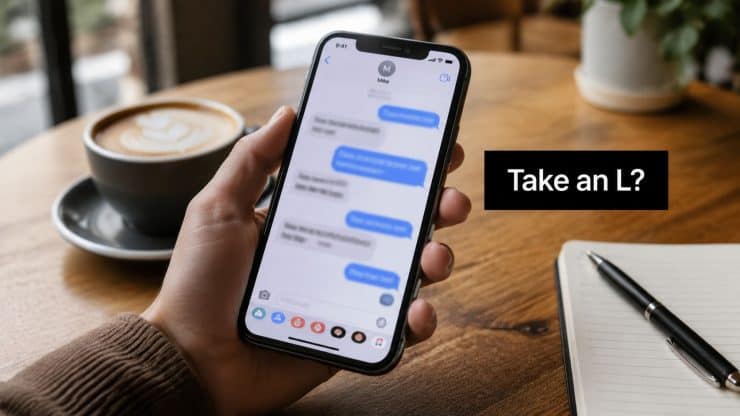
In texting, “L” most commonly means “loss” or “take a loss,” a quick way to mark defeat, failure, or an embarrassing setback. That baseline meaning comes from sports, where MLB formalized the Loss statistic in 1876 and the NBA used it from its 1946 inception, so the letter already had a long, fixed meaning before it became slang.
If you manage social media, that one letter can still be tricky. A comment that says “L” under a campaign post might mean your content flopped, your audience is joking with you, or someone is using a completely different meaning based on platform, age, or region. That's why the important question isn't only what does L mean when texting. It's how to read it correctly, and how to respond without sounding out of touch.
An 'L' in the Comments What Does It Mean
You publish a new post. The creative is polished, the copy is tight, and the first comment says only: “L”.
Most professionals have had some version of that moment. You pause because a single letter gives you very little to work with. Is the commenter saying the post is a loss? Are they teasing the brand? Did they mean something else entirely?
In many everyday conversations, “L” means loss. If someone says “I took an L,” they usually mean they failed, got rejected, or ended up on the wrong side of a situation. That's the safe starting point.
But social media rarely rewards safe assumptions. Tone, audience, and platform all matter. A gaming community may use “L” as playful trash talk. A customer comment may use it as shorthand for genuine disappointment. A teen audience may push it toward something more personal.
A one-letter comment is never just a dictionary problem. It's a context problem.
That matters for community managers because response style changes everything. If you treat a joke like a complaint, you can sound stiff. If you treat a complaint like a joke, you can make things worse. Teams that already monitor social media closely know this pattern well. Small signals often carry the strongest emotional charge.
A fast first read
When you see “L,” ask three questions before replying:
- Who wrote it: A loyal follower, a new account, a customer, or a troll?
- Where did it appear: Under a meme, a promo, a customer support thread, or a live event post?
- What surrounds it: Emojis, extra words, replies, and timing often reveal whether it's sarcasm, criticism, or banter.
That's the practical frame. Start with loss, then test whether the surrounding language points somewhere else.
The Primary Meaning Taking an L
The main meaning of “L” in texting is still loss. In plain English, it means someone lost, failed, got embarrassed, or came away with a bad outcome.
That's why phrases like “take an L” travel so well across platforms. They're short, sharp, and immediately legible in competitive situations. Someone loses a fantasy matchup, misses a trend, gets rejected after an interview, or posts a bad take and gets corrected. Any of those can become “an L.”

Why this meaning stuck
The slang didn't appear out of nowhere. It comes straight from sports notation, where “L” has been a mandatory statistical category for over 150 years. Major League Baseball formalized the Loss statistic in 1876, and the NBA adopted it in its 1946 inception. In those systems, “L” has one job. It marks failure to win.
That clarity made it easy to migrate into digital language. Sports scorekeeping already trained people to read W as win and L as loss. Social slang lifted the shorthand and applied it to everyday life.
Common examples in real use
Here's what that looks like in ordinary conversation:
- Self-deprecating: “Missed the deadline. Took an L.”
- Competitive: “We lost the match. Big L.”
- Social: “Tried to be funny in the group chat and nobody replied. That's an L.”
- Professional but informal: “The ad creative didn't land. We'll take the L and test a new angle.”
Notice what's happening. “L” usually points to the event, not the identity of the person. It names the setback.
Practical rule: If “L” can be swapped with “loss,” “defeat,” or “bad outcome” without changing the sentence, you're probably reading it correctly.
What marketers should hear in it
For marketers, “L” often means one of two things:
Performance disappointment
The audience is reacting to something that didn't work, like pricing, timing, messaging, or creative.Playful commentary
The audience is using internet shorthand to narrate a moment, not file a formal complaint.
That distinction matters. “This launch is an L” has a very different tone from “My team took an L today.” One criticizes your brand output. The other echoes community slang around a shared event.
If you're trying to answer what does L mean when texting, start here. It usually means loss. Everything else is a branch from that core meaning.
Interpreting Intent Loss vs Loser
Many professionals get tripped up by this. “L” doesn't always describe a situation. Sometimes it targets a person.
When “L” means loss, it refers to an outcome. When it means loser, it becomes a label, and often an insult. That's a major difference in tone.
The sentence usually tells you
Compare these examples:
| Phrase | Likely meaning | Tone |
|---|---|---|
| “I took an L” | I experienced a loss | Self-aware, often joking |
| “That's an L” | That situation failed | Critical or dismissive |
| “You got an L” | Could mean loss or loser | Ambiguous |
| “You're an L” | You're a loser | Direct insult |
The most reliable clue is grammar. If the “L” attaches to an event, it usually means loss. If it attaches to a person, it can slide toward loser.
That shift isn't theoretical. Emerging TikTok discourse from 2024 to 2025 shows a 34% increase in usage where “L” explicitly means “Loser”. The same verified dataset says a Pew Research Center 2025 study found 42% of Gen Z users misinterpret “L” as “Loss” when context suggests “Loser,” causing unintended offense.
Why this matters in comment moderation
A social team can easily underreact here. If someone replies “Brand admin is an L,” that's not a casual note about campaign performance. It's a personal jab. If someone says “This promo is an L,” they're criticizing the work.
That distinction changes moderation and response:
- Comment on the content: usually respond, clarify, or ask for specifics.
- Comment on the person: consider tone, house rules, and whether engagement would help.
- Ambiguous phrasing: read the thread before you jump in.
If your team uses social media sentiment analysis, this is one of those terms that needs manual review. Automated systems can flag negativity, but they often miss whether the target is a post, a product, or a person.
Don't treat every “L” as equal. Some are performance feedback. Some are mockery.
A quick diagnostic for professionals
Use this short filter before responding:
- Target check: Is the commenter talking about a post, an outcome, or a person?
- Tone check: Is the surrounding language playful, hostile, or deadpan?
- Audience check: Is this a teen-heavy thread where “loser” slang is more likely?
- Escalation check: Would a reply calm the situation, or spotlight the insult?
For brand accounts, caution beats cleverness. If there's even a chance “L” means loser, don't mirror the language back. A casual reply can read as combative fast.
The Other Faces of L Shorthand and Emoticons
A common mistake is assuming “L” always signals defeat. In digital language, it can also work as an instruction, a text shortcut, or a facial expression made out of punctuation.
That's where context does its work.

When L means action, not failure
In social media prompts, “L” can function as shorthand for “Like.” Verified usage includes commands such as L&R for Like and Rate and L+C for Like and Comment.
If you work in creator marketing, this matters. A comment like “L+C and I'll check your page” isn't criticism. It's an engagement prompt. Read it as “loss,” and you'll misread the entire exchange.
The typographic form :L also has its own meaning. It signals speechlessness, awkwardness, or a dry sarcastic reaction, not defeat.
Decoding L in Different Contexts
| Variant | Meaning | Example |
|---|---|---|
| L | Loss | “We took an L on that launch” |
| take an L | Accept a defeat or setback | “I guessed wrong and took the L” |
| L+C | Like and Comment | “L+C this if you want feedback” |
| L&R | Like and Rate | “Post your fit, L&R” |
| :L | Speechless or awkward sarcasm | “You really sent that email? :L” |
The same letter, different jobs
For professionals, the useful distinction is this:
- Standalone “L” often carries evaluative meaning.
- Compound forms like L+C usually function as instructions.
- Emoticon forms like :L express mood.
Some adjacent internet expressions also confuse readers because they start with L but don't mean loss at all. Think of LOL, LMAO, LY, or L8R. Those aren't variants of “L” as slang judgment. They're separate abbreviations with their own histories.
Read the characters around the letter. In internet language, one extra symbol can change the meaning completely.
If you're answering comments at speed, mistakes can occur. A lone “L” under a product post can be negative. “L+C” in a creator thread is operational. “:L” in a reply may be awkward amusement. Same letter, different linguistic role.
L Around the World and Across Generations
US social slang tends to dominate explainers, but “L” isn't universal. The meaning can shift by country, community, and age group.
For global brands, that's not a side note. It affects interpretation, copy choices, and campaign risk.

Regional meanings can change the message
Verified survey data points to clear differences. A 2025 Global Language Survey by Oxford University found that 28% of UK users interpret “L” as “Late” in time-sensitive contexts, 19% of Australian users associate it with “Liar” in gossip chats, and 31% of Indian-English users still use “L” for “Love” in affectionate messages.
That means a message as simple as “sorry, I'm L” may read very differently depending on the audience. In one context it means late. In another audience, “L” in a direct message might carry warmth rather than criticism.
Generational use matters too
Older internet users may still process “L” more cautiously, or connect it to older shorthand systems. Younger users often read it faster as live slang, especially in competitive, ironic, or meme-heavy environments.
That generational split shows up in brand comments all the time:
- A younger follower may post “common L” as routine internet commentary.
- A customer support lead may read it as unusually harsh.
- A global audience may not read it as “loss” at all.
This is one reason slang-based copy can age badly or localize poorly. What feels current in one market can feel hostile, confusing, or meaningless in another.
What global teams should do instead
If your audience spans regions, don't force “L” into branded copy unless the community already uses it naturally. In audience-facing communication, clarity beats trend fluency.
A better approach is to localize intent:
- For UK time-sensitive messaging: avoid standalone “L” if lateness is in play.
- For Australian youth-facing moderation: test whether “L” is describing dishonesty rather than defeat.
- For Indian-English audience segments: watch for affectionate or relational use.
Slang doesn't travel cleanly. Teams have to localize not just language, but implied meaning.
For social teams, the operational takeaway is simple. Build interpretation around audience, not just dictionary definition. The answer to what does L mean when texting depends partly on who's texting, where they are, and who they expect to understand them.
A Playbook for Brands Responding to L
Seeing “L” in your comments doesn't require panic. It requires discipline. Brand teams get into trouble when they answer too fast, mimic slang they don't fully control, or ignore audience differences.
The safest approach is to respond to the intent, not the letter.

When to reply and when to hold back
If “L” clearly signals customer disappointment, respond like you would to any compact negative feedback. Acknowledge the frustration, ask a useful follow-up, and move the conversation toward resolution.
If it's playful community banter, a light touch can work. But the bar is high. Brands sound awkward when they borrow slang without matching the audience's tone.
If the term appears to mean loser, or the thread feels personal or escalating, don't mirror it. Moderation standards should take priority over wit.
A practical response model
Use this sequence:
Identify the target
Is the user criticizing the post, the product, the brand, or a person?Read the social setting
Meme page, support thread, creator collab, product launch, and live event comments all produce different norms.Choose one of three responses
- Supportive response: for real dissatisfaction
- Light acknowledgment: for harmless banter
- No slang, firm boundary: for insults or harassment
Localize before scaling
Don't reuse a slang-heavy reply across markets. A 2026 Buffer analytics report found 45% higher engagement drop-offs in global posts using ambiguous “L” slang without localization.
What good brand handling sounds like
- Customer complaint: “Sorry this missed the mark for you. Tell us what felt off, and we'll take a closer look.”
- Playful banter: “Fair. We'll try for a W on the next one.”
- Escalating insult: “We're happy to help with feedback on the product. We won't engage with personal attacks.”
That third category matters most. Social teams often feel pressure to be clever. Cleverness is overrated when tone is unstable.
The brand voice should be more mature than the comment section.
What not to do
- Don't adopt “L” just to sound current. If your audience doesn't use it with you, it can feel forced.
- Don't reply with “take the L.” That invites screenshots, especially in support contexts.
- Don't globalize slang templates. A line that lands in one market may confuse another.
- Don't confuse brevity with low stakes. A one-letter comment can still signal real dissatisfaction.
For teams building response guidelines, this is closely related to the work of a community manager in social media. The skill isn't only speed. It's calibrated interpretation.
There's also a broader reputation lesson here. If you're training creators or brand spokespeople to handle public criticism well, this guide on how to improve as an influencer is useful because it focuses on tone, feedback, and response discipline rather than clapbacks.
The smartest default is simple: if you're not sure what “L” means in a comment, don't try to out-slang the audience. Ask, clarify, or answer the underlying sentiment in plain English.
If your team wants a steadier way to keep high-quality content moving while you focus on moderation, response strategy, and audience context, EvergreenFeed helps automate evergreen social scheduling through Buffer so your channels stay active without constant manual posting.

 Leiann