James
James
So, what exactly are content pillars?
Think of them as the foundational, core topics that you want your brand to be known for. Imagine a massive, sturdy tree. The thick, central trunk is your content pillar—it's the main subject. All the smaller pieces of content you create—like blog posts, videos, and social media updates—are the branches that sprout from that trunk. Together, they create a rich, interconnected ecosystem of knowledge.
Deconstructing The Content Pillar Model

Instead of just churning out random, one-off articles, a content pillar strategy gives your efforts a clear direction. It organizes everything around a handful of essential themes. This immediately brings structure and authority to your content, making it way easier for both people and search engines to see you as a true expert.
At the heart of this strategy is the pillar page. This isn't just any blog post; it's a comprehensive, deep-dive resource, often clocking in at over 3,000 words. It covers a broad topic from top to bottom. The data doesn't lie: this kind of long-form content consistently drives more traffic, gets more shares, and earns more valuable backlinks than shorter pieces.
To give you a clearer picture, this table breaks down the core components of the model.
The Content Pillar Model at a Glance
| Component | Description | Primary Goal |
|---|---|---|
| Pillar Page | A long-form, comprehensive guide covering a broad topic (e.g., "SEO Basics"). | To act as the central authority and rank for high-volume, competitive keywords. |
| Topic Cluster | A collection of shorter articles that explore specific subtopics in detail. | To answer specific user questions and rank for long-tail, less competitive keywords. |
| Internal Link | A link from a cluster post back to the main pillar page. | To pass authority to the pillar page and guide users to more information. |
As you can see, each piece has a specific job to do, but they all work together to build your site's authority.
The Power of Topic Clusters
So, what supports this massive pillar page? That's where topic clusters come in. These are the branches of our tree—shorter, more focused articles that dig into the nitty-gritty details of subtopics mentioned in the pillar.
Each of these cluster posts links back to the main pillar page. This creates a powerful web of internal links that screams "we know our stuff" to search engines like Google. It's a smart structure that helps you rank for a whole constellation of related keywords, not just a single one.
A content pillar isn't just one big article; it's a strategic framework that turns your website into a library of expertise on a specific subject, with the pillar page as its main reference guide.
When you build out your content this way, you create an engine that consistently proves your authority. To see how this powerful strategy fits into a broader plan, it’s worth checking out these 10 content marketing best practices.
Why Content Pillars Are Your SEO Superpower

SEO used to feel like a simple keyword-matching game. Those days are long gone. Search engines like Google have gotten much smarter, and now they reward websites that prove they have deep topical authority. This is exactly why content pillars can completely change the game for your entire strategy.
Instead of just publishing one-off articles, the pillar-and-cluster model helps you organize your content in a way that search engines can easily understand and appreciate. Think of your website like a library. The pillar page is the main, comprehensive encyclopedia on a broad subject, while your cluster content acts as the individual chapters, each diving deep into a specific aspect of that topic.
This web of interconnected content sends a crystal-clear signal to Google: you’re not just scratching the surface; you’re a genuine expert.
Building Trust Through E-E-A-T
This whole approach fits perfectly with Google’s quality guidelines, often referred to as E-E-A-T (Experience, Expertise, Authoritativeness, and Trustworthiness). A solid content pillar strategy naturally builds up each of these signals.
- Expertise: When you cover a topic from every conceivable angle, you're actively demonstrating your in-depth knowledge.
- Authoritativeness: All those internal links pointing back to your pillar page create a strong, cohesive information hub, cementing its status as the central authority.
- Trustworthiness: By consistently providing well-organized, genuinely helpful content, you build credibility with your audience and, in turn, with search engines.
It all comes down to showing that your site is a reliable resource people can count on.
By creating an organized hub of expertise, you're not just ranking for one keyword. You're building the authority needed to rank for an entire family of related search queries, multiplying your visibility and traffic potential.
This is a strategic shift from chasing individual keywords to owning entire conversations in your niche. When you prove this kind of depth and organization, Google is far more likely to reward you with better rankings across a whole host of related terms. That's what makes content pillars a true SEO superpower.
How to Find Your Unbeatable Content Pillars
Figuring out your core content pillars isn't a shot in the dark. It's a deliberate process that starts with some good old-fashioned detective work into your audience, the keywords they use, and what your competitors are up to. Before you can build a content empire, you have to find the right piece of land.
It all begins with your audience. What keeps them up at night? What questions are they frantically typing into Google? This is your starting line. Dive into your customer service inbox, scroll through social media comments, and lurk in the online forums where your ideal customers hang out. You're looking for the big, recurring problems they're trying to solve.
These problems are the fertile ground where your best content pillars will grow.
Perform Smart Keyword Research
Once you have a handle on your audience's challenges, it's time to connect those problems to actual search terms. We're not hunting for super-specific, long-tail keywords just yet. Right now, the goal is to find the broad, high-volume "head terms" that act as the umbrella for a whole topic.
Think about a topic that has enough meat on its bones to support an entire family of related content. A solid pillar topic should easily break down into dozens of more focused, smaller sub-topics.
Here’s a quick gut check for any potential pillar keyword:
- Search Volume: Is there a real audience for this? Are enough people searching for it each month?
- Relevance: Does this keyword actually line up with what your business sells or does?
- Topic Depth: Can you sit down and brainstorm at least 10-15 smaller blog post ideas related to it without breaking a sweat?
Analyze Competitors and Spot Gaps
Last but not least, take a peek at what everyone else is doing. Check out the top-ranking content for the keywords you're eyeing. What topics do they cover thoroughly? And, more importantly, what did they miss? This isn't about copying their playbook; it’s about finding the holes in their game.
A content gap—a topic your competitors have barely scratched the surface on—is your golden ticket. It's your chance to step in and create the definitive resource on the subject.
This is how you go from being just another voice in a crowded market to becoming the go-to authority. By blending real audience insights with smart keyword choices and a critical eye on the competition, you can lock in content pillars that don’t just rank—they truly connect with the people you’re trying to help.
Crafting Your Pillar Page and Topic Clusters
So, you've pinpointed your core pillars. Now comes the fun part: actually building them out. This whole process boils down to creating two things: a central pillar page and a network of supporting articles, which we call topic clusters.
Think of your pillar page as the ultimate, go-to guide on a subject. It's the big one.
This isn't just another blog post; it's a comprehensive, long-form piece that often clocks in at over 2,000 words. Your mission is to cover your topic from a broad, high-level perspective. Because it's so in-depth, good structure is non-negotiable. Use clear headings, subheadings, and a clickable table of contents so people can jump to the sections they care about most. Your goal should be to create the single most helpful page on the internet for that topic.
This flowchart shows the groundwork you need to lay to figure out what your content pillars should even be about in the first place.
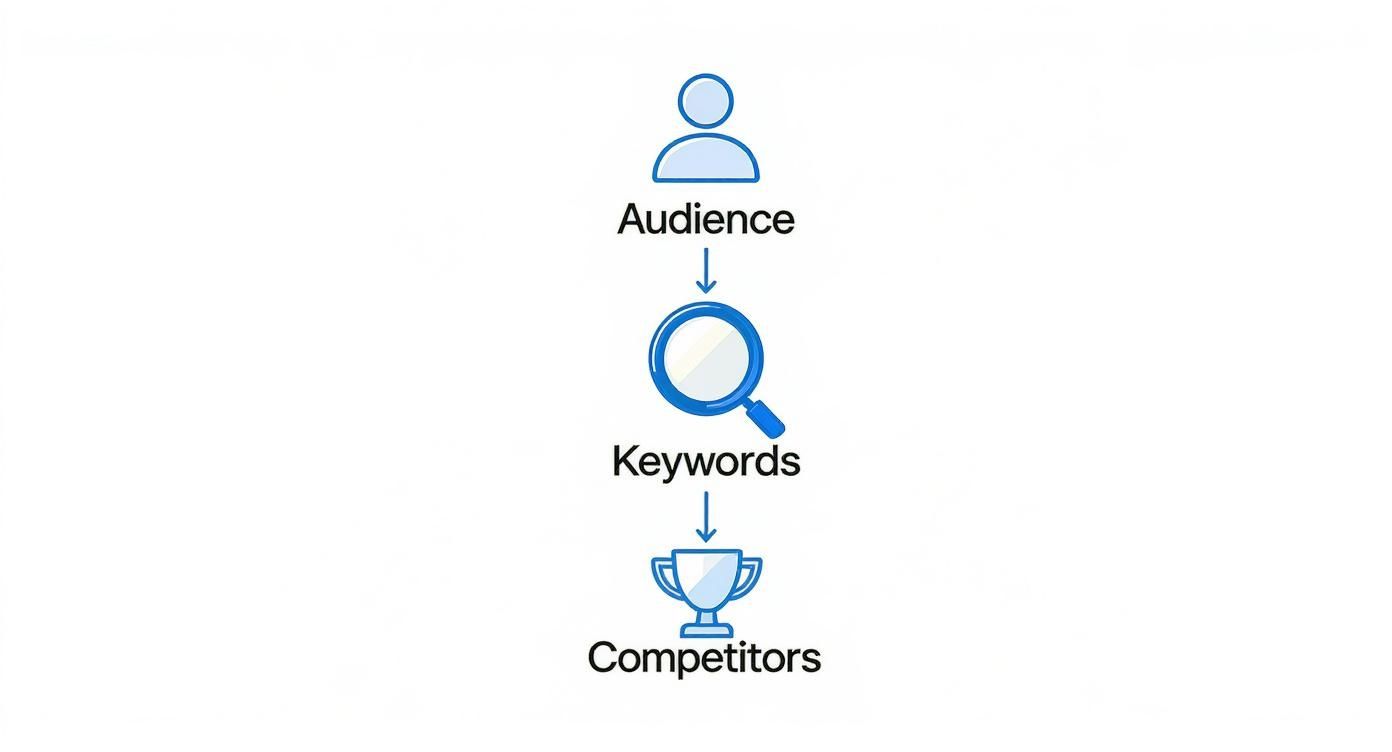
As you can see, a solid strategy finds that sweet spot where what your audience needs, what they're searching for, and what your competitors aren't doing well all overlap.
Building Your Topic Clusters
Once your pillar page is planned out, you can start creating the smaller, more focused articles that orbit it—your topic clusters. These posts dive deep into the specific subtopics you touched on in the pillar. Each one should zero in on a very specific question and answer it completely.
Let's say your pillar page is "Social Media Marketing." Your cluster content might look something like this:
- "How to Create a Social Media Content Calendar"
- "A Beginner's Guide to Instagram Advertising"
- "Top 10 Analytics Tools for Social Media Managers"
Each of these articles adds another layer of specialized knowledge, beefing up your overall authority on the subject. To make sure this content keeps working for you long-term, you’ll want to have a smart evergreen content strategy in place. You can find out more about that here: https://www.evergreenfeed.com/blog/evergreen-content-strategy/
Here's the secret sauce that makes this entire model work: internal linking. Every single one of your topic cluster articles must link back to the main pillar page. This is what creates that "hub-and-spoke" structure that tells search engines you're an expert.
This web of interconnected content does more than just boost your SEO. It creates a natural pathway for your visitors, guiding them from one piece of helpful content to the next and keeping them on your site longer. This is a core part of Mastering Social Media and Content Strategy because it organizes everything you publish for maximum effect. When you link your content together this thoughtfully, you build a powerful resource that both people and search engines will love.
Using Content Pillars to Win on Social Media
Content pillars are more than just a buzzword for your blog—they're a secret weapon for bringing order to the beautiful chaos of social media. Instead of waking up every morning wondering, "What on earth should I post today?", pillars give you a solid framework. This keeps your messaging sharp and your audience coming back for more.
Think about a SaaS company that wants to build a community. They could build their entire social calendar around a few core themes: ‘Productivity Hacks,’ ‘Customer Success Stories,’ and ‘Industry Insights.’ Suddenly, every video, carousel, and story has a purpose, creating a feed that feels intentional and genuinely valuable.
Defining Your Social Themes
On social media, your content pillars are the core topics you’ll consistently talk about. The sweet spot is usually 3 to 5 pillars; this gives you enough variety to keep things interesting without spreading your message too thin. You can always discover more insights about social media content pillars on sproutsocial.com to see how others are doing it.
The real magic happens when you start tracking performance. By seeing which pillars get the most love, you get a direct line into what your audience actually cares about. This lets you confidently double down on the topics that are hitting the mark.
By assigning every post to a specific pillar, you turn your social media analytics into a strategic tool, revealing exactly which themes drive the most engagement, clicks, and conversions.
This simple shift turns your social media from a shot in the dark into a reliable growth engine. Of course, amazing content is only half the battle. You still need to get it in front of the right people. For more on that, take a look at our guide to effective content distribution strategies.
How Pillars Can Streamline Your Content Workflow
It's not just about SEO and social media—content pillars bring some serious operational muscle to your marketing. They can transform your creation process from a frantic, last-minute scramble into a smooth-running, predictable engine.
Instead of waking up and asking, "What on earth are we going to post today?" your team has a clear blueprint to follow. This is how you finally put an end to random acts of content and make sure every piece has a purpose.
This framework gets your whole team on the same page, ensuring every article, video, and social post is pulling in the same strategic direction. Most brands find their sweet spot with around five to six pillars. This gives you enough variety to keep things interesting but enough focus to build real authority.
This structure is also a natural fit for the 80/20 rule, a core marketing principle where 80% of your content delivers pure, unadulterated value, and only 20% is directly promotional.
From Scramble to System
Once your pillars are set, you can finally shift from a reactive mode—always chasing the next idea—to a far more efficient, proactive one.
A pillar-based workflow gives you a clear, repeatable system for brainstorming and creating. It’s the difference between building a house with a solid blueprint versus just showing up with a pile of bricks and hoping for the best.
This system makes it so much easier to plan your content calendar weeks or even months ahead.
It also unlocks powerful production methods like batch content creation. Imagine dedicating a block of time to create an entire cluster of related articles, videos, or posts all at once. That's a massive efficiency gain. By organizing your work around pillars, you're not just making content; you're building a sustainable content machine.
Got Questions About Content Pillars? Let's Clear Things Up.
So, you're getting the hang of content pillars, but a few practical questions are probably popping up. That's completely normal. Let's tackle some of the most common "what ifs" and "how tos" so you can move forward with confidence.
How Many Clusters Should I Aim For With Each Pillar?
When you're just starting out, a good target is 5 to 8 solid topic clusters for each pillar page. Think of it as building a strong foundation. This gives you enough content to show search engines you're serious about the topic, but it's not so much that your team gets bogged down.
Remember, the real win here is quality, not just quantity. It's far better to have five incredibly helpful cluster articles than ten that are just so-so. You can always build out more clusters later as you spot new trends or customer questions.
Can I Turn an Old Blog Post into a Pillar Page?
Absolutely! In fact, that's one of the smartest ways to get started. If you've got an old article that already covers a broad topic and pulls in some steady traffic, you've found your perfect candidate.
The trick is to give it a major upgrade. You'll want to beef it up with fresh information, a more organized structure, and new sections to make it truly comprehensive. Once that's done, you can start creating new, specific cluster posts that all point back to your newly-crowned pillar page, turning that old article into a powerful content hub.
Pillar vs. Cluster Quick Recap: The content pillar is your big, comprehensive guide on a major topic. The topic clusters are shorter, more focused articles that dive deep into one specific piece of that bigger topic, always linking back to the pillar.
What's the Ideal Word Count for a Pillar Page?
There's no magic number here, but pillar pages are definitely a long-form game. Most successful ones land somewhere between 2,000 and 5,000 words, with some epics going even longer.
But don't get hung up on the word count. The real goal is to be the most helpful resource out there on that subject. Your pillar page should be as long as it needs to be to answer every potential question a reader might have, more thoroughly than any of your competitors.
Ready to stop guessing and start scheduling? With EvergreenFeed, you can automate your evergreen social media content in minutes. Add your posts once, set a schedule, and let our platform keep your social channels active and engaging around the clock. Start your free trial today and save hours of work.