James
James
Trying to find trending hashtags on Facebook can feel like chasing ghosts. But here's the secret: it's not about jumping on every viral tag. The real goal is to use them strategically, almost like a digital filing system, so the right people can discover your content. When done right, hashtags turn your posts into valuable, findable assets that connect with specific communities and conversations.
Why Facebook Hashtags Still Drive Real Growth

Before we get into the "how," let's quickly cover the "why." I get asked all the time if hashtags even work on Facebook anymore. The answer is a loud and clear "yes," but the game is played differently here than on, say, Instagram or TikTok.
Think of Facebook hashtags less like a megaphone and more like a smart-filing system. Facebook's algorithm uses them to figure out what your content is about, which helps it show up for new audiences in a few key places:
- Feeds: Your post might pop up in the feeds of people who follow a hashtag you've used.
- Searches: When someone types a hashtag into the search bar, your public posts get a chance to appear in the results.
- Groups: Inside communities, hashtags are crucial for organizing conversations and making sure members find the discussions most relevant to them.
The Power of Niche vs. Broad Tags
The biggest mistake I see people make is plastering their posts with huge, generic tags like #business or #marketing. Sure, they have millions of posts, but that’s the problem—your content is just a drop in the ocean, gone in seconds.
The real wins come from using specific, community-focused hashtags that attract an audience that’s actually engaged.
For instance, a marketing agency targeting small businesses would get far more traction with #SmallBizMarketingTips than with the generic #marketing. The first tag puts them directly in front of business owners looking for that exact advice. This targeted approach is a core part of effective B2B social media marketing strategies and is absolutely vital for growth.
A well-chosen hashtag transforms a simple post into a discovery engine. It's not just about adding a tag; it's about using it with a clear purpose to connect with people who are already looking for what you offer.
This strategic mindset is what separates posts that get seen from those that don't. To dig deeper into this, check out our guide on how to https://www.evergreenfeed.com/blog/boost-engagement-with-hashtags-on-facebook/. By prioritizing relevance over raw numbers, you'll start reaching people who are not only more interested but also more likely to become customers.
Uncovering Trends with Facebook's Native Tools

You don’t have to shell out cash for fancy tools to find out what’s buzzing on Facebook. Believe it or not, some of the best insights are already waiting for you right on the platform. Learning to use Facebook’s built-in features is the smartest first step to building a hashtag strategy that actually works.
The most obvious place to start? The humble Facebook search bar. It’s more powerful than you think. Pop in a hashtag you’re curious about, say #SmallBizMarketing, and see what Facebook serves up. You'll get an instant feed of public posts using that tag, giving you a real-time snapshot of the conversation.
What you're looking for here is a sign of life. Is the feed active with recent, relevant posts from accounts like yours? Or is it a digital graveyard filled with spam and old content? That simple search tells you whether a hashtag is worth your time.
Look Beyond the Obvious Search
Direct search is great for testing specific tags, but don't stop there. Keep an eye on Facebook’s "Topics to Follow" suggestions. This is where the platform bundles content around bigger themes, and it can be a fantastic way to spot broader cultural or industry shifts before they blow up.
For instance, you might notice the topic "Sustainable Business" is picking up steam. Diving in will show you a mix of popular posts, news articles, and—most importantly—the specific hashtags people are using to join that conversation. This is how you connect your content to the bigger picture.
Remember, the game isn't just about finding popular tags. It's about understanding the conversation behind them. A trending hashtag is useless if it doesn't align with your brand's message and what your audience actually cares about.
Monitor Industry Conversations in Groups
Facebook Groups are absolute goldmines for hashtag research. These are ready-made focus groups where your ideal customers are already talking about their problems, passions, and interests. Join a few groups that are central to your niche and just listen.
Pay attention to how members and admins organize discussions. A community for freelance writers might be consistently using #FreelanceWriterLife or #WritingCommunity. These are battle-tested tags, already approved and used by the very people you want to reach. You’re essentially getting a list of authentic, pre-vetted hashtags.
Ethically Spy on Competitors and Leaders
One of the oldest tricks in the book is still one of the best: see what’s already working for others. Make a short list of your top competitors and a few industry leaders you admire, then go study their Facebook pages.
A quick audit can reveal a ton:
- What hashtags do they use over and over on their posts with the most engagement?
- Do they stick to broad, high-volume tags or do they use more specific, niche ones?
- Are they running any campaigns with their own branded hashtags?
The point isn't to just copy and paste their strategy. Think of it as informed inspiration. If a direct competitor is getting great results with a certain hashtag, that’s a pretty strong signal that it might work for your audience, too. It’s a shortcut that can save you from a lot of trial and error.
Using Third-Party Tools for Smarter Research
Let's be honest: Facebook's built-in tools for hashtag research only get you so far. They’re a decent starting point, but to really get an edge, you need to bring in the big guns—third-party platforms.
Think of these tools as your social media reconnaissance team. They dig deep into public data, showing you the bigger picture behind the hashtags. Instead of just seeing that a hashtag is popular right now, they can show you its entire performance history. Is it a flash in the pan, or is its popularity on a steady upward climb? That's the kind of insight that turns a good strategy into a great one.
Uncovering Hidden Hashtag Opportunities
One of the best things about these tools is their knack for finding related, long-tail hashtags. These are the hidden gems—the less obvious, hyper-specific tags that attract a truly engaged audience.
While everyone else is shouting into the void with a broad tag like #DigitalMarketing, a good tool might point you toward #B2BContentStrategy or #SaaSGrowthHacks. These niche hashtags connect you with a smaller, but far more relevant, community that’s genuinely interested in what you have to say. It’s all about finding your people, not just any people.
Analyzing Competitor Strategies
Ever wonder what’s really working for your competitors? With a dedicated tool, you can stop guessing. Just plug in a competitor’s Facebook Page and get a full breakdown of the hashtags they're using and which ones are actually driving engagement.
The goal here isn't to copy and paste their strategy. It’s about reverse-engineering what resonates with your shared audience. If you see a rival getting tons of traction with a specific hashtag, that's a clear signal that the topic is hot. You can then create your own unique, high-value content to join that conversation.
For a deeper dive, this detailed social listening tools comparison is a great resource for weighing your options.
Key Takeaway: Third-party tools are less about finding hashtags and more about building a strategic arsenal. They arm you with the data to create targeted hashtag lists for every goal, from boosting brand awareness to nurturing a loyal community.
A Quick Look at Popular Hashtag Research Tools
Choosing the right tool can feel overwhelming, so here’s a quick rundown to help you compare some of the most popular options. Each one has its own strengths, so consider what's most important for your workflow and budget.
| Tool Name | Key Feature | Best For | Price Point |
|---|---|---|---|
| Brand24 | Advanced sentiment analysis and real-time monitoring. | Agencies and brands that need deep social listening insights. | $$ |
| Sprout Social | All-in-one platform with publishing, analytics, and listening. | Teams looking for a single solution to manage their entire social presence. | $$$ |
| BuzzSumo | Excellent for content discovery and influencer identification. | Content marketers who want to find trending topics and key voices. | $$ |
| Keyhole | Real-time hashtag tracking for campaigns and events. | Marketers focused on campaign performance and event monitoring. | $$$ |
Ultimately, investing in one of these platforms is about moving beyond finding trending hashtags on Facebook. It’s about understanding the context, performance, and competitive landscape surrounding them. That level of insight is what allows you to build a sophisticated strategy that gets consistent results.
How to Select and Test Hashtags for Your Brand
It's one thing to spot a popular hashtag, but the real magic happens when you pick the right one for your audience. This is where strategy comes in. Hopping on a massive trend might get you a momentary blip of visibility, but if the conversation has nothing to do with your brand, you’re just shouting into the wind.
Before you even think about adding a hashtag to your post, do a quick search for it directly on Facebook. What kind of content shows up? Who’s using it? What’s the general vibe? A tag like #SupportSmallBusiness is a fantastic fit for a local boutique, but it might ring hollow coming from a huge corporation. You're looking for alignment—does the hashtag's community feel like your community?
Balancing Reach with Relevance
A smart hashtag strategy isn't about finding one perfect tag. It's about building a small, powerful mix for each post. Think of it as a mini-portfolio designed to hit different goals.
Your mix should ideally contain:
- Broad, High-Reach Hashtags: Think big-picture industry terms like
#DigitalMarketing. Use just one of these to cast a wider net and give your content a shot at broader discovery. - Niche, Community Hashtags: This is your sweet spot. These tags connect you to a smaller but far more engaged audience. Something like
#LocalSEOTipsis a great example. This is where real connection happens. - Branded Hashtags: A tag that's all yours, like
#EvergreenFeedFeature. It’s perfect for organizing your own content, tracking mentions, and encouraging user-generated content.
This simple workflow—discover, analyze, then plan—is key to moving beyond guesswork.
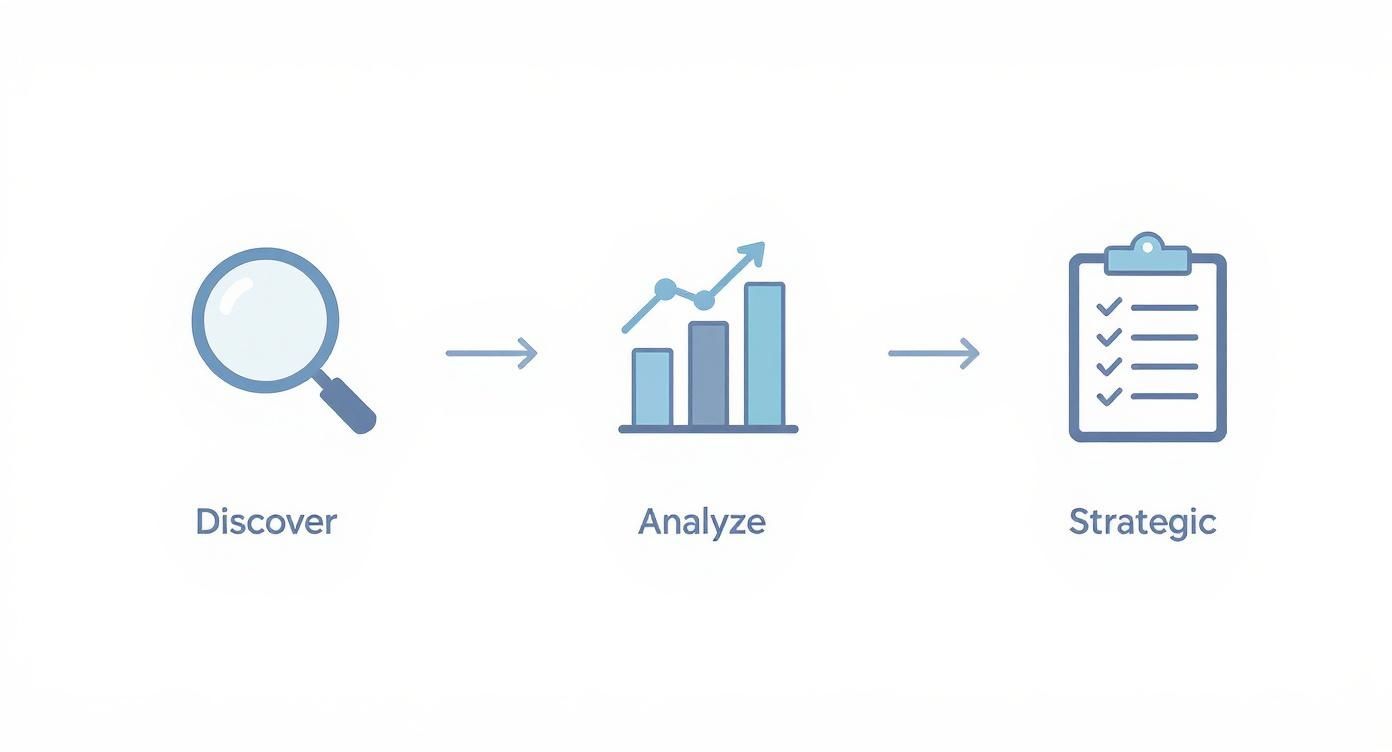
Following a framework like this helps you make deliberate, data-backed choices instead of just chasing whatever is trending today.
Testing for Maximum Impact
So, you’ve got a solid list of potential hashtags. Don't just set it and forget it. You need to see what actually works. A simple A/B test is your best friend here.
Create two posts that are almost identical, but swap out the hashtags. For instance, Post A might use #SmallBusinessGrowth, while Post B uses #EntrepreneurTips. Post them at similar times on different days to avoid overlap, then dive into your Facebook Insights.
Keep a close eye on reach and engagement. Did one post reach significantly more people who don't follow you? Which one got more meaningful interactions like comments and shares?
Don't just look at what's trending. Test what resonates. The best trending hashtags on Facebook for your brand are the ones that your specific audience actually responds to, not just the ones with the highest volume.
This constant loop of testing and tweaking is what separates the pros. It's also worth remembering that on Facebook, less is often more. In fact, research from the American Marketing Association shows that posts with just one hashtag tend to perform best, averaging 593 engagements. That number drops off a cliff as you add more. Facebook rewards relevance over quantity, so choose wisely.
By taking this structured approach, you'll build a repeatable system for finding hashtags that actually move the needle. For a deeper dive, check out our ultimate hashtags guide.
Weaving Hashtags into Your Content Workflow

A solid hashtag strategy isn’t something you throw together seconds before you hit “publish.” Honestly, that last-minute scramble is a recipe for missed opportunities and spotty results. To get real traction, hashtags need to be a core part of your content creation process from the start.
The goal is to build a system that saves you time and actually works. Instead of the daily grind of hunting for new tags, you can create curated "hashtag sets" that align with your main content pillars.
Creating and Managing Your Hashtag Sets
First, think about the big themes you cover. If you're a marketing agency, maybe your pillars are "social media tips," "client case studies," and "team culture." For each one, you’ll build a dedicated list of 5-10 super-relevant hashtags.
A good hashtag set is a balanced mix:
- Broad Industry Tags: Just one or two high-level terms, like
#DigitalMarketing. - Niche Community Tags: This is the heart of your list. Get specific to attract your ideal audience—think
#LocalSEOTipsor#ContentStrategy. - Branded Tags: Your own unique tag for your business or a specific campaign, like
#EvergreenFeedSuccess.
Keep these sets handy in a simple document or spreadsheet. When it's time to schedule content, you can just grab the right set, give it a quick once-over to make sure it fits the post, and you're done in seconds. This is how you move from random tagging to a consistent, strategic approach.
The most effective social media workflows are built on repeatable systems, not last-minute decisions. By preparing hashtag sets in advance, you turn a daily chore into a strategic advantage that fuels discoverability.
Folding Hashtags into Your Schedule
With your sets ready to go, the next step is plugging them into your content calendar. As you plan out your posts, assign the corresponding hashtag set to each piece of content. This systematic method is exactly why a powerful social media scheduler is so valuable—it helps you automate and organize this entire process.
A question I get all the time is where to actually put the hashtags. In the caption or the first comment? For Facebook, the answer is simple: always put hashtags directly in the post caption. Unlike some other platforms, hiding them in the comments does nothing for discoverability. The algorithm might miss them completely.
So, how do you know if it's all working? Dive into your Facebook Insights. Keep a close eye on the "Reach" metric and, more specifically, the breakdown between your followers and non-followers. When you see a jump in non-follower reach, that’s a fantastic sign that your hashtags are doing their job—getting your content in front of fresh, relevant eyes. That data is the real proof that your new workflow is paying off.
Common Facebook Hashtag Mistakes to Avoid
Using hashtags on Facebook isn't a silver bullet. In fact, if you get it wrong, you can do more harm than good, tanking your reach and even tarnishing your brand's reputation. Let's walk through some of the most common pitfalls I see brands stumble into every day so you can sidestep them completely.
The biggest temptation? Hopping on a massive, viral trend just because you see it everywhere. Sure, a tag like #trending might have a staggering 875 million uses, but throwing it on your post about artisanal coffee is just noise. This might get you a short-lived bump in impressions, but it's from an audience that has zero interest in what you're actually selling.
You're far better off aiming for meaningful engagement from a smaller, relevant audience than getting lost in a sea of irrelevant content. For a deeper dive into why massive tags often fall flat, you can explore the data on popular Facebook hashtags at Taggbox.com.
The Problem with Hashtag Stuffing
Another classic mistake is "hashtag stuffing." This is when you see a post with a laundry list of tags crammed at the end, hoping to cast the widest net possible. While this might work on other platforms, it’s a big red flag on Facebook.
To Facebook's algorithm, a wall of hashtags often looks spammy. It dilutes your message and can actually get your post penalized, throttling its reach. Remember, a post with one to three highly specific, relevant hashtags will almost always perform better than one with ten generic ones.
Failing to Check the Context
This last one is a biggie, and it can be the most damaging: using a hashtag without understanding the conversation behind it. A tag that seems innocent on the surface could be tied to a sensitive news event, a social controversy, or a brand crisis you want no part of.
Before you even think about adding a trending hashtag to your post, do a quick search. Just click on it and see what other people are posting. Those five seconds of due diligence can save you from a world of brand embarrassment.
I once saw a local bakery use a trending hashtag they thought was about community spirit. It turned out to be associated with a heated local protest, and they were flooded with negative comments that hurt their reputation. Always, always look before you leap.
Answering Your Top Facebook Hashtag Questions
Figuring out the "rules" for Facebook hashtags can feel like a moving target. But after years of managing accounts and running tests, I've found that a few simple guidelines make all the difference. Get these basics down, and you'll see your hashtags start working for you, not against you.
How Many Hashtags Should I Actually Use on Facebook?
When it comes to Facebook, less is absolutely more. I've consistently seen the best results with just one or two laser-focused hashtags.
If you push it to three or four, you're entering a gray area. Anything more than that, and your post starts to look spammy—not just to your followers, but to the algorithm itself. It's a classic case of quality over quantity.
Should I Put Hashtags in the Post or in the First Comment?
Put them right in the post caption. Every single time.
This isn't Instagram, where hiding hashtags in the comments became a popular trick. On Facebook, that tactic does absolutely nothing for you. For your post to be properly categorized and shown to new audiences, those hashtags need to be part of the original caption.
The biggest mistake I see brands make is copying and pasting the same block of 10+ hashtags on every single post. Facebook's algorithm is smart enough to see this as repetitive, spam-like behavior, and it will often penalize your reach for it. A much better approach is to build small, curated "hashtag sets" for each of your content pillars and rotate through them.
Ready to stop guessing and start scheduling your best content effortlessly? EvergreenFeed automates your social media workflow, saving you hours every week. Sign up for free and see how it works!