James
James
Think of social media scheduling software as your own personal content assistant. It's a tool that lets you automatically publish posts on platforms like Facebook, Instagram, and LinkedIn. Instead of having to log in and post manually every single day, you can get everything lined up and scheduled in advance. This keeps your profiles active and consistent, even when you're not online.
What Is Social Media Scheduling Software
Trying to manage multiple social media accounts manually is like trying to water a huge garden with a tiny watering can. You’re constantly running around, trying to give each plant (or platform) exactly what it needs at the perfect time. It’s exhausting and inefficient.
Now, imagine you installed a smart sprinkler system. It waters everything for you, right on schedule. That’s exactly what social media scheduling software does for your content. It takes the frantic, day-to-day work of posting and turns it into a calm, strategic process. You can sit down for a few hours and plan out your entire week—or even a whole month—of content in one go. This small change shifts you from being a reactive poster to a proactive brand builder.
Getting Off the Content Treadmill
That constant pressure to create and post something right now just to stay visible? We call that the "content treadmill." It's a relentless cycle that can burn out even the most dedicated social media manager. A scheduling tool is your off-ramp. It works behind the scenes, keeping your accounts lively and engaging while you focus on the bigger picture.
Once you start automating your posts, a few things happen right away:
- You become incredibly consistent. Posting at regular intervals is a huge signal to both algorithms and your audience that you're reliable. This consistency builds trust and keeps people coming back for more.
- You get a lot of time back. On average, marketers save more than six hours a week just by using scheduling tools. Think about what you could do with that extra time: engaging with comments, refining your strategy, or creating even better content.
- You can actually plan ahead. When you’re not scrambling to find something to post today, you can look at your content calendar from a bird's-eye view. This lets you weave together thoughtful campaigns, tell better stories, and make sure you have a healthy mix of content.
When you let software handle the repetitive job of publishing, you free up your creative energy for what really moves the needle: connecting with your audience and growing your brand.
It's More Than Just Hitting "Schedule"
The best scheduling platforms today are so much more than simple "set it and forget it" tools. They're command centers for your entire social media operation. As this ultimate guide to Social Media Management For Your Business explains, these tools are a cornerstone of any effective online strategy.
At the end of the day, using scheduling software isn't just about being more efficient—it's about being more effective. It lets you publish content when your audience is most likely to see it, even if that's at 10 PM on a Saturday. By taking the logistical headache of posting off your plate, a great scheduling tool gives you the freedom to create content that truly connects.
What a Powerful Scheduling Tool Actually Does
Let's be clear: not all social media scheduling tools are built the same. Sure, most of them can push a post live at a set time. But the really powerful ones do so much more. They're designed to turn your entire content strategy from a checklist of manual chores into a smart, automated system.
Think of it like this: a basic scheduler is a kitchen timer. It pings when it's time to do something. A truly great scheduling tool is like a smart oven that knows exactly how to cook everything to perfection, without you having to stand there and watch it. These core features are what drive consistency, save you countless hours, and deliver results you can actually see.
This diagram shows how you can move from doing everything by hand to having a system that works for you.
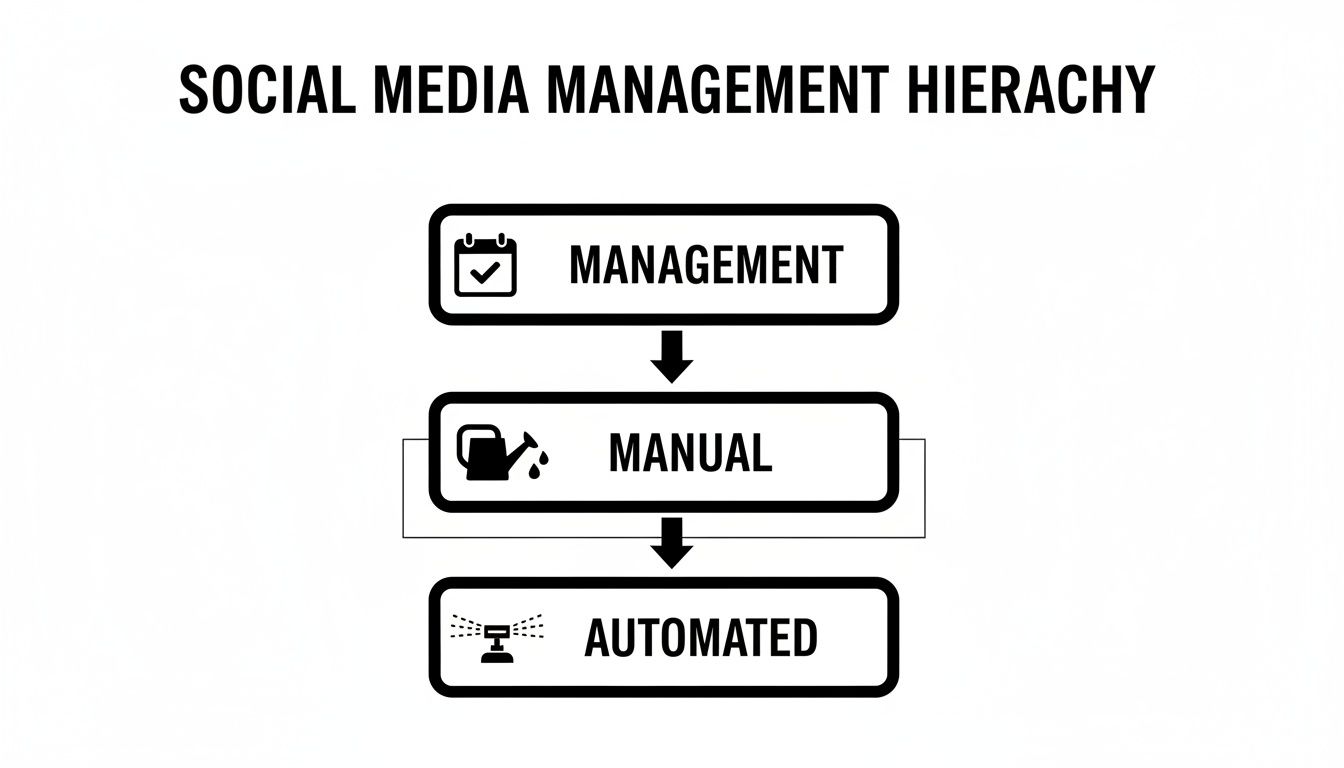
As you can see, the right software becomes a force multiplier, taking all those time-sucking, repetitive tasks off your plate.
Content Buckets: The Secret to a Balanced Feed
Ever feel like you're posting the same kind of thing over and over? Your audience definitely notices. That's where content buckets come in. Imagine them as different playlists for your social media channels, making sure you're always serving up a fresh and engaging mix.
You can set up distinct categories for all your different types of content. For instance:
- Blog Posts & Articles: A bucket just for sharing your newest long-form content.
- Company News & Promos: For posts about sales, product launches, or special offers.
- Customer Stories: A category specifically for resharing testimonials and user-generated content.
- Helpful Tips & Industry News: A bucket dedicated to sharing valuable insights from other sources.
Once you have your buckets, you can create a schedule that pulls from each one on different days or at different times. This simple strategy guarantees a balanced feed that educates, sells, and entertains without ever feeling stale or overly promotional.
Evergreen Recycling: Get More Mileage from Your Best Content
You know that amazing how-to guide you wrote six months ago? It's just as valuable today, but it's probably buried deep in your feed. Evergreen content recycling is a game-changer that automatically resurfaces your timeless, high-performing posts for new eyes to see.
Instead of letting great content die after its first share, an evergreen system puts it back into rotation. This means new followers always see your greatest hits, and you get a steady stream of traffic and engagement from a single piece of work—without lifting a finger. It's the ultimate "work smarter, not harder" feature.
A powerful evergreen scheduling system ensures that every piece of high-value content you create delivers a continuous return on investment, driving traffic and engagement long after its initial publication.
This kind of automation is precisely why the social media management market is exploding. Valued at USD 5,246.57 million in 2025, the global market is on track to hit USD 19,587.81 million by 2033. This growth is fueled by a 62% increase in the need to manage content across platforms and a 48% demand for automation. In fact, AI-powered tools are already boosting engagement by 38%.
Seamless Integrations and Granular Controls
A great scheduling tool doesn't work in isolation; it plays nicely with the other platforms you rely on. A critical connection for many, especially for powerful evergreen automation, is with tools like Buffer. This allows a specialized tool like EvergreenFeed to handle the content recycling while Buffer manages the core publishing schedule.
Beyond that, you need granular scheduling controls. This gives you the power to set precise posting times for each social network and even for each individual content bucket. You can fine-tune your schedule to match when your audience is most active on Twitter versus LinkedIn, giving your posts a massive boost in visibility. For a deeper look, check out our guide comparing social media management tools to see how different platforms stack up.
Insightful Analytics to Guide Your Strategy
Finally, what's the point of all this if you don't know what's working? The best scheduling software gives you insightful analytics that act as a compass for your content strategy. It goes way beyond "vanity metrics" like likes and follows to show you what truly connects with your audience.
These platforms track the metrics that matter:
- Engagement Rate: Which posts are actually starting conversations?
- Click-Through Rate: What content is successfully driving people back to your website?
- Best Performing Times: When are your posts getting the most eyeballs and interaction?
This data is your roadmap. It tells you which content buckets are home runs, which headlines are duds, and what you need to create more of. Without analytics, you're just throwing content at the wall and hoping something sticks. With them, you’re making smart, data-backed decisions that drive real growth.
To wrap things up, here’s a quick summary of the features that really move the needle.
Essential Features of Scheduling Software
| Feature | Primary Benefit | Who It Helps Most |
|---|---|---|
| Content Buckets | Ensures a varied and balanced content mix | Marketers juggling multiple content types and campaigns |
| Evergreen Recycling | Maximizes the ROI of your best content automatically | Content creators and businesses with a blog or library of resources |
| Seamless Integrations | Connects with other essential tools like Buffer | Teams who rely on a suite of marketing tools |
| Granular Controls | Optimizes posting times for each specific platform | Anyone managing multiple social media accounts |
| Insightful Analytics | Provides data-driven insights to refine your strategy | Strategists and business owners focused on growth |
These core capabilities are what separate a simple scheduler from a true content automation powerhouse.
How Different Professionals Use Social Media Automation
The real magic of social media scheduling software isn't in the tech specs; it's seeing how it solves actual problems for real people. Concepts like "content buckets" and "evergreen recycling" might sound like jargon, but they are lifelines for busy professionals. Let's walk through a few scenarios to see how these tools turn frustrating busywork into measurable growth.

Each of these stories starts with a common pain point and ends with a smart, automated solution.
The Agency Owner Juggling Multiple Clients
Picture Sarah, who runs a boutique marketing agency with ten different clients. Her team's biggest headache? Keeping every brand’s social media presence active and on-point without drowning in logins and spreadsheets. Before they had a system, it was a daily scramble of manual posting, endless email chains for approvals, and tedious reporting. It was messy and mistakes were bound to happen.
By bringing in a solid social media scheduling platform, Sarah completely changed the game for her agency.
- Centralized Management: All client accounts now live in one dashboard. She can assign roles to her team, giving them access only to the accounts they manage. No more password sharing or confusion.
- Efficient Content Approval: Her team drafts posts and submits them for client review right inside the tool. This creates a crystal-clear, documented workflow that puts an end to the back-and-forth emails.
- Automated Reporting: Instead of her team spending hours cobbling together metrics, the tool generates professional, white-label reports showing post performance and growth. This frees them up to focus on high-value strategy work.
The result? A much more efficient agency that delivers consistent quality, proves its value with hard data, and can actually take on more clients without burning everyone out.
The Solo Blogger Driving Traffic on Autopilot
Now, let's look at David. He’s a passionate blogger who writes incredible, in-depth articles on sustainable living. His main goal is driving people to his website, but his time is stretched thin. He needs to be researching and writing, not glued to social media promoting old posts.
David’s secret weapon is a scheduling tool built for evergreen content.
He treats his best blog posts like valuable assets, not one-time announcements. By loading his top-performing articles into an evergreen recycling system, he ensures they are continuously shared with new followers across his social channels.
This simple change created a passive traffic machine. While he’s deep in research for his next article, his social media scheduling software works tirelessly in the background, sharing his greatest hits. His social feeds stay active, he reaches new people constantly, and a steady stream of visitors land on his blog—all on autopilot.
The Small Business Owner Wearing All the Hats
Finally, there’s Maria, the owner of a local bakery. She’s not just the baker; she’s the manager, accountant, and marketer, too. She knows social media is crucial for bringing in customers, but finding time to post every day felt impossible. Her online presence was spotty, which didn’t reflect the quality of her business.
Maria solved this by adopting a straightforward social media scheduler. Now, she blocks off just two hours every Sunday to plan and schedule her content for the entire week.
She uses content buckets to keep things organized and interesting:
- Daily Specials: Mouth-watering photos of her fresh bread and pastries.
- Behind the Scenes: Quick videos of her team decorating cakes.
- Customer Features: Reposting photos from happy customers enjoying their treats.
This simple system helps her maintain a vibrant, professional online presence without taking time away from actually running the bakery. For a small business, this kind of efficiency is a game-changer. It’s no surprise the sales and marketing segment holds a 37.41% share of the social media tools market—it’s driven by professionals like Maria. Plus, when these tools offer predictive content optimization, they can lead to a 27% improvement in engagement, a massive win for any local shop. You can find more data on the social media management market on Fortune Business Insights.
Choosing the Right Social Media Scheduling Tool
With so many options out there, picking the right social media scheduling software can feel a bit overwhelming. Every tool on the market promises to save you hours and skyrocket your engagement, but the reality is, the "best" one really just depends on you.
What works wonders for a big agency is often total overkill for a solo blogger, and a simple tool perfect for a small business might not have the power a growing team needs. The key is to avoid getting stuck with a subscription that just becomes another complicated task on your to-do list.
This isn't about finding the software with the most bells and whistles. It's about finding the one with the right features for your specific workflow. Before you even glance at a pricing page, take a minute to figure out what you truly need.
Start With Your Core Needs
Think of this as creating your own personal buyer's guide. The goal here is to get a crystal-clear picture of what the ideal tool would actually do for you day-to-day. Once you have that clarity, you can easily cut through all the marketing hype.
Start by asking yourself a few straightforward questions:
- Your Team Size: Is it just you running the show? Or do you have a team that needs to collaborate on creating and approving posts?
- Primary Social Platforms: Where does your audience live? A tool that's brilliant for Instagram's visual-heavy scheduling might not be the best fit if your focus is all on LinkedIn articles.
- Content Mix: Are you mostly posting timely news and updates? Or do you have a goldmine of evergreen blog posts you want to keep sharing over and over again?
Getting these answers down first stops you from being wowed by flashy features you'll never actually use. For instance, if you're a solopreneur, you definitely don't need to pay extra for complex team approval workflows.
Key Evaluation Criteria
Once you’ve got a handle on your foundational needs, you can start looking at different vendors. Try to look beyond just the feature list and picture how a tool will fit into your daily routine. After all, even the most powerful platform is useless if it’s a pain to use.
Here are the critical things to look for when you're comparing your options:
User Interface (UI) Simplicity: Is the dashboard clean and intuitive? A good tool should make your life simpler, not more complicated. A clunky interface will turn scheduling into a chore, completely defeating the purpose.
Essential Integrations: Does it play well with the other tools you already use every day? For many people, a crucial integration is with a core publisher like Buffer, which allows specialized tools to handle specific jobs like evergreen automation without a hitch.
Quality of Customer Support: When you inevitably hit a snag, how easy is it to get help? Look for tools with a reputation for fast, friendly, and genuinely helpful support. Check out some user reviews to see what real customers are saying.
Scalability and Growth: Will this tool be able to grow with you? The platform that works for you today should still be a great fit a year from now, whether that means adding team members, connecting more social accounts, or just handling a lot more content.
Choosing a social media scheduler is a strategic decision. The right tool becomes an invaluable asset that saves you time and amplifies your results. The wrong one just becomes a source of frustration and a hole in your budget.
To help with your decision, you might want to check out a broader review of the best social media management tools on the market. This can give you a good overview of the major players and what makes each one unique. And if you want to dive deeper into the specific features of these tools, our guide can help. Learn more about what a social media scheduler can do in our article.
By following this simple framework, you can move past the noise and confidently pick a tool that actually fits your workflow, your budget, and your goals.
Automating Evergreen Content With EvergreenFeed
If you're looking for a long-term growth strategy, you need to get smart about your evergreen content. I’m talking about those timeless, high-value articles, guides, and case studies that stay relevant for months or even years. The problem? Most of us share them once, and then they get buried, lost in the digital dust.
This is where specialized social media scheduling software really changes the game. It can transform your best assets from one-off posts into a perpetual traffic-driving machine. Instead of manually digging up old links every single week, you can build an automated system that keeps resurfacing your most valuable content for new audiences to find.

This image nails the core idea perfectly: set a schedule one time, and let automation take care of the rest. A tool built specifically for this, like EvergreenFeed, makes this whole concept a simple, practical reality.
The Power of Content Buckets
The secret to a solid evergreen strategy is all about organization. Think about it—you wouldn't just dump all your computer files into a single, chaotic folder. The same logic applies to your content, which is why content buckets (or categories) are so crucial.
Imagine sorting your best content into distinct, thematic libraries. This simple act of organization gives you total control over the mix and frequency of what your audience sees, helping you create a feed that feels balanced and genuinely engaging.
Here's what that might look like in practice:
- How-To Guides: A bucket filled with your most helpful, step-by-step tutorials.
- Case Studies & Testimonials: A category dedicated to showing off customer success and building social proof.
- Industry Insights: A collection of your thought leadership articles and opinion pieces.
- Product Tips: A bucket for sharing quick, useful tricks about what you sell.
By sorting your content this way, you gain pinpoint control over your posting schedule. You can decide to share a "How-To Guide" every Monday, a "Case Study" every Wednesday, and an "Industry Insight" every Friday. Suddenly, you've got a predictable yet valuable rhythm.
The real magic happens when you pair content buckets with automation. You add your best content to each category once, set a recurring schedule, and the system takes over, pulling from the right bucket at the right time, forever.
A Practical Setup With EvergreenFeed and Buffer
Don't worry, this is much simpler to set up than it sounds. A tool like EvergreenFeed is built to plug directly into a core scheduler like Buffer, creating a completely seamless workflow. The whole point is to get you up and running quickly, not bog you down in technical details.
It really comes down to a simple, three-step process:
- Connect Your Buffer Account: First, you just link EvergreenFeed to your existing Buffer queue. This is what lets the system send your scheduled evergreen posts directly to the social media accounts you already have connected.
- Create Your Content Buckets: Next, you set up the categories that make sense for your brand, just like the "How-To Guides" or "Case Studies" examples we talked about.
- Add Your Content and Set a Schedule: Finally, you start adding your links and post variations to the right buckets. Then you create a simple, recurring schedule (e.g., "Post from the Blog Posts bucket every Tuesday at 10 AM") and switch it on.
That’s it. Seriously. The system now works quietly in the background, randomly picking a post from the designated bucket and dropping it into your Buffer queue at the scheduled time. Your evergreen content is now on autopilot.
Calculating the Tangible ROI
The return on this kind of strategy isn't just about convenience—it's concrete and measurable. You’re reclaiming your most valuable resource (time) and squeezing every last drop of value out of the content you’ve already worked so hard to create.
Think about a digital marketer who spends two hours every Monday morning hunting down and scheduling older blog posts for the week. That’s over eight hours per month spent on a task that’s repetitive and, frankly, a bit mind-numbing.
By putting an evergreen automation system in place, that marketer basically eliminates this chore after a one-time setup. Those eight-plus hours saved every single month can be put back into high-value work, like creating new content, actually talking to your community, or digging into performance data.
This constant promotion also drives a steady stream of traffic and leads, amplifying the original ROI of creating that content in the first place. For those ready to build out their own content library, you can learn more about crafting an effective evergreen content strategy in our detailed guide. It's the best way to make sure your hard work keeps paying off long after you hit "publish."
Common Mistakes to Avoid When Scheduling Content
Getting a social media scheduling tool is a huge step up for your workflow, but it’s easy to stumble if you think automation replaces strategy. The biggest pitfall I see is the "set it and completely forget it" approach. Yes, scheduling frees you from the daily grind of posting, but your social media still needs a real person behind the curtain.
Think of your scheduler as a hyper-efficient assistant, not the new manager. It gets the posts out the door, but you still need to be present. That means jumping into your accounts to reply to comments, answer questions, and actually engage with the people who follow you. Automation without engagement is just shouting into an empty room.
Forgetting to monitor those conversations is a massive missed opportunity. A scheduled post could kick off a fantastic discussion or generate valuable feedback, but if you're not there to respond, you've lost a chance to build a real connection.
Sounding Like a Robot
Another classic mistake is letting your feed become a repetitive, robotic drone. If every post looks and sounds the same, your audience will get bored and tune you out fast. This usually happens when you rely too heavily on one type of content or forget to inject any personality into your scheduled captions.
The fix? Mix it up. Use different content buckets that blend helpful tips, behind-the-scenes stories, and interesting articles with your promotional stuff. A great guideline is the 80/20 rule: make sure 80% of your content is genuinely useful or entertaining for your audience, and only 20% is a direct sales pitch.
Your scheduling tool is there to make your timing consistent, not to make your voice uniform. The goal is to automate the delivery, not the personality.
Also, take a few extra minutes to tweak your captions for each platform. The formal tone that works on LinkedIn is going to feel stiff and out of place on Instagram. That little bit of extra effort to tailor the message makes all the difference and keeps your brand from sounding cold and impersonal.
Ignoring Your Analytics
Finally, one of the most critical errors is scheduling posts without ever looking at the data. The analytics inside your scheduling tool aren't just for show; they're your guide to what’s actually resonating with your audience and what's falling flat.
Ignoring this data is like driving blind. You're moving, sure, but you have no clue if you're even on the right road. To get back on track, set aside time for a monthly analytics check-in.
Look for these simple patterns:
- Top-Performing Content: Which posts or content categories get the most likes, comments, and shares? Make more of that.
- Best Posting Times: Are people more active in the morning or later in the afternoon? Tweak your schedule to match.
- Audience Growth: Is what you're doing actually helping you gain more followers?
By regularly checking your analytics, you can make small, informed tweaks to your plan. This simple habit turns your social media scheduler from a basic automation tool into a true engine for growth.
A Few Common Questions
Diving into social media scheduling tools can bring up a few questions. It's totally normal. Let's walk through some of the most common ones I hear from people so you can feel confident moving forward.
One of the biggest hang-ups people have is this idea that automation will kill their engagement. It’s a persistent myth, but that's all it is. In my experience, the opposite is true. When you schedule posts, you're not being lazy; you're being strategic.
Good software lets you post consistently when your audience is actually online and listening. This consistency builds trust and keeps you visible. It's not about being robotic; it's about being reliably present for your followers.
Evergreen vs. Regular Scheduling: What’s the Real Difference?
So what's the deal with "evergreen" content versus just "scheduling" a post? It's a great question, and the distinction is crucial for getting the most out of your content.
Think of it like this: regular scheduling is for your daily specials, while evergreen scheduling is for your signature dishes that people love all year round.
- Regular Scheduling: This is for your timely, "in-the-moment" content. Think flash sales, event announcements, or commentary on breaking news. It has a short shelf life and you post it once.
- Evergreen Scheduling: This is where the magic happens for your best, most timeless content—your ultimate guides, killer blog posts, or insightful case studies. An evergreen system automatically re-shares this content over time, making sure it keeps working for you long after you first hit publish.
Understanding this difference is how you stop the content creation treadmill and start building a real asset library.
How Long Does It Really Take to Get Started?
Honestly, you can be up and running faster than you think. Most modern tools are built to get you started in just a few minutes, not hours.
If you’re using a specialized tool that plugs into something you already use, it's even quicker. For instance, hooking up a tool like EvergreenFeed to your existing Buffer account is literally a two-click process. There’s no complex technical setup or steep learning curve. You can genuinely go from signing up to automating your content in less time than it takes to brew a pot of coffee.
Ready to put your best content on autopilot and save hours every week? With EvergreenFeed, you can set up your evergreen content buckets in minutes and let our smart automation handle the rest. Start your free trial today and see the difference for yourself.