James
James
So, what exactly are social media marketing goals? Think of them as the specific, measurable targets you want to hit with your social media efforts. These goals are what give your strategy a real purpose, turning random posts into a focused plan designed to increase brand awareness, generate leads, or drive sales.
Without clear goals, you’re just posting into the void.
Why Posting Without a Plan Is a Waste of Time
Let’s be honest, we’ve all been there— dutifully pushing out content day after day but seeing zero real impact on the business. This is a super common frustration, and it's exactly why setting clear social media marketing goals is so important. It's the difference between being busy and actually being productive.
Imagine trying to sail a ship without a map or a destination. You could have the best crew and a perfect wind, but you'd just be drifting. Posting on social media without a goal is the same thing. You might create a beautiful post and get a few likes, but are you moving your business forward? Probably not.
Transforming Busywork into Business Growth
When you set goals, your social media stops being a daily chore and starts becoming a strategic engine for your business. Instead of asking, "What should I post today?" you'll start asking, "What kind of post will get me closer to my quarterly sales target?" That subtle shift in thinking changes everything.
A goal-oriented approach helps you:
- Justify your budget and resources: You can show stakeholders exactly how your social media activity contributes to the company's bottom line.
- Measure what truly matters: It’s time to move beyond vanity metrics like follower counts and focus on the KPIs that signal real business impact.
- Create more effective content: Every single piece of content you create will have a clear purpose, whether that’s to educate your audience, spark a conversation, or drive a conversion.
The difference between a thriving social presence and a stagnant one isn't about posting more; it's about posting with purpose. A well-defined goal acts as your filter for every decision you make.
Take a real estate agent, for instance. Their main goal is likely to generate qualified leads. Instead of just posting pretty pictures of houses, their entire strategy would shift. The focus would be on creating engaging social media posts that convert, like virtual tour videos, glowing client testimonials, or neighborhood guides designed to capture a potential buyer's contact information.
Ultimately, goals give you the framework you need to build a winning strategy. They set a benchmark to measure your performance against, helping you see what’s working, what’s not, and when it's time to try something new. Without that clarity, you're just spending time and money on guesswork instead of growth. This guide will give you a practical, no-nonsense roadmap to defining what success looks like for you.
Choosing the Right Goals for Your Business Stage
Picking the right social media goals isn’t about pulling ideas from a generic checklist. It's about figuring out what your business desperately needs right now.
Think of it like this: a toddler's main goal is learning to walk, a teenager's is getting into college, and an adult's might be planning for retirement. Each stage has a completely different priority. Your business is no different. A brand-new startup has fundamentally different needs than a well-established e-commerce store.
Your social media strategy has to match your business's current reality. If nobody knows who you are, trying to push for immediate sales is like training for a marathon when you can't even jog a mile yet. You're just setting yourself up for frustration. The key is to align your efforts with your most pressing priorities, so every post and every ad dollar pushes you toward something you can actually achieve.
Remember, your social media objectives should support your entire successful online presence, including social media, not just exist in a bubble.
Goals for Startups and New Businesses
When your business is just getting started, your biggest enemy is obscurity. You could have the most amazing product in the world, but if no one has heard of you, you don't really have a business. That's why your number one social media goal should be building brand awareness.
Your mission is simple: get your name, your story, and your value in front of as many of the right people as possible.
Here’s how that plays out:
- Focus on Reach and Impressions: You want to obsess over how many unique eyeballs are seeing your content.
- Create Stuff People Want to Share: Think infographics, funny memes that hit home, or quick educational videos. Get your audience to do the marketing for you.
- Build an Initial Following: This isn't just a vanity metric. It's about creating a core audience you can talk to and learn from as you grow.
For a new company, every like, share, and follower is a small win in the battle against being invisible. You're planting your flag and letting the world know you've arrived.
This flowchart shows how different businesses, from startups to established stores, should be thinking about their primary social media objectives.
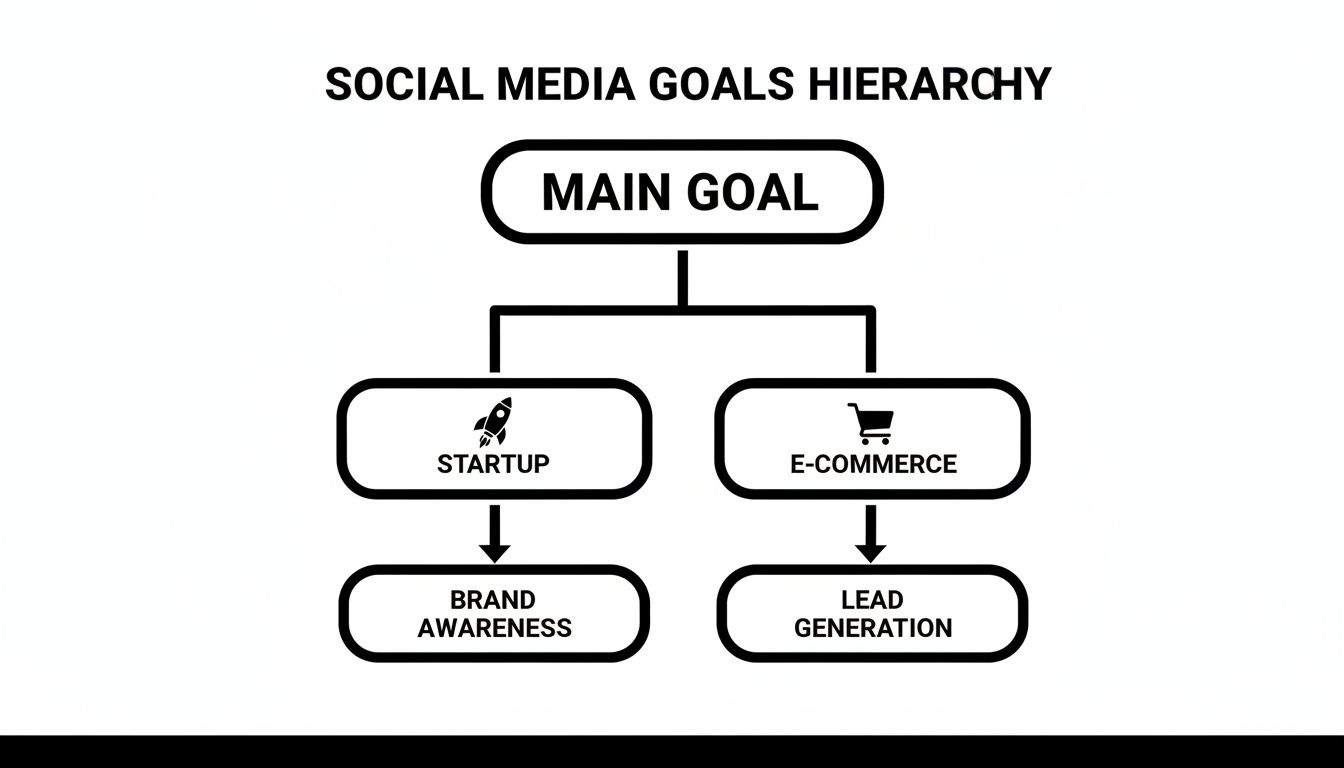
As you can see, a successful strategy starts by matching your main social goal to what your business needs most at that moment.
Goals for Established and Growing Businesses
Okay, so people know who you are. You've got an audience that shows up. Now what? Your priorities can finally shift from "hello, world!" to something more sophisticated. While you never stop building awareness, you can now start moving people further down the marketing funnel.
For established brands, the focus naturally moves toward community engagement, lead generation, and, of course, driving sales. You've already made the introduction; now it's time to build a real relationship and make some money.
At this point, your social media presence stops being a megaphone and starts becoming a magnet. Instead of just shouting your message out, you’re pulling qualified prospects and loyal fans closer.
Let's break down these more advanced goals:
-
Increase Community Engagement: This is all about creating a tribe. Your goal is to spark conversations, get people sharing their own experiences with your brand (user-generated content), and make your audience feel like they're part of something. An engaged community creates brand advocates and repeat customers for life. Keep a close eye on your engagement rates.
-
Generate Leads: Now we can start using social media to collect valuable contact info. The goal is to get followers to move from a platform you don't own (like Instagram) to one you do (like your email list). This means creating lead magnets they can't resist, running targeted ads, and promoting exclusive content like webinars or ebooks. You'll measure this with metrics like cost per lead (CPL) and conversion rate.
-
Boost Sales and Conversions: This is where the rubber meets the road. We're talking about directly linking your social activity to revenue. This means using social commerce features (like Instagram Shopping), running flash sales, and driving traffic directly to your product pages. Your most important KPIs here will be click-through rate (CTR), conversion rate, and return on ad spend (ROAS).
For example, a seasoned e-commerce brand might decide to run a campaign to increase its conversion rate by 15% next quarter. How? By using targeted Instagram ads that feature video testimonials from happy customers. This goal is specific, measurable, and tied directly to the bottom line—a perfect objective for a mature business.
Turning Your Vision into Actionable SMART Goals
Saying you want "more engagement" is a great start, but it's more of a wish than a plan. It doesn't have the structure needed to actually make things happen. This is where we need to translate those vague ambitions into a real roadmap using the proven SMART goal framework.
Think of it like this: a general goal is like pointing at a mountain on the horizon. A SMART goal is like pulling out a map, plotting the exact trail, calculating the time it'll take, and packing the right gear. It turns a fuzzy idea into a clear, step-by-step mission.

Breaking Down the SMART Framework
To set social media goals that actually work, you have to get specific. Every letter in the SMART acronym plays a critical role in sharpening your focus and giving your team clear marching orders.
Here’s what each one means:
- Specific: Your goal needs to be crystal clear. Vague is the enemy here. Instead of "increase followers," you'd say, "increase our LinkedIn company page followers."
- Measurable: How will you know you've succeeded? You need numbers to track your progress. This could be a specific count, a percentage increase, or another hard data point.
- Achievable: Aiming high is great, but your goal must be realistic. You have to consider your team, your budget, and your timeline. Setting an impossible target just demotivates everyone.
- Relevant: Does this social media goal actually help your bigger business objectives? If your company is launching a new product, a goal to boost engagement on an old, unrelated topic is a waste of effort.
- Time-bound: Every goal needs a deadline. Without one, important objectives get pushed aside for more urgent (but less important) tasks. A deadline creates a sense of focus and accountability.
A goal without a deadline is just a dream. That "T" for Time-bound is what forces you to move from thinking to doing, creating the push you need to get your strategy in motion.
This framework is a cornerstone of any marketing plan worth its salt. To explore this idea further, take a look at our guide on why you need SMART goals for your content marketing strategy to work.
From Vague Ideas to Powerful SMART Goals
Let's put this into practice. We’ll take a few common, fuzzy social media wishes and forge them into solid SMART goals that a team can actually run with.
Vague Idea 1: Get more engagement.
This is probably the most common request, but what does it even mean? What kind of engagement? Where? How much is "more"?
- SMART Goal: "Increase our average Instagram post engagement rate from 2% to 3.5% within the next 60 days. We'll do this by launching a new interactive content plan that includes weekly polls and Q&A Stories."
See the difference? It's specific (Instagram engagement rate), measurable (2% to 3.5%), achievable (a 1.5% jump is tough but doable), relevant (builds community), and time-bound (60 days).
Vague Idea 2: Drive more website traffic.
Another good intention, but it's way too fuzzy. How much more traffic are we talking about, and where should it come from?
- SMART Goal: "Boost referral traffic from our Facebook page to the company blog by 20% over the next quarter (90 days). We will promote each new blog post with a video teaser and a targeted ad campaign backed by a $500 budget."
Now we have a clear source (Facebook), a target (20% increase), a deadline (90 days), and a plan for getting there.
Vague Idea 3: We need more leads.
This is a critical business need, but as a social media goal, it's missing the how. A SMART goal connects your social activity directly to the sales funnel.
- SMART Goal: "Generate 50 marketing qualified leads (MQLs) through LinkedIn in Q3 by promoting our new downloadable industry report. We will publish three posts per week driving to the report's landing page and run a $1,000 sponsored content campaign to support it."
This is a goal you can build a real strategy around. It has a specific number (50 MQLs), a clear source (LinkedIn), a defined timeframe (Q3), and a concrete action plan.
Measuring What Matters with the Right KPIs
Setting a powerful SMART goal is a huge step, but it’s only half the battle. A great goal is meaningless if you can’t prove you’re making progress—or that you’ve even crossed the finish line. This is where Key Performance Indicators, or KPIs, come into play.
Think of it like this: your goal is the destination you've plugged into your GPS. Your KPIs are the instruments on your car's dashboard—the speedometer, the fuel gauge, the engine light. They are the specific, trackable numbers that tell you if your strategy is actually working, if you're on the right road, and if you're about to run out of gas.
Without them, you’re just driving blind.

Actionable Metrics Versus Vanity Metrics
Here's a hard truth: not all metrics are created equal. You have to learn the difference between the numbers that feel good and the numbers that actually drive business decisions. This is the classic showdown between vanity metrics and actionable metrics.
Vanity metrics, like your total follower count, look impressive on the surface. They’re easy to point to, but they don’t tell you anything meaningful about your impact on the business. A million followers mean very little if none of them ever engage with your content, visit your website, or buy from you.
On the other hand, actionable metrics tell a story about user behavior and how it connects directly to your bottom line. These are the numbers that truly matter.
- Conversion Rate: The percentage of people who actually take the action you want them to, like signing up for a newsletter after clicking a link in your post.
- Click-Through Rate (CTR): The percentage of people who see your post and are compelled enough to click the link inside it.
- Cost Per Lead (CPL): The real-world cost of acquiring one new potential customer through your social media efforts.
These metrics are your scoreboard. They tell you if you're actually winning the game by generating real value for your company.
Connecting Your Social Media Goals to KPIs
Every single social media goal you set needs a handful of corresponding KPIs to measure its success. This direct line of sight is what turns a wishy-washy strategy into a measurable, defensible plan. Without it, you're just collecting numbers without any real context.
If your goal is to grow brand awareness, you should be laser-focused on KPIs like reach and impressions. But if your goal is to generate leads, you need to be obsessed with your conversion rate and cost per lead.
It's all about alignment. For a deeper dive into this topic, check out our complete guide to choosing the right social media key performance indicators.
Take engagement, for example. It's still a cornerstone of any solid social strategy. In fact, 80% of marketers say that boosting engagement is their primary social media goal. This makes perfect sense when you realize that nearly three-quarters of internet users research products on social platforms before they buy. Those interactions are critical. Discover more insights on the power of social media engagement.
Choosing the right KPIs transforms your social media marketing from a guessing game into a science. It empowers you to prove your value, optimize your performance, and speak the language of business results.
Matching Your Goals to the Right Social Media KPIs
To make this crystal clear, I've put together a table that maps common social media goals directly to the KPIs that measure them. Use this as your cheat sheet to make sure you're always tracking the numbers that will move your business forward.
| Social Media Goal | Primary KPIs | What It Measures |
|---|---|---|
| Build Brand Awareness | • Reach • Impressions • Follower Growth Rate |
The number of unique people who see your content and the speed at which your audience is expanding. |
| Increase Engagement | • Engagement Rate (Likes, Comments, Shares per Follower) • Amplification Rate (Shares per Post) |
How actively your audience is interacting with your content and spreading your message. |
| Generate Leads | • Conversion Rate • Click-Through Rate (CTR) • Cost Per Lead (CPL) |
The effectiveness of your social content in driving users to take action and become leads. |
| Boost Sales | • Sales Conversion Rate • Return on Ad Spend (ROAS) • Average Order Value (AOV) |
The direct revenue generated from your social media efforts and the profitability of your paid campaigns. |
| Provide Customer Support | • Response Rate • Average Response Time |
How quickly and consistently your team is addressing customer inquiries and feedback on social channels. |
By tying your goals to these specific metrics, you’ll always have a clear answer to the question, "Is our social media working?"
How to Automate Consistency and Nail Your Goals
Okay, you've done the hard work. You have a set of clear, measurable social media goals. You know your destination, you have your map, and you’ve picked the right KPIs to watch. But there's one final piece that holds the entire strategy together: consistency.
Consistency is the secret sauce behind almost every brand that wins on social media. It’s how you build trust with your audience, stay top-of-mind, and show the algorithms that you’re a reliable source of good content. The problem is, it's also the first thing to fall apart when you get busy. The daily scramble to create and schedule posts is where most great strategies die.
This is exactly where automation comes in, not as a robotic replacement for you, but as your most reliable team member. It’s about building a system that executes your plan perfectly, even when you’re pulled in a dozen other directions.
Matching Automation to Your Main Objectives
The real trick is to stop thinking of automation as just a time-saver. Think of it as a goal-achievement machine. A tool like EvergreenFeed is built to take the draining, repetitive work off your plate so you can focus on the big-picture thinking that actually moves the needle.
Instead of hunting for something to post every day, you build curated libraries of content that are directly linked to your business objectives. This approach turns your abstract strategy into a concrete, automated workflow.
- Want more leads? Create a content bucket for "Case Studies" or "Customer Testimonials."
- Need to build brand awareness? Set up buckets for "Industry News" and "Company Culture."
- Driving website traffic? A "Blog Post Promotion" bucket is your best friend.
Just by sorting your content this way, you make sure every single post that goes out is working toward a specific, pre-approved goal.
Automation isn't about setting and forgetting your social media. It's about building a consistent, reliable engine that works tirelessly to hit the strategic goals you've already defined.
Let's Walk Through a Real-World Example
Let's make this tangible. Say your main SMART goal is to "increase referral traffic from social media to our blog by 25% over the next quarter." Trying to manually remember to share your blog posts across different platforms, multiple times a week, is a surefire way to be inconsistent.
Here’s how you’d use automation to make it happen without the daily stress:
- Create a Content Bucket: Inside EvergreenFeed, you’d make a new bucket and name it something like "Blog Promotion."
- Add Your Content: Next, you'd add links to your top 10-15 best-performing blog posts. You'd give each one a few different catchy captions to keep things fresh.
- Set the Schedule: Finally, you'd instruct EvergreenFeed to pull one post from your "Blog Promotion" bucket and share it on LinkedIn and X every Tuesday and Thursday afternoon.
And that's it. You’ve just created an automated system that guarantees a steady flow of traffic back to your site, directly supporting your goal with zero daily effort. All you have to do is drop new blog posts into the bucket as you publish them, and the system takes care of the rest.
By automating your best content, you keep your social channels buzzing and driving results 24/7. This constant activity is the foundation for hitting your engagement, traffic, and lead generation numbers. To dive deeper into this, check out our guide on how to automate social media posts and get your time back. It's the final piece of the puzzle for a truly effective, goal-driven strategy.
Frequently Asked Questions About Social Media Goals
Alright, you've put in the work and mapped out your social media goals. That’s a huge step, but it’s completely normal to have some questions pop up now that you're ready to hit the road.
Think of this section as your final checklist before you turn the key. We'll tackle some of the most common questions that come up, making sure you have the confidence to handle any detours or bumps along the way.
How Often Should I Review My Social Media Goals?
The biggest mistake I see people make is treating their goals like a dusty document they create once and never look at again. Your social media goals need to be living, breathing things. The online world just moves too fast for a "set it and forget it" mindset.
A great rhythm to get into is monthly check-ins and quarterly strategic reviews.
The monthly check-in is your tactical huddle. It's a quick, focused look at your KPIs to see if you're on pace. Are you on track to hit that 90-day engagement target? Do you need to tweak your ad spend? Maybe it's time to experiment with a new content format. It's all about making small adjustments to stay on course.
The quarterly review is where you zoom out. This is your strategic sit-down. You ask the big questions here: "Is brand awareness still our top priority, or has something changed in the business?" Maybe you've crushed your audience growth goal and now it’s time to pivot toward generating leads for the next quarter. This regular review cycle keeps your strategy sharp and perfectly aligned with what your business actually needs.
What Is the Difference Between a Goal and a Strategy?
This is a classic point of confusion, but getting it straight is absolutely critical. It’s the difference between knowing where you're going and knowing how you'll get there.
Let's stick with the road trip analogy. Imagine you're driving from Chicago to Los Angeles.
-
Your Goal (The Destination): "Arrive in Los Angeles." It's the what. It’s specific and measurable. In marketing speak, this is: "Increase leads from social media by 20% this quarter."
-
Your Strategy (The Map): "Take Route 66." This is the how—the high-level plan you'll use to reach your destination. Your marketing strategy might be: "Use customer success stories and video testimonials on LinkedIn to attract qualified prospects."
-
Your Tactics (The Turns): These are the individual actions you take to execute the strategy. Think "stop for gas in St. Louis" or "book a hotel in Albuquerque." Your marketing tactics are things like: "Post one new video testimonial every Friday" or "Run a targeted ad campaign featuring our latest case study."
Goals define what success looks like. Strategy outlines the path to get there. Tactics are the individual steps you take on that path. You need all three to make the journey.
Can I Have Multiple Social Media Goals at Once?
Of course! In fact, most businesses do. It's rare for a company to care about only one thing. The key, however, isn't just having multiple goals—it's prioritizing them.
Trying to be the best at everything all at once is a surefire way to burn out and get mediocre results across the board. Don't fall into that trap.
Instead, pick one primary goal and maybe one or two secondary goals.
Your primary goal should be tied to your business's most pressing need right now. For a brand new startup, that's almost always brand awareness. For an established company, it might be improving customer loyalty and retention. This is where the lion's share of your budget, time, and creative energy goes.
You can still chip away at your secondary goals. For instance, while your main focus is on brand awareness, you can absolutely share content that brings in the occasional lead. But your biggest campaigns, your loudest messaging, and your primary metrics should all be aimed squarely at that number one priority. This focus is what allows you to make real, measurable progress instead of just spinning your wheels.
Ready to turn those well-defined goals into a consistent reality? EvergreenFeed helps you build a powerful library of your best content and automate your posting schedule. You can stay on track to hit your targets without the daily grind. Stop letting great posts go to waste and start achieving your goals with less effort. Sign up for free and start automating your success today!