James
James
Social media usually slips from “important” to “urgent” in a slow, frustrating way. A few missed posting days turn into a stale profile. Replies sit unanswered. Campaigns launch late because nobody had time to resize graphics, write captions, or schedule the sequence. Then leadership asks the obvious question: are we underinvesting, overcomplicating it, or handling it the wrong way?
That's where social media management services become a real business decision instead of a vague marketing expense. Some companies need a full external partner. Some need better internal process. Others need a middle ground, where a tool handles repetitive publishing and a person handles strategy, campaigns, and customer conversations.
The right answer depends less on whether social matters and more on how much execution your team can carry without dropping higher-value work.
Is It Time to Outsource Your Social Media?
If your social channels feel permanently half-finished, you're not alone. Most small teams don't struggle because they lack ideas. They struggle because social media is a production system. It needs planning, writing, design, approvals, publishing, monitoring, and reporting. One person can do all of that for a while, but it usually comes at the expense of something else.

A common pattern looks like this:
- The owner posts inconsistently: social gets attention only when there's a launch, event, or slow sales week.
- The marketing manager becomes the catch-all: they're writing emails, updating the website, managing vendors, and trying to “fit in” social.
- The team confuses activity with progress: more posts go out, but nobody can say whether they supported pipeline, bookings, or customer retention.
That's when outsourcing starts to make sense. Not because outsourcing is fashionable, but because the work has become operationally heavy enough that it needs clear ownership.
The category itself has moved far beyond boutique agency work. The global social media management market grew from $15.24 billion in 2021 to a projected $118.03 billion by 2031, with a 22.8% CAGR, according to Allied Market Research's social media management market outlook. That scale tells you something important. Businesses aren't treating this as a side task anymore.
Signs your team has outgrown DIY
Outsourcing is usually worth exploring when these conditions show up together:
- Content creation is bottlenecked. Good ideas exist, but nobody has time to turn them into posts, short videos, and usable assets.
- Engagement is reactive. Replies happen late, DMs pile up, and comments go unanswered unless they're complaints.
- Reporting is weak. You can see likes and comments, but you can't connect social activity to site traffic, leads, or sales conversations.
- Campaigns keep replacing consistency. You show up during launches and disappear between them.
Practical rule: If social media depends on one overextended person “finding time,” you don't have a channel strategy. You have a staffing problem.
For smaller teams, there's also a hybrid path. If you're sorting through options, this guide to a social media management service for small business is a useful reference point because it frames the decision around capacity, not just package pricing.
What Is Included in Social Media Management
A good provider doesn't just “post for you.” They act more like the person running both the kitchen pass and the dining room. They plan what gets served, make sure it goes out on time, respond to customers, and watch what performs.

That matters because the workload is large. 65.7% of the global population uses social media, and users spend an average of 141 minutes per day on these platforms, based on Statista's social networks overview. Your brand isn't competing with a few local businesses. It's competing with everyone in the feed.
Strategy and planning
This is the least visible part of the service and often the most important. Strategy means deciding:
- which platforms matter for your business
- what content themes support your commercial goals
- how often to post
- what voice the brand should use
- which campaigns deserve paid support
Without this layer, the provider becomes a caption factory. You'll get output, but not direction.
Content production and publishing
The practical execution of content is often the primary focus for most clients, and for good reason. Social media management services typically handle the practical work of turning ideas into finished posts.
That often includes:
- Written captions: platform-specific copy, hooks, calls to action, and basic adaptation by channel
- Visual assets: graphics, carousels, image selection, and sometimes short-form video editing
- Scheduling: queuing content in advance so your channels stay active without daily manual posting
A lot of businesses underestimate how much of social success comes from the boring parts being done consistently.
Later in the workflow, performance review becomes critical. If you're trying to improve execution rather than just add volume, a structured process for optimizing social media performance can help you identify weak points before you hire or expand scope.
Here's a useful walkthrough of the work in motion:
Community management and paid support
Many buyers assume social management stops at publishing. It shouldn't.
A real service often covers two additional functions:
| Function | What it looks like in practice | Why it matters |
|---|---|---|
| Community management | Replying to comments, routing questions, flagging issues, handling routine engagement | Protects brand trust and keeps prospects from going cold |
| Advertising management | Building paid social campaigns, audience targeting, creative coordination, budget monitoring | Extends reach when organic content alone isn't enough |
Posting content without managing replies is like opening a storefront and leaving the front desk empty.
Analytics sits across all of this. Not a vanity-metric PDF. Useful reporting should tell you what content drove meaningful action, what missed, and what to change next.
Understanding Pricing Models and What to Expect
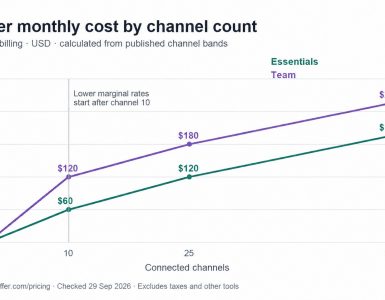
A $1,200 monthly quote and a $4,500 monthly quote can both be labeled "social media management." They are rarely selling the same job.
One provider may be offering scheduled posts built from existing assets and a light approval process. Another may be pricing in channel strategy, original design, short-form video, comment moderation, paid campaign support, reporting, and regular client calls. If you compare fees without comparing scope, you risk buying a cheaper service that still leaves your team doing half the work.
What basic, mid-tier, and full-service usually mean
A useful way to evaluate pricing is to ask what level of ownership you are outsourcing. According to EmberTribe's breakdown of social media marketing packages, full-service social media management costs $3,000 to $5,000 per month and typically includes 25 to 40 posts across 4 to 5 platforms with custom content. In the same analysis, basic packages at $500 to $2,000 per month usually cover 8 to 12 template-based posts across 1 to 2 platforms.
The difference is not just how much gets posted. It is who is doing the thinking, the production, and the follow-through.
- Basic packages usually cover presence maintenance. They fit businesses that already have solid messaging and creative assets, and mainly need content published on schedule.
- Mid-tier retainers often add campaign planning, better creative support, and reporting that helps with decisions instead of just filling a slide deck.
- Full-service engagements function more like an outsourced social team. You are paying for judgment, production capacity, and channel management, not just output.
That distinction matters because many companies do not need full replacement. They need selective support. In practice, that often means outsourcing the work that requires people, then using automation tools such as EvergreenFeed to keep repeatable publishing work efficient and lower the total labor bill.
Where the money actually goes
Social media fees are mostly labor costs shaped by workflow complexity.
If the provider is creating custom graphics, writing channel-specific copy, editing video, coordinating approvals, monitoring comments, and reviewing performance each month, the price rises fast because the hours rise fast. If the service relies on templates, reused assets, limited engagement, and simple scheduling, the price comes down for a reason.
Here is where scope usually changes the bill:
| Cost driver | Lower-cost setup | Higher-cost setup |
|---|---|---|
| Content | Templates and repurposed assets | Custom design, photography, short-form video |
| Strategy | Light planning | Ongoing campaign development and channel direction |
| Engagement | Limited monitoring | Active community management |
| Reporting | Basic analytics | Revenue-oriented analysis and review |
| Paid social | Not included or minimal | Ad creation, testing, and campaign management |
Cheap pricing often means the provider removed time-intensive work such as creative development, approvals, audience response, or strategic review.
That is not automatically a bad deal. It is a bad deal when the quote suggests one level of service and delivers another.
If you want a broader lens on how agencies structure retainers, project fees, and scope-based pricing, 925 studios on agency pricing offers a useful comparison model that applies well beyond UX.
What clients often get wrong
The most common mistake is buying deliverables when the business problem requires ownership.
A local firm that only needs to stay active and look credible may be fine with a lighter package plus scheduling software. A brand launching products regularly, managing paid campaigns, and fielding customer questions usually needs more hands-on support. Those are different operating models, so they should not share the same budget expectations.
The smarter decision is to match spend to the job. Use a service for the work that depends on expertise and response time. Use tools and automation for repeatable publishing tasks. That middle-ground approach often gives businesses better coverage without paying a full-service retainer for work that software can already handle well.
How to Choose the Right Provider for Your Business
Most hiring mistakes happen before the first proposal arrives. Businesses start by asking who's affordable, who has a polished website, or who posted a strong-looking reel. Those are weak filters. Start with fit.

Define the business job first
A provider can't solve a vague problem. “We need help with Instagram” isn't a useful brief. A better brief sounds like this: we need consistent publishing, stronger creative for product launches, faster response handling, and reporting tied to qualified inquiries.
Write down three things before you speak to anyone:
- Primary business goal: awareness, lead generation, sales support, retention, recruiting, or customer education
- Internal constraints: weak design capacity, delayed approvals, no in-house copywriter, limited founder time
- Decision limits: budget range, required channels, and how much collaboration your team can realistically handle
That list eliminates a surprising number of bad-fit providers.
Evaluate their operating model
Not all agencies or freelancers work the same way. Some are strategy-led. Some are design-led. Some are really schedulers with a nice deck.
Here's what to assess during review:
| Evaluation point | What to look for | Red flag |
|---|---|---|
| Industry understanding | They understand your buyer, sales cycle, and compliance limits if relevant | They pitch the same content formula to every business |
| Portfolio depth | Work shows range across formats, not just attractive graphics | Portfolio is all style and no evidence of business thinking |
| Communication style | Clear meeting rhythm, approval process, and escalation path | Vague on who replies, when, and how often |
| Team structure | You know who creates, reviews, and manages the account | Senior person sells, junior team disappears into the background |
A provider should be able to explain their process in plain language. If they hide behind jargon, they probably don't have a strong process.
Test judgment, not just creativity
A pretty feed can still be commercially weak. Ask how they handle low-performing content, delayed approvals, negative comments, and sales-heavy periods when every internal stakeholder wants to push promotions at once.
Good partners make trade-offs visible. They'll tell you when a platform deserves less attention, when your approval chain is too slow, or when your internal content supply is the actual constraint.
A pilot project is often smarter than a long contract right away. You'll learn more from a short working period than from a polished pitch deck.
Key Questions to Ask Potential Social Media Managers
Most discovery calls are too soft. The client asks what's included, the provider talks about creativity and engagement, and nobody gets to the hard part: how the work will run. Better questions expose competence quickly.
Ask questions that reveal thinking
A strong interview doesn't ask for promises. It asks for process, judgment, and accountability.
| Category | Question to Ask |
|---|---|
| Strategy | How would you translate our business goals into channel priorities and content themes? |
| Strategy | What would you stop doing first if our current social activity is wasting time? |
| Strategy | How do you decide whether a platform deserves active investment or just basic maintenance? |
| Content Process | Who creates the content, and what parts depend on our team to provide source material? |
| Content Process | How do you handle approvals when stakeholders disagree or respond late? |
| Content Process | How far in advance do you plan content, and how do you make room for timely posts? |
| Community Engagement | Who monitors comments and messages, and what gets escalated back to us? |
| Community Engagement | How do you handle complaints, sensitive comments, or customer service issues in public threads? |
| Community Engagement | What response boundaries do you set so the brand stays consistent? |
| Reporting and KPIs | What metrics would you track for our specific business goal, and why those metrics? |
| Reporting and KPIs | How do you distinguish between healthy engagement and empty activity? |
| Reporting and KPIs | What would you expect to learn in the first reporting cycle, even if performance is still early? |
Listen for specifics in the answer
The quality of the answer matters more than the answer itself.
A capable provider usually does three things well:
- They define responsibility clearly. You know what they own and what still sits with your team.
- They explain trade-offs. They don't pretend every platform, format, and campaign can get full attention at once.
- They speak in business terms. They connect publishing, engagement, and reporting to lead flow, sales support, customer trust, or retention.
A weak provider usually defaults to generic language. They talk about “brand growth,” “viral content,” or “community building” without showing how those ideas become a repeatable workflow.
If a provider can't explain how they'll handle approvals, feedback, and reporting, they're not describing a service. They're describing optimism.
One more practical note. Ask who attends the monthly review and who does the day-to-day work. Those are often different people, and that gap can define the entire client experience.
Streamlining Your Strategy with Automation
A common outsourcing mistake looks like this. The business hires an agency to keep posts going, then pays agency rates for work that is mostly scheduling, reposting, and filling a calendar. That setup gets expensive fast.

Automation gives you another option. You can keep human attention on creative direction, campaign decisions, community management, and performance review, while software handles the repeatable publishing layer.
That middle ground works well for teams that already know their message and have a backlog of usable content, but do not want to spend skilled hours manually re-queuing the same assets every month.
What automation should handle
Automation fits content with a long shelf life. Blog posts, case studies, testimonials, product education, FAQs, and clips pulled from existing assets are strong candidates because their value does not disappear after one week.
The operational split is simple:
- Routine distribution: recurring posts that maintain visibility and keep proven content in circulation
- Active marketing: launches, offers, reactive content, partnerships, customer conversations, and anything that depends on timing or judgment
Used this way, automation reduces low-value labor. It also changes the outsourcing decision. A business may not need a broad monthly retainer if the ongoing need is mostly consistent publishing of evergreen material.
Where tools fit into the stack
The strongest setups are not tool-only and not agency-only. They combine software with clear human ownership.
A practical model usually looks like this:
- A scheduling system manages queueing and publishing.
- A simple approval process controls what enters the queue and how often each content type runs.
- A marketer, freelancer, or agency handles campaign ideas, platform-specific creative, replies, and monthly review.
Teams considering that model should study social media automation workflows before they buy more service hours. The goal is not to automate everything. The goal is to remove repetitive execution so paid expertise goes toward work that can change revenue, lead quality, or customer trust.
One example is EvergreenFeed, which automates evergreen scheduling through Buffer by organizing posts into buckets and publishing them on preset schedules. For brands with a useful content library, that means less manual reposting and a steadier baseline presence.
Some categories need more specialized tools. Brands that publish high-volume humor or trend-driven creative may also review automated meme posting tools if that format is part of their content model.
Automation removes repetition. It does not replace judgment.
That trade-off matters. Software can keep your channels active and organized, but it cannot decide which offer deserves promotion, how to respond when sentiment shifts, or when a campaign needs a different angle. Use automation to lower production drag, then put human time where it earns its keep.
Defining Success with KPIs and Service Level Agreements
A social media vendor relationship gets easier when expectations are written down early. That's where a service level agreement matters. In practice, an SLA defines the working rules: deliverables, approval timelines, communication cadence, response expectations, escalation paths, and who owns what.
Without that structure, small issues become recurring friction. Posts sit in review. Messages go unanswered because both sides assumed the other was watching. Reports arrive, but nobody agreed on what success should look like.
Use KPIs that connect to business outcomes
The most useful KPIs depend on the job you hired the provider to do. If social is meant to support demand generation, track indicators tied to site visits, inquiry quality, or conversion actions from social traffic. If the job is customer support and brand trust, response quality and issue resolution matter more than raw reach.
Avoid building the relationship around vanity metrics alone. Likes and follower counts can be directionally interesting, but they don't tell you enough on their own.
A stronger reporting conversation asks:
- what business objective each content stream supports
- what user action you want social traffic to take
- what changed this month, and why
- what the provider will adjust next
For a practical framework, this guide to social media key performance indicators helps anchor measurement to actual business goals instead of surface-level activity.
When social media management services are working well, they stop feeling like a black box. You know what the team is doing, why they're doing it, and how the work connects to commercial outcomes.
If your team is stuck between doing everything manually and paying for a larger retainer than you need, EvergreenFeed can cover the repetitive side of evergreen scheduling so your time goes to strategy, campaigns, and customer engagement instead of rebuilding the same posting queue every week.

 Leiann