James
James
Think of social media guidelines as your brand's official rulebook for the internet. It’s a document that lays out exactly how your company and its employees should present themselves and interact online. This isn't just about control; it's about providing a clear roadmap that protects your reputation, keeps you on the right side of the law, and gives your team the confidence to engage.
Why Your Business Needs Social Media Guidelines
Jumping into social media without a plan is like sailing without a compass—you might be moving, but you're probably headed for trouble. Every single post, comment, and share shapes how the world sees your brand. One wrong move can easily snowball into a full-blown PR nightmare.
And with the lines between our personal and professional lives becoming increasingly fuzzy online, employees can find themselves in tricky situations without any guidance. This is where a clear set of social media guidelines becomes a lifesaver. The goal isn't to micromanage your team, but to empower them. By setting clear boundaries, you give them the freedom to be authentic online while still reflecting your company's core values.
The Core Purpose of a Social Media Policy
Your guidelines are both a protective shield and a strategic map. They’re designed to create a consistent, safe space for your brand to grow its online community. And in today's world, that's more important than ever.
By 2025, it’s predicted that over 5.4 billion people will be using social media, spending around 141 minutes a day on an average of seven different platforms. That's a massive, and sometimes chaotic, arena. A structured policy is your best defense against the unpredictability of it all.
Ultimately, these guidelines boil down to a few key benefits:
- Protect Your Brand Reputation: They stop off-brand messages, inconsistent tones, and inappropriate posts from damaging the trust you’ve built with your audience.
- Ensure Legal and Regulatory Compliance: A good policy helps you steer clear of legal hot water related to confidentiality, copyright infringement, and other industry rules.
- Empower Employees: When the rules are clear, there’s no guesswork. Your team can confidently step into their roles as brand advocates.
- Maintain a Consistent Brand Voice: A unified voice makes your brand more recognizable and builds a stronger identity across all your channels.
A well-crafted policy is an essential piece of any successful small business social media strategy, helping you turn online risks into real opportunities for connection.
Key Components of Effective Social Media Guidelines
A solid set of social media guidelines is much more than a simple list of "dos and don'ts." It's the playbook that protects your brand, guides your team, and sets the stage for how you show up to the world online. Without it, you’re just winging it, and that’s a risky game to play.
Every piece of the puzzle matters. From nailing your brand's personality to knowing exactly what to do when a crisis hits, each component works together to build a smart, secure social media strategy.
This infographic breaks down how the three pillars—Brand, Legal, and Team—are the bedrock of any good policy.
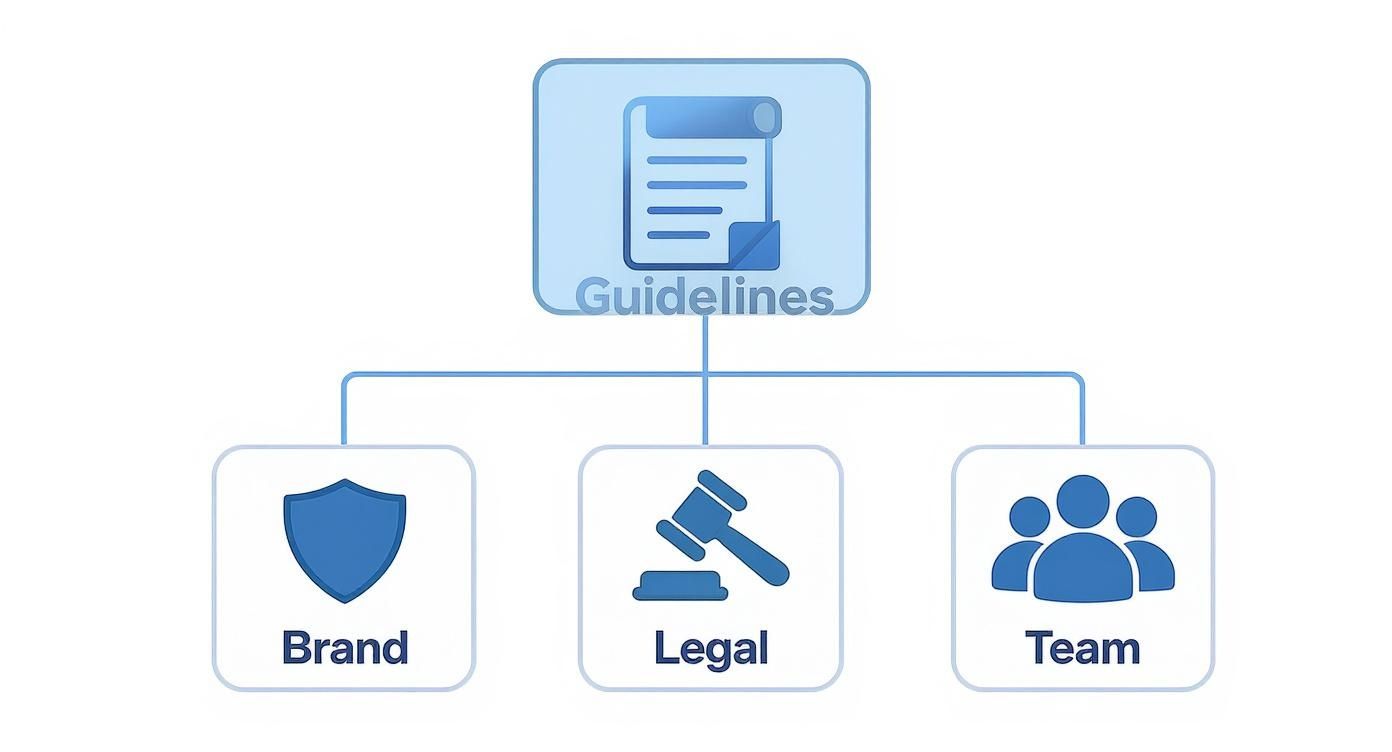
As you can see, a successful strategy needs to find the sweet spot between protecting the brand, staying on the right side of the law, and giving your people clear directions.
Defining Your Brand Voice and Tone
Think of your brand's voice as its personality. Are you quirky and fun, serious and authoritative, or warm and inspiring? Your tone is how that personality adapts to different situations. Your guidelines need to spell this out clearly so your brand sounds like itself everywhere, whether you're celebrating a big win or handling a customer complaint.
For instance, a brand known for its humor on one platform still needs to shift its tone to be empathetic and helpful when a customer has a problem. Defining these nuances is what stops your brand from feeling disjointed or robotic.
Outlining Roles and Responsibilities
When nobody knows who’s in charge, things fall through the cracks. Your guidelines must get specific about who does what. Who has the keys to the official accounts? Who gives the final green light on content? Who’s on the front lines responding to DMs and comments?
Leaving no room for confusion, you should clearly define roles like:
- Content Creators: The folks responsible for writing posts, designing graphics, and making sure everything aligns with the brand voice.
- Content Approvers: Managers or leads who have the final say before anything is published.
- Community Managers: The people who directly engage with your audience, answer questions, and manage the conversation.
This structure creates clear ownership, smooths out your workflow, and prevents rogue posts or missed opportunities to connect with your audience.
Setting Rules on Confidentiality and Security
One of the biggest landmines in social media is the accidental leak of private information. Imagine an employee excitedly posting a sneak peek of a product that hasn't been announced yet—the fallout could be huge. This is why strong social media rules are a critical part of building a modern ethics and compliance program.
Your policy must be crystal clear: sharing confidential company information is strictly off-limits. This includes things like internal sales numbers, future product details, or private customer data.
It's also the place to mandate basic security hygiene, like requiring strong passwords and two-factor authentication for all official accounts. These rules aren't about policing your team; they're about protecting your company's assets, your customers' privacy, and ultimately, everyone's job.
Balancing Personal and Professional Social Media Use
In today's world, the line between who we are at work and who we are online has all but disappeared. An employee's personal social media account can be a huge asset for genuine brand advocacy, but let's be honest—it's also one of the biggest potential landmines for a company's reputation. This is exactly why your social media guidelines need to be crystal clear.
The real trick is finding that sweet spot between encouraging authentic personal expression and protecting the business. A post that seems innocent enough—maybe an employee venting after a long day or sharing a strong opinion on a hot-button issue—can spiral into a public relations nightmare in a matter of hours if it gets tied back to your brand.
This isn't a small problem. The scale is staggering. As of October 2025, there are roughly 5.66 billion social media user identities around the globe. That number is climbing by nearly eight new users every single second. With an audience that massive, a single post can have an unbelievable reach, making clear employee rules an absolute must. You can dig deeper into these numbers with the global social media user data on datareportal.com.
Setting Clear Boundaries for Personal Accounts
To cut through the confusion, your guidelines need to offer simple, practical advice. The goal isn't to control your team's personal lives; it's to draw a clear line where their professional responsibility kicks in.
A great place to start is clarifying how employees should (or shouldn't) identify themselves as part of your company. The moment they list your business in their bio, they’re connecting their personal content directly to your brand image.
To keep everyone safe, your policy should clearly address these points:
- A Simple Disclaimer: Require employees who mention their job to add a quick disclaimer to their bio, like "Opinions are my own" or "Views expressed are personal." It's a simple step that creates a bit of separation.
- Keep Secrets Secret: Be explicit. Sharing confidential company info, client details, or upcoming projects on personal social media is a major policy violation. No exceptions.
- Professional Conduct: Remind employees to steer clear of online arguments or posting content that could be seen as hateful, discriminatory, or unprofessional. That kind of behavior can splash back on the company.
The core idea you want to get across is simple: "When you publicly link yourself to our company, you're acting as an ambassador. Please represent us well, even on your own time."
Empowering Employees as Advocates
While rules and boundaries are important, the best guidelines are about empowerment, not just prevention. Your team can be your most authentic and powerful marketing channel, but they need to feel supported and confident to step into that role. Good guidance transforms potential risks into amazing opportunities.
Instead of just listing what they can't do, give them clear ideas of what they can do. Encourage them to share company blog posts, post about team successes, or weigh in on industry news. This is especially true on platforms like LinkedIn, where professional interactions matter. For more on that, check out our guide to mastering LinkedIn etiquette.
When you take this approach, you stop seeing your team as a liability and start seeing them for what they are: a powerful network of genuine brand advocates.
Learning from Real-World Social Media Policies
https://www.youtube.com/embed/4dJ16WcfclY
Theory is great, but there's nothing like seeing how the pros do it. The best way to understand what makes a social media policy truly work is to look at examples from brands you already know. Seeing how different companies and industries tackle the same basic challenges will help you figure out what makes sense for your own organization.
Take a company like Intel. They live and breathe in a fiercely competitive tech world where trade secrets are everything. Their guidelines have to walk a very fine line: they need to empower their brilliant experts to act as brand ambassadors while building an iron-clad fortress around confidential information.
This screenshot from Intel's own social media guidelines shows how they kick things off with a clear, positive set of principles.
See how the focus is on being transparent, thoughtful, and responsible? This isn't about telling people what they can't do. It's about framing the rules as professional standards for representing the brand in the best possible light.
Comparing Different Industry Approaches
What works for a tech giant won't necessarily fly for a news outlet or a retail company. Every organization has to tailor its policy to its own unique risks and goals. It can even be helpful to look at how broader company documents, like general terms and conditions, set expectations for acceptable behavior.
Let's look at a couple of different flavors:
- The Associated Press (AP): For a news organization, journalistic impartiality is the holy grail. The AP’s guidelines are famously strict, advising journalists to avoid sharing political opinions online so they don't damage their credibility. Here, the focus is all about brand protection through absolute neutrality.
- Adidas: A massive consumer brand like Adidas has a totally different goal. Their policy is designed to empower employees to be passionate advocates. They give their team the tools and trust to share their love for the brand, focusing on employee advocacy to connect with customers and boost sales.
Looking at these examples, a clear spectrum emerges. At one end, you have tight, risk-averse policies built around control. At the other, you find open, trust-based guidelines designed to turn employees into your best marketers.
Finding Your Policy's Personality
At the end of the day, your social media guidelines should feel like a natural extension of your company culture. A laid-back creative agency would probably laugh at a rigid, corporate-style policy. It just wouldn't work. On the flip side, a financial firm needs a much more buttoned-up approach to stay on the right side of heavy regulations.
So, ask yourself: What's our main goal? Is it to prioritize control and consistency, or do we want to encourage authenticity and advocacy? Your answer will tell you exactly where you fall on that spectrum between the AP and Adidas. The trick is to build a policy that feels right for your team while still managing your specific risks.
How to Implement and Maintain Your Guidelines

You’ve done the hard work and created a solid set of social media guidelines. That’s a huge step, but the document itself doesn’t change anything. The real test is turning those words on a page into a living, breathing part of your company culture.
Think of it this way: without a clear rollout plan, your shiny new guidelines will just gather digital dust. The goal is to make sure everyone—from the newest intern to the CEO—understands how to represent the brand online.
Launching Your Social Media Policy
Just sending a company-wide email with a PDF attachment and calling it a day is a recipe for failure. A proper launch is more like an internal marketing campaign where your goal is to get everyone on board and genuinely invested.
Here’s a simple checklist to get you started:
- Get Leadership Onboard: This is non-negotiable. If your leadership team openly supports and champions the guidelines, everyone else is far more likely to take them seriously.
- Run Team Training Sessions: Don't just tell people to read the document. Host mandatory workshops where you can walk through the key points, discuss real-world scenarios, and open the floor for questions.
- Bake It Into Onboarding: The best time to set expectations is right at the start. Make reviewing and understanding the social media policy a standard part of your new hire orientation.
Getting these initial steps right builds a strong foundation. For more tips on this, check out our guide on how to create standard operating procedures that people actually follow.
Keeping Your Guidelines Relevant
Social media never stands still. New platforms emerge, features change, and audience behaviors shift constantly. Your guidelines can't be a "set it and forget it" document; they need to evolve, too.
The most effective social media guidelines are dynamic. Schedule a review at least once a year—or more frequently if a new platform gains traction or a major incident occurs—to ensure they still meet your needs.
This is critical because the social media world looks different everywhere. For example, in 2025, estimates show that while nearly 97% of the connected population in Eastern Asia uses social media, that number is only around 30% in Middle Africa. Global differences like these shape how platforms operate and what's considered normal, which is exactly why your guidelines need to stay current. You can explore more insights about the global state of digital on wearesocial.com.
By actively maintaining your policy, you’re ensuring it remains a useful tool that protects your brand and guides your team through whatever comes next.
Got Questions About Social Media Guidelines? Let's Answer Them.
Even the most thoughtfully crafted set of social media guidelines will spark questions. That’s a good thing! It means your team is actually reading them and thinking about how to apply them in the real world.
Let's walk through some of the most common questions that pop up when rolling out a new social media policy. Getting these answers right from the start can make a huge difference.
How Often Should We Update Our Social Media Guidelines?
The simple answer? Probably more often than you think. Social media moves fast—new platforms explode in popularity, features get added or removed overnight, and what’s considered normal online behavior is always shifting. A policy you wrote when Facebook was king might be completely useless for navigating the world of TikTok or Threads.
Think of your social media guidelines as a living document, not something carved in stone. A good baseline is to schedule a full review at least once a year. But you also need to be nimble enough to make updates on the fly when something big happens, like a new app taking over or a new type of online risk popping up.
What’s the Biggest Mistake Companies Make with These Policies?
Hands down, the most common blunder is creating a policy that's either way too strict or terribly communicated. If your rules are too restrictive, you'll suffocate the very creativity and authenticity you want to encourage. Employees will be too scared to post anything, and your employee advocacy program will be dead on arrival.
But even a perfect policy is worthless if nobody knows it exists or understands what it means. Just attaching a PDF to a company-wide email and calling it a day is a classic mistake. The real failure is not providing proper training and ongoing conversation to make the guidelines feel real and relevant to your team.
How Can We Actually Get Employees to Follow the Rules?
This isn't about policing your team's every move. Creating a culture of fear where people second-guess every single post is a recipe for a bland, disengaged online presence. It completely backfires.
Instead, the goal is to build a sense of trust and shared ownership. Try focusing on these positive approaches:
- Clarity is Kindness: Keep your rules simple, direct, and easy to digest. When people know exactly what you’re asking of them, they’re far more likely to get on board.
- Show, Don't Just Tell: Leadership needs to walk the walk. When your executives are active on social media and following the guidelines themselves, it sends a powerful message to everyone else.
- Celebrate the Wins: When you see an employee doing an amazing job representing the brand online, shout them out! A little public recognition goes a lot further than a slap on the wrist.
By making it about education and encouragement, following the guidelines becomes a natural part of a strong company culture, not just another rule to follow.
Ready to keep your social channels consistently active without the daily grind? EvergreenFeed automates your evergreen content scheduling, saving you hours every week. Sign up for free and start automating today!