James
James
Social media copywriting is more than just writing captions. It’s the art and science of using words to stop someone mid-scroll, make them feel something, and nudge them to act—whether that's to comment, click, or buy. Think of it as crafting short-form content that punches above its weight, sparking conversations and turning followers into genuine fans.
Building Your Foundation for High-Impact Copy

Before you even think about writing a headline or a call to action, you need to lay the groundwork. The best social media copy isn't born from cleverness alone; it's built on a solid strategic foundation that understands why people connect with brands in the first place. When done right, it feels less like a sales pitch and more like a real conversation.
This foundational work is what separates content that gets lost in the noise from copy that drives actual business results. It all boils down to two things: defining a crystal-clear brand voice and deeply understanding the people you’re talking to. Skip this step, and even the most creative copy will fall flat.
Defining Your Authentic Brand Voice
Your brand voice is essentially your brand's personality, brought to life through words. If your brand were a person, how would it speak? Is it witty and a bit mischievous, or is it more thoughtful and professional?
Consistency here is everything. It builds trust and makes your brand instantly recognizable in a crowded feed. Just look at Wendy's on X (formerly Twitter)—their sassy, humorous tone is worlds away from the authoritative, insightful voice of a brand like IBM on LinkedIn. Both work perfectly because they're consistent and true to who they are.
To nail down your own voice, it helps to break it down into its core components.
Here’s a simple framework to get you started:
Core Components of a Social Media Brand Voice
| Component | Description | Example |
|---|---|---|
| Personality | The key traits of your brand. Pick 3-5 adjectives that feel right. | Energetic, Quirky, Supportive |
| Tone | How your personality adapts to different situations. | Excited for a product launch, Empathetic for customer support. |
| Vocabulary | The specific words you use and, just as importantly, those you avoid. | Do use: "community," "you're," "awesome." Don't use: "synergy," "utilize." |
| Purpose | The "why" behind your communication—what do you want people to feel? | To inspire creativity, to feel empowered, to simplify a complex topic. |
Having this level of detail is a game-changer for creating a powerful content strategy for social media. It gives you and your team a clear guide, ensuring every single post feels like it comes from the same place.
Understanding Your Audience on a Deeper Level
Great copy speaks directly to a person's needs, fears, and dreams. To get there, you have to go beyond surface-level demographics like age and location. The real magic is in the psychographics—what they value, what keeps them up at night, and what problems they're desperately trying to solve.
For instance, knowing your audience is "millennial homeowners" is a start, but it's not enough. Digging deeper might reveal they are "first-time millennial homeowners who feel totally overwhelmed by DIY projects and are terrified of making a costly mistake." That specific insight is a goldmine for writing copy that truly hits home.
The most powerful copy doesn't just describe a product; it reflects the customer's problem back to them so clearly that they feel completely understood.
This is how you write copy that doesn’t just get a few likes, but actually makes someone stop and think, "Wow, they get me." It positions your brand not just as a product, but as the solution they’ve been looking for.
Tying It All Together for Impact
Think of your brand voice and your audience insights as the two pillars holding up your entire social media strategy. Once you have this clarity, you can create content that is both authentic to your brand and genuinely valuable to your audience. This strategic shift is why the global copywriting market is projected to skyrocket from USD 27.96 billion in 2025 to USD 42.83 billion by 2030. Brands are moving beyond simple awareness and focusing on performance-driven content that connects and converts.
To get your creative juices flowing, you can explore some top social media content ideas designed for engagement. By grounding your creative work in this strategic foundation, every post you write will serve a clear purpose, turning your social media channels into a reliable engine for growth.
Writing Hooks That Stop the Scroll
Think of the social media feed as a fast-moving river. If your first sentence doesn't immediately hook your reader, your entire message gets swept away, unseen. That opening line is everything—it’s your one chance to break through the noise and stop the mindless scroll.
Your goal is to be a pattern interrupt. People are flicking through dozens of posts a minute, their brains on autopilot, filtering out anything that looks like the same old stuff. You have to jolt them out of it with an opening that’s unexpected, intriguing, or hits them right where they live.
Master the Art of the Curiosity Gap
One of the most powerful tools in a copywriter's kit is the curiosity gap. It’s a simple psychological trick: you hint at an interesting story but deliberately leave out the most important part. The human brain hates an open loop and feels a natural urge to find the missing piece, which pulls them right into your copy.
Instead of just laying out the facts, you create a little mystery. This small change can take a snooze-worthy statement and make it absolutely magnetic.
- Before: "We increased our client's web traffic by 300% using a new content strategy."
- After: "Our client fired their old marketing agency after seeing the results of one simple content trick."
See the difference? The second one immediately makes you wonder, "What was that trick?" And just like that, you’ve earned their attention for the next sentence.
Ask Questions That Demand an Answer
Asking a question is another classic hook for a reason: it works. When someone reads a question, their brain instinctively starts to formulate an answer. This simple act engages them with your content before they've even made a conscious decision to read it.
The trick is to ask questions that are either provocative or deeply relatable to your target audience. A productivity app, for instance, might open with something like this:
"Ever get to the end of the day feeling like you were busy but got nothing done?"
This question hits on a universal pain point. It forces the reader to pause and think about their own life, creating an immediate personal connection and making them eager to hear your solution.
Make a Bold and Contrarian Statement
Sometimes the best way to get noticed is to swim against the current. A bold, contrarian statement shatters the user's scrolling pattern because it challenges what they think they know. It makes them stop and say, "Wait, what?"
Here are a couple of examples:
- "Everything you know about building an email list is wrong."
- "Stop setting goals. Do this instead to actually achieve what you want."
These hooks are powerful because they’re provocative. They create a healthy dose of tension and promise a perspective that the reader hasn't heard before. This is a fundamental part of creating compelling copy, as it makes people sit up and pay attention. For a deeper dive, check out our guide on how to write engaging content.
Whatever hook you choose, remember to keep it tight. In fact, research shows that posts with 80 to 100 characters often receive 66% higher engagement rates. Getting straight to the point is absolutely essential for grabbing and holding attention in a crowded feed. You can find more data on this in a recent 2025 industry report. Get the hook right, and the rest of your copy has a fighting chance.
How to Tailor Your Social Media Copy for Each Platform
If you're just copy-pasting the same message across all your social media channels, you're making a huge mistake. It’s like wearing a tuxedo to a pool party—the message just doesn't land because the context is completely off. To get real results, you have to speak the unique language of each platform.
What works on LinkedIn, like a detailed case study, will die a slow death on TikTok. Thinking you can use one message for all channels is a surefire way to get zero engagement. The trick is to become a master translator, fluent in the distinct dialects of Facebook, Instagram, X, and all the rest.
Instagram and Facebook: Keep it Conversational and Community-Focused
There's a reason marketers flock to Facebook and Instagram. A recent 2025 industry report showed that 89% prioritize Facebook and 80% use Instagram more than any other platform. Why? Because they are massive communities built on personal connection. Your copy here needs to feel like a conversation with a friend, not a broadcast from a corporation.
On these two platforms, storytelling is your secret weapon.
-
For Instagram: Your first line is everything. Hook them immediately before the "read more" cutoff hides the rest of your caption. I always use emojis to inject some personality and strategically place line breaks to make the text easier to scan on a small screen. Your tone can be funny, educational, or inspiring, but it must match your visual.
-
For Facebook: You've got a little more breathing room here, so don't be afraid to go longer. Think of it as a space for mini-blog posts, detailed event promotions, or questions designed to get people talking in the comments. The goal is to start a real dialogue and get people to share.
LinkedIn: The Professional Value Exchange
Let's be clear: people are on LinkedIn for a reason—to grow their careers, get industry insights, and connect with other professionals. Your copy has to respect that. Anything that sounds too salesy or overly casual will get scrolled past in a heartbeat.
The name of the game on LinkedIn is establishing yourself as an expert.
Every post should immediately answer your reader's silent question: "What's in this for me and my career?" Give them a unique take, a practical tip, or a piece of data they can actually use.
Think of it as a value exchange. Did you learn a hard lesson from a recent failure? Share it. Can you break down a complicated industry trend into simple terms? Do it. A professional-yet-approachable tone is key. Show them you know your stuff.
No matter the platform, you need a strong hook. These three concepts are a great place to start when you need to grab someone's attention right away.
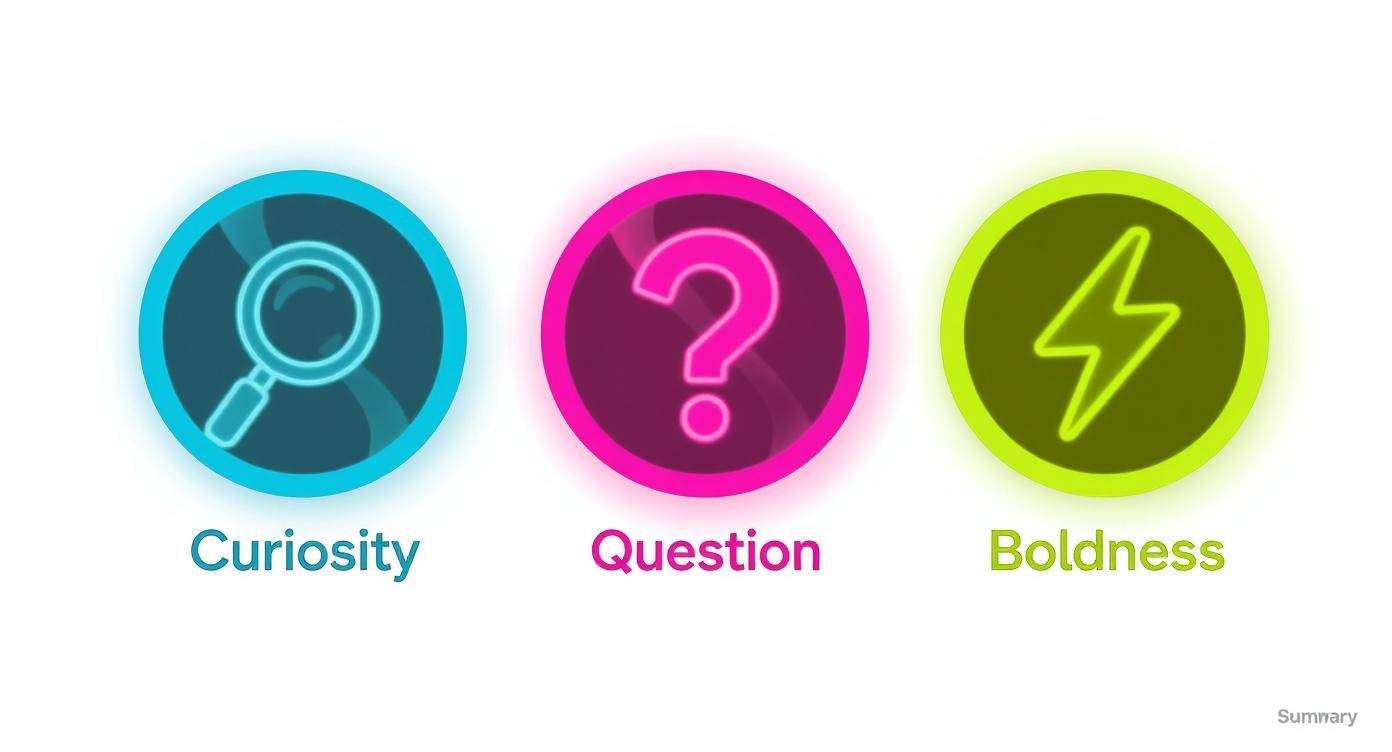
Whether you lead with a fascinating fact, a direct question, or a bold claim, your opening line is what earns you the right to their attention.
X and TikTok: Be Quick, Punchy, and In-the-Know
If LinkedIn is a professional conference, then X (what we all still call Twitter) and TikTok are a loud, chaotic, and hilarious party. You have to be quick on your feet. Brevity isn't just a suggestion; it's a requirement.
-
On X: Every character matters. This is the place for witty one-liners, breaking news alerts, quick polls, and jumping into trending conversations with the right hashtags. The vibe is informal, direct, and fast-paced.
-
On TikTok: Here, the copy supports the video, not the other way around. Keep your on-screen text and captions minimal and to the point. The goal is to add context or a punchline. Using trending sounds and relevant hashtags is non-negotiable for getting seen. Your writing should feel completely native to the platform—casual, funny, and direct.
To make this even easier, here’s a quick cheat sheet I use to keep my copy aligned with the right platform.
Social Media Platform Copywriting Cheat Sheet
| Platform | Optimal Tone | Ideal Length | Key Focus |
|---|---|---|---|
| Conversational, Community-driven | Medium to Long (100-250 words) | Storytelling, Sparking Dialogue | |
| Visual, Aspirational, Personal | Short to Medium (under 125 characters is best) | Strong Hooks, Emojis, Readability | |
| Professional, Authoritative, Helpful | Medium (150-200 words) | Providing Value, Building Credibility | |
| X (Twitter) | Witty, Timely, Concise | Very Short (under 280 characters) | Brevity, Joining Trends, Quick Hits |
| TikTok | Informal, Humorous, Trend-aware | Minimal (caption supports the video) | Enhancing Visuals, Hashtag Strategy |
Remember, adapting your copy isn't just about tweaking a few words. It's about shifting your entire mindset to match how users behave on each network. When you speak their language, you stop shouting into a void and start having real conversations that build your brand.
Crafting Calls to Action That Drive Results

You've hooked your audience and delivered a great message. Now what? This is the moment where so much social media content falls flat. Every single post you publish needs a purpose, and a powerful call to action (CTA) is what turns a passive scroller into an active customer or fan.
Without a clear CTA, even the most brilliant copy is just words floating in the feed. A great call to action doesn't just tell people what to do; it gives them a compelling reason to do it now. It's the essential final step that bridges the gap between seeing your content and taking a meaningful action.
Match Your CTA to Your Goal
Not all CTAs are created equal, and they shouldn't be. The most effective ones are laser-focused on the specific goal of your post. Are you trying to get more comments, send people to your blog, or make a sale? Your answer completely changes the kind of action you ask for.
- For Engagement: This is all about starting a conversation. Ask a question, encourage them to tag a friend, or start a friendly debate. For example: "What's the one productivity hack you can't live without? Drop it in the comments! 👇"
- For Traffic: Your goal is a click, so be direct and promise value. Something like: "Ready to master your morning routine? Grab our free checklist at the link in bio."
- For Sales: Make the ask clear and highlight the immediate benefit. A little urgency can work wonders here. For instance: "Our flash sale ends tonight! Shop now and get 25% off your entire order."
Don't confuse your audience. If you share a heartfelt story about your brand's mission, a hard-sell CTA like "Buy Now!" feels jarring and out of place. A softer ask, like "Learn more about our story on the blog," is a much better fit for the post's tone.
The best CTAs feel like a natural next step, not a demand. They should be the logical and helpful conclusion to the value you've just provided in your post.
The rise of social commerce makes this more critical than ever. Purchases made directly on social platforms are projected to hit a staggering $1 trillion globally by 2028. This incredible growth shows why persuasive copy and crystal-clear CTAs aren't just nice-to-haves anymore—they're essential for driving real revenue.
Reduce Friction and Create Urgency
Two of the biggest conversion killers are friction and procrastination. Your job is to make it incredibly easy for your audience to act right now.
First, reduce friction by being ridiculously specific. Don't just say, "Check out our website." Instead, guide them with precise instructions: "Tap the link in our bio to read the full guide." You're removing the guesswork. The more brainpower someone has to use to figure out what you want, the less likely they are to do it.
Next, create a sense of urgency. You can do this by using time-sensitive language or highlighting scarcity.
- "Limited spots available"
- "Offer ends Friday"
- "Last chance to grab your spot"
A word of caution: always be honest. Manufacturing fake urgency is a quick way to erode the trust you've worked so hard to build. For a deeper dive into this, check out our guide on what makes a compelling call to action.
By combining a clear, goal-oriented prompt with a low-friction path and a touch of genuine urgency, your social media copy will finally start driving the results you've been looking for.
Using Data to Sharpen Your Copywriting Skills
Truly great copy isn't just about being creative; it’s a science. The best social media copywriters I know don't guess what works—they test, measure, and refine everything based on real data. This is how you separate pretty words from writing that genuinely drives business results.
When you start letting data guide you, you stop relying on gut feelings and start making informed decisions. It transforms your social media from a shot in the dark into a predictable system for growth.
A Practical Guide to A/B Testing Your Copy
A/B testing (or split testing) sounds way more complicated than it is. All you're doing is creating two versions of a post, changing just one thing, and seeing which one performs better. This is your secret weapon for systematically improving your copy.
To get started, focus your tests on the parts of your copy that will have the biggest impact:
- Headlines and Hooks: Pit a question-based hook ("Struggling with productivity?") against a bold statement ("Your to-do list is killing your focus.").
- Calls to Action (CTAs): Compare a direct, no-nonsense CTA ("Shop Now") with one that’s more benefit-driven ("Start Saving Today").
- Tone of Voice: Try a witty, humorous caption for one post and a more straightforward, educational tone for the other, while keeping the core message the same.
The golden rule here is to change only one variable at a time. If you change the headline and the CTA, you’ll have no idea which element was actually responsible for the difference in performance. Keep it clean and simple for clear results.
Moving Beyond Vanity Metrics
Likes and shares feel great, but they don't pay the bills. These are often called "vanity metrics" because they look impressive on the surface but often have little to do with real business impact. To actually sharpen your skills, you need to focus on the numbers that truly matter.
Here are the metrics I always keep an eye on:
- Click-Through Rate (CTR): This is the percentage of people who saw your post and actually clicked the link. A high CTR is a fantastic signal that your copy was compelling enough to make someone take action.
- Conversion Rate: This is the ultimate test. It tracks how many of those clicks turned into a desired action, like a newsletter signup, a download, or a purchase.
- Engagement Rate per Reach: Instead of just looking at raw engagement numbers, divide your total engagements (likes, comments, shares) by your reach. This gives you a much more accurate picture of how engaging your content is to the people who actually saw it.
By focusing on metrics like CTR and conversion rate, you shift your mindset from "Did people like this?" to "Did this work?" This subtle change is the foundation of high-performance social media copywriting.
Analyzing these numbers tells you what your audience truly responds to. Did the emotional hook get more clicks than the data-driven one? Did the simple CTA convert better than the clever one? This feedback loop is what will make you a better writer, faster.
Scaling Success with Smart Scheduling and Repurposing
Once you've identified your top-performing content, it's time to put it to work. You don't need to reinvent the wheel every single day. The smartest strategy is to build a library of proven, evergreen content that you can schedule and repurpose over and over.
This is where tools become your best friend. A platform like Buffer is perfect for organizing and scheduling your posts across all your social accounts.
The dashboard lets you see your entire queue at a glance, making it easy to maintain a consistent presence without living on social media. For an even more hands-off approach, you can connect a tool like EvergreenFeed to automatically re-share your best content, ensuring it's always working for you.
AI is also changing the game, helping us draft copy faster and refine messages with more data. This is creating a huge demand for copywriters who are skilled in both persuasive writing and analytics.
If you really want to get ahead, start exploring the top AI tools for ad copy generation to see how they can help you craft compelling messages. By combining sharp data analysis with smart automation, you can save a ton of time, scale your impact, and build a powerful social media presence that consistently delivers results.
A Few Lingering Questions About Social Media Copywriting
Even with the best templates and a solid strategy, you're bound to run into some tricky situations. Being a great social media copywriter means thinking on your feet. Here are a few of the most common questions that pop up and my straight-up advice for handling them.
Let's get into it.
What Do I Do About Negative Comments?
First, take a breath. Don't immediately hit delete (unless it’s clear spam or genuinely abusive, of course). A negative comment, while stressful, is actually a golden opportunity to show what your brand is made of.
The best move is to respond publicly, but briefly. Acknowledge their frustration with empathy and professionalism, then immediately offer to take the conversation private. Think DMs, email, or a support ticket.
This approach is a win-win:
- It proves you're paying attention. A public reply shows your entire audience that you don’t shy away from criticism and genuinely care about getting it right.
- It stops a public flame war. Moving the nitty-gritty details offline prevents a messy, back-and-forth argument for everyone to see.
A cool, helpful response can honestly turn a frustrated customer into a fan for life. I've seen it happen plenty of times.
Seriously, How Often Should I Be Posting?
This is the million-dollar question, isn't it? The truth is, there's no single magic number. The real key is consistency over sheer frequency.
It’s a thousand times better to post three genuinely valuable pieces of content a week than it is to post ten rushed, mediocre ones just to hit a quota. All that does is burn out your audience (and you!) and tank your engagement.
Start with a pace you know you can keep up with. For most brands, a good starting point looks something like this:
- Facebook: 3-5 times per week
- Instagram (Feed): 3-5 times per week
- X (Twitter): 1-3 times per day (if it's a core platform for you)
- LinkedIn: 2-4 times per week
Then, watch your analytics like a hawk. If your engagement starts to dip, you might be overdoing it. If your audience is eating up everything you post, you can try adding another post to your schedule. Let your data tell you what to do next.
Your ideal posting schedule is whatever allows you to deliver consistent value without killing yourself to create content. Find a sustainable rhythm that works for your brand and your audience, not some arbitrary number you read in a blog post.
How Can I Write Great Copy for a “Boring” Industry?
Let me tell you a secret: there are no "boring" industries. There are only boring ways to talk about them.
The people in your audience, whether they're accountants or asphalt contractors, are still human. They have problems they need to solve, goals they want to achieve, and questions they're dying to ask. Your job is to connect with them, not just talk about your product.
Instead of listing the technical specs of new accounting software, write about the feeling of relief a small business owner gets when tax season is finally stress-free.
Shift your perspective from features to feelings. Tell human stories. Spotlight your customers' wins. Answer the questions they're secretly Googling. Remember, a study found that 33% of people read content just to learn something new. If you can be the one to simplify a complex topic in your "boring" field, your audience will think you're anything but.
Ready to put your best content on autopilot and save hours every week? EvergreenFeed automates your social media scheduling with Buffer, ensuring your top-performing posts are always working for you. Stop the manual grind and start growing your presence effortlessly. Sign up for free and start automating today!