James
James
Think of a social media audit as a complete physical for your brand's online presence. It's how you find out what’s working, what’s a total time-waster, and where your best growth opportunities are hiding. This isn't just about collecting data; it's about turning that data into a real, actionable strategy.
Why a Social Media Audit Is a Game Changer

Let's be real—managing social media can often feel like you're just shouting into the void. You're posting content, keeping an eye on follower counts, and crossing your fingers, but do you really know if any of it is moving the needle for your business? That's the exact uncertainty a social media audit is designed to fix.
Instead of guessing, an audit gives you hard data to back up your decisions. It’s the critical difference between just posting stuff and building a targeted strategy that actually attracts the right audience and gets results.
Moving From Reactive to Proactive
We've all been there: staring at stagnant follower numbers or wondering if that ad budget is actually delivering a solid return on investment (ROI). A local shop owner might post daily specials on Instagram only to see zero change in foot traffic. These are classic signs of a disconnect between effort and outcome.
An audit forces you to take a step back and look at the big picture. This process helps you pinpoint exactly what's going on.
- Your Best Platforms: You’ll see which channels bring in the most engagement and conversions, so you can stop spreading yourself thin and focus your energy where it counts.
- Content That Clicks: You can finally identify the specific post types—whether it's videos, case studies, or behind-the-scenes content—that your audience actually loves.
- Audience Reality Check: You might even discover that your followers' demographics don't line up with your ideal customer profile, which is a massive red flag that your content strategy needs a pivot.
By systematically reviewing your performance, you can stop wasting time on tactics that don’t work and double down on what does. This strategic shift is crucial for maximizing your impact without burning out your team.
Connecting Social Efforts to Business Goals
At the end of the day, your social media presence isn't just about vanity metrics. It’s supposed to support your real business objectives, like generating leads, building brand awareness, or fostering customer loyalty. An audit draws a straight line between your daily posts and those bigger goals.
The social media world is incredibly crowded. With 5.24 billion people projected to be on social media by 2025—spending an average of 2 hours and 20 minutes a day on about 6.8 different platforms—you can't afford to be just another voice in the noise. You can dig into more social media trends to see why this is so critical.
A proper audit cuts through all that clutter. It gives you the clarity to make smarter decisions that drive real, measurable growth, turning your social media from a chore into a powerful business asset.
What Are We Trying to Accomplish Here?
Before you dive headfirst into a mountain of analytics, let’s take a step back. Kicking off a social media audit without a clear goal is like setting sail without a compass—you’ll be busy, sure, but you won't get anywhere meaningful. The first, most crucial step is to define what winning actually looks like for your brand.
This initial groundwork frames your entire audit. Are you trying to pull in more qualified leads? Is the main goal to cultivate a die-hard community around your brand? Or are you just trying to get your name in front of as many eyeballs as possible? Each of these goals points to a completely different set of metrics.
Define Your Goals and KPIs
Let’s get specific. Vague goals like “get more followers” are useless. We need to turn those fuzzy ideas into sharp, measurable objectives. The classic SMART framework (Specific, Measurable, Achievable, Relevant, Time-bound) is your best friend here.
For example, don't just say, "I want better engagement on Instagram." Instead, a SMART goal sounds like this: "Increase our average engagement rate on Instagram posts by 15% over the next quarter by creating more interactive Stories and user-generated content campaigns."
See the difference? Now you're not just looking at data; you're hunting for specific clues that will help you hit that 15% target. If you need more help translating your business objectives into a solid social strategy, our guide on how to create a social media plan is the perfect next step.
A goal without a metric is just a wish. Every objective you set for your social media audit must be paired with a Key Performance Indicator (KPI) that tells you whether you're winning or losing.
To make this crystal clear, here’s how you can connect your bigger business goals to the specific numbers you’ll be tracking in your audit.
Connecting Social Media Goals to Your KPIs
Use this table to translate your business objectives into specific, measurable KPIs for a focused social media audit.
| Business Goal | Example Social Media Objective | Primary KPIs to Track |
|---|---|---|
| Increase Brand Awareness | Grow our reach on Facebook by 20% in Q3. | Reach, Impressions, Follower Growth Rate |
| Generate More Leads | Drive 100 qualified leads from LinkedIn this month. | Clicks on Lead Gen Forms, Conversion Rate |
| Build Community | Boost comment volume on Instagram by 30% next quarter. | Comments per Post, Engagement Rate |
| Drive Website Traffic | Increase click-through rate (CTR) from Twitter by 10%. | CTR, Link Clicks, Website Sessions from Social |
This simple exercise ensures you're not just collecting data for the sake of it—you’re gathering intelligence to drive real business results.
Create a Complete Account Inventory
Alright, with your goals locked in, it’s time for a little housekeeping. You need to create a complete inventory of every single social media profile connected to your brand. It sounds tedious, but trust me, this step almost always uncovers forgotten accounts, impostor profiles, or wildly inconsistent branding.
Your mission is to hunt down every last profile. This includes:
- The Mainstays: Your active, everyday accounts on platforms like Instagram, Facebook, LinkedIn, and X (formerly Twitter).
- The Experiments: That TikTok account someone started last year or the forgotten Pinterest board.
- The Ghosts: Old profiles from past campaigns or created by former employees that are now just floating in the digital ether.
Documenting everything prevents you from missing key data and protects your brand from rogue accounts that could be causing damage without you even knowing it.
Fire up a simple spreadsheet and start logging the essentials for each profile you find:
- Platform Name: (e.g., Facebook, Instagram)
- Profile URL: The direct link to the page.
- Username/Handle: Your official @ name.
- Date of Last Post: Instantly tells you if an account is active or dormant.
- Current Follower Count: Your starting benchmark.
- Account Admin/Owner: Who actually holds the keys to this account?
- Stated Purpose: Why does this account exist? (e.g., customer support, lead gen, brand building)
This inventory isn't just busywork. It’s the command center for your entire audit. It’ll save you hours of confusion later and ensure your analysis is buttoned-up and thorough from the start.
Making Sense of Your Performance Data

Alright, this is where the audit gets real. You’ve laid the groundwork by setting goals and mapping out your accounts. Now, it’s time to roll up your sleeves and dive into the numbers. Don't let the data intimidate you; you don’t need to be a stats whiz to figure this out. We’re just going to focus on the core metrics that actually tell you what's working and what isn't.
We'll break this down into three essential pillars: Reach, Engagement, and Follower Growth. Getting a handle on these gives you a complete picture of your impact and helps you make much smarter decisions down the road.
Unpacking Your Reach and Impressions
Reach is one of the most basic—but crucial—metrics you’ll look at. It tells you the total number of unique people who saw your content. Think of it as the size of the crowd you’re talking to with any given post. Impressions, on the other hand, count the total number of times your content was displayed, even if it was to the same person multiple times.
A high reach is a great start, but it’s definitely not the whole story. If thousands of people see your post but nobody interacts with it, you might be reaching the wrong audience, or your content just isn't compelling enough to stop their scroll. It’s a classic problem for brands that get too hung up on follower count instead of building a real community.
So, where do you find this data?
- Instagram Insights: Look under "Accounts Reached." You can see a helpful breakdown of reach from followers vs. non-followers.
- Facebook Page Insights: The "Reach" tab gives you a pretty detailed look at both your organic and paid reach over time.
- LinkedIn Analytics: Head to the "Content" tab to see impressions and views for your individual posts.
Of course, every platform has its own nuances. If video is a big part of your strategy, a deep dive into YouTube analytics is non-negotiable to really understand what's happening with your channel.
Decoding Your Engagement Metrics
Engagement is how you measure the pulse of your community. It’s all the likes, comments, shares, saves, and clicks that prove people aren't just seeing your content—they're actively responding to it. This is probably the most important part of your audit because it shows how well you're actually connecting with people.
A healthy engagement rate signals to the platform's algorithm that your content is valuable, which in turn can boost your organic reach. A low rate? That's a major red flag.
Let’s say you’re a small e-commerce brand. You post a new product photo on Instagram, and it gets 5,000 views (reach) but only 50 likes and 2 comments. This tells you something’s off. Maybe the visual wasn't exciting enough, or the caption didn't ask a good question to get a conversation started. Your audit should pinpoint this and recommend experimenting with different creative, like user-generated photos or short video demos.
Key Takeaway: Engagement is the currency of social media. High reach with low engagement is like having a full stadium with a silent crowd—you have an audience, but you haven't captured their attention.
Calculating your engagement rate is easy. For any given post, just use this formula: (Total Engagements ÷ Total Followers) x 100. Tracking this KPI over time is one of the best ways to gauge the health of your social presence.
Analyzing Follower Growth and Audience Quality
While "follower count" can feel like a vanity metric, analyzing its growth is incredibly valuable. A steady increase shows your content is resonating and attracting new people to your brand. But if that number is stagnant or, worse, declining, it’s a clear sign that your strategy needs a rethink.
But it’s not just about how many followers you have; it’s about who they are. Your audit needs to answer a critical question: Are you attracting your ideal customers?
Dig into the demographic data available in each platform’s native analytics.
- Are your followers located in the regions you actually serve?
- Do their age and gender line up with your target customer profile?
- On LinkedIn, are their job titles and industries a match for your B2B targets?
A mismatch here is a serious problem. If you're a local bakery in Austin, Texas, but half your new followers are from another country, they're never going to become customers. This is exactly the kind of insight an audit should uncover, prompting a shift in strategy—maybe by using more location-specific hashtags or running tightly targeted local ads.
When you present these findings, you need to make them easy to understand. Using a solid report structure can make all the difference. To get started, check out our guide on creating a https://www.evergreenfeed.com/blog/social-media-analytics-report-template/ to help you visualize your data effectively.
Looking at Your Content and the Competition

Okay, now that we're done with the raw numbers, it's time for the fun part. This is where we get into the why behind your performance. High reach and engagement are fantastic, but those metrics are useless if you can't pinpoint the exact posts that are actually driving those results.
Here, we'll put your content under a microscope. We'll also peek over the fence to see what your competitors are up to. This dual approach is critical for figuring out not just what you need to fix, but where your biggest opportunities are hiding.
What's Working and What's Not? A Deep Dive Into Your Content
Think of your content as the engine of your entire social media machine. In this part of the audit, you’re going to be a mechanic, taking a close look at everything you've posted to find the good, the bad, and the ugly. The goal here is to stop guessing and start creating content based on what you know works.
Start by pulling your top-performing and lowest-performing posts from the last 90 days. And don't just look at likes! Dig into the metrics that really matter, like shares, comments, saves, and link clicks. What patterns do you see?
- Video: Are short, snappy Reels or TikToks getting more love than your longer YouTube videos?
- Images: Do crisp product shots do better than lifestyle photos or text-heavy graphics?
- Carousels: Are your educational, step-by-step carousels getting a lot of saves and shares?
- Text Posts: On platforms like LinkedIn or X, are your thoughtful, opinionated posts sparking more conversation than your standard company updates?
Beyond the format, look at the purpose behind your posts. Are you constantly selling, or are you also educating, entertaining, and building a community? If 90% of your content is a direct sales pitch, you've probably found the reason your engagement is flatlining. For a more structured approach, a detailed content performance analysis can give you a much clearer picture of what your audience truly wants.
Does Your Brand Feel Consistent?
Now, zoom out and look at all your profiles together. Do they feel like they belong to the same brand? A scattered, inconsistent presence can confuse people and make you seem less trustworthy.
Your tone of voice is a huge piece of this puzzle. Are you cracking jokes on Instagram but using stiff, corporate jargon on LinkedIn? It’s smart to tweak your tone for each platform, but your core brand personality should always shine through.
A consistent brand voice isn't about repeating the same thing everywhere. It's about having a recognizable personality that people connect with, no matter if they find you on TikTok, Facebook, or your company blog.
Don't forget the small details, either. A quick check of these elements can make a big difference:
- Profile Pictures & Banners: Are you using a clean, high-resolution logo and on-brand imagery?
- Bios & Descriptions: Is your bio clear, compelling, and sprinkled with the right keywords?
- Links: Do all of your profiles link to the correct, up-to-date landing page?
These might seem minor, but they add up to create a professional and polished presence. Fixing these little inconsistencies is one of the easiest wins you'll get from this whole audit.
How Do You Stack Up Against the Competition?
Your social media strategy doesn't exist in a bubble. A crucial part of any good audit is knowing what your competitors are doing well—and where they're dropping the ball. The goal isn't to copy them; it's to find gaps in the market you can exploit.
Pick three to five of your main competitors and start gathering some intel. You can create a simple spreadsheet to track what they're doing across the same platforms you're on.
For each competitor, keep an eye on these key areas:
| Metric to Analyze | What to Look For |
|---|---|
| Follower Count & Growth | Are they growing way faster than you are? That’s a sign they’re doing something right. |
| Posting Frequency | How often are they posting? This gives you a solid benchmark for your own schedule. |
| Content Themes | What topics do they talk about? Are they hitting on customer pain points you’ve missed? |
| Engagement Rates | Compare their average likes, comments, and shares to your own numbers. |
| Audience Interaction | Are they actively talking to their audience in the comments? Are they building a real community? |
This kind of analysis can be a goldmine. You might find that none of your competitors are using Instagram Reels to demo their products. That's not a problem—that's a massive, wide-open opportunity for you to own that space.
Likewise, if you see a competitor’s post about a specific industry challenge go viral, that's a blinking neon sign telling you that this topic is on your audience's mind. Use these competitive insights to make your own content calendar smarter and more strategic.
Turning Your Audit into an Actionable Plan
All that digging for data and analyzing metrics is great, but an audit full of insights is just a document. What you really need is a roadmap. This is where you turn all that hard work into a clear, strategic plan for what comes next on social media. Without this step, your audit risks becoming just another spreadsheet that collects dust.
The goal here is to distill everything you've learned into a prioritized to-do list. But this isn't about creating some massive, overwhelming list of every single thing you could possibly do. It's about being smart and separating the quick, high-impact fixes from the bigger, long-term plays that will define your success down the road.
Prioritize Quick Wins and Strategic Shifts
First things first, let's sort your findings into two buckets: Quick Wins and Strategic Shifts. This simple act of categorizing is crucial for building momentum while also making sure you're tackling the big-picture stuff.
Quick Wins are your low-hanging fruit. Think of them as the small, easy changes you can make right now for an immediate impact. Many of these likely popped up when you were checking your profile consistency.
- Update your profile bios. Make sure they’re consistent across platforms, use relevant keywords, and have a clear call-to-action.
- Refresh your visuals. Swap out old banner images and profile photos for new, high-quality, on-brand graphics.
- Fix broken links. Go through every single link in your bios. Nothing looks less professional than a 404 error.
- Archive old, crusty content. Get rid of anything that’s irrelevant, low-quality, or just doesn't represent your brand anymore.
Strategic Shifts, on the other hand, require more thought, planning, and resources. These are the bigger adjustments that will guide your content and engagement strategy for the next quarter or even the next year.
- Launch a new content series. Maybe your audit revealed a hunger for behind-the-scenes content or a weekly Q&A.
- Rethink your posting cadence. Your data might have screamed that you're posting too much on Facebook but not nearly enough on LinkedIn. Time to adjust.
- Experiment with a new platform. If you discovered your competitors are crushing it on Pinterest and your audience is there, it's time to build a plan to join the party.
- Refine your target audience. The demographics might have surprised you. Maybe it's time to tweak your messaging to better connect with the people who are actually following you.
Create a One-Page Summary for Your Team
To get everyone on the same page, boil down your findings into a simple, one-page summary. It's the perfect way to share the plan with your team, your boss, or your clients without sending them a 50-tab spreadsheet. Keep it visual, concise, and focused on the path forward.
Your one-pager should briefly cover:
- Top 3 Key Findings: What were the most "aha!" moments from the audit?
- Primary Goals for Next Quarter: Reiterate the top 2-3 SMART goals you're now chasing.
- Top 5 Action Items: List the highest-priority tasks—a mix of quick wins and the first steps of your big strategic shifts.
- Key Metrics for Success: How will you know if you're winning? Define the specific KPIs you'll track.
A one-page summary democratizes your findings. It transforms a complex social media audit into a clear, digestible, and motivating plan that gets everyone on the same page without overwhelming them with data.
Connect Your Audit to a Smarter Workflow
Finally, a good audit shouldn't just be a one-and-done project. It should fundamentally improve how you work day-to-day. One of the most powerful things to come out of a content audit is a clear picture of your top-performing evergreen content. These are the timeless posts that consistently deliver value and drive engagement.
Instead of letting these gems get buried in your feed, you can build them into a smarter, automated workflow. Once you've identified your best blog posts, tips, case studies, and quotes, you can make sure they get re-shared continuously, squeezing every last drop of value out of them.
This is exactly where a tool like EvergreenFeed comes in. It automates the entire process of recycling your best content so you don't have to.
By setting up different categories for your evergreen posts, you can build a library of proven content that works for you on autopilot.
This approach keeps your profiles active with high-quality posts, filling the gaps in your content calendar without you having to constantly scramble for something to post. It's a direct, practical way to make your audit's benefits last, turning insights into a sustainable strategy that saves you time and drives real results.
Answering Your Top Social Media Audit Questions
Even with the best guide, a few questions always come up when you get into the weeds of a social media audit. Let's clear up some of the most common ones so you can feel confident you're on the right track.
How Often Should I Really Do This?
This is probably the number one question I get. While a comprehensive, down-to-the-studs audit is usually an annual event, you can’t just set it and forget it for 12 months.
I strongly recommend a lighter quarterly check-in. Think of it as a quick health check. It helps you stay agile and react to platform changes or new trends without having to wait a whole year to course-correct.
What Tools Do I Need?
You might think you need a pricey, all-in-one platform, but that's not always the case. Big-name tools like Sprout Social or Hootsuite are fantastic and offer deep analytics, but don't sleep on the free tools already at your fingertips.
The native analytics inside your platforms—like Instagram Insights and Facebook Page Analytics—are surprisingly robust. They offer a goldmine of data on your audience, post performance, and reach, often for free.
How Deep Do I Need to Go?
The right level of detail really comes down to your goals and resources.
If you're a small business owner, trying to audit five platforms at once is a recipe for burnout. A focused audit on your top two channels is more than enough to get started. But if you're part of a larger marketing team, you'll want to go broader, covering every single channel, including paid campaigns and a thorough competitor analysis.
The goal is to gather enough data to make smart decisions, not to drown in metrics you'll never use. A finished, focused audit is infinitely more valuable than a comprehensive one you never complete.
From there, you can turn what you've found into a solid plan.
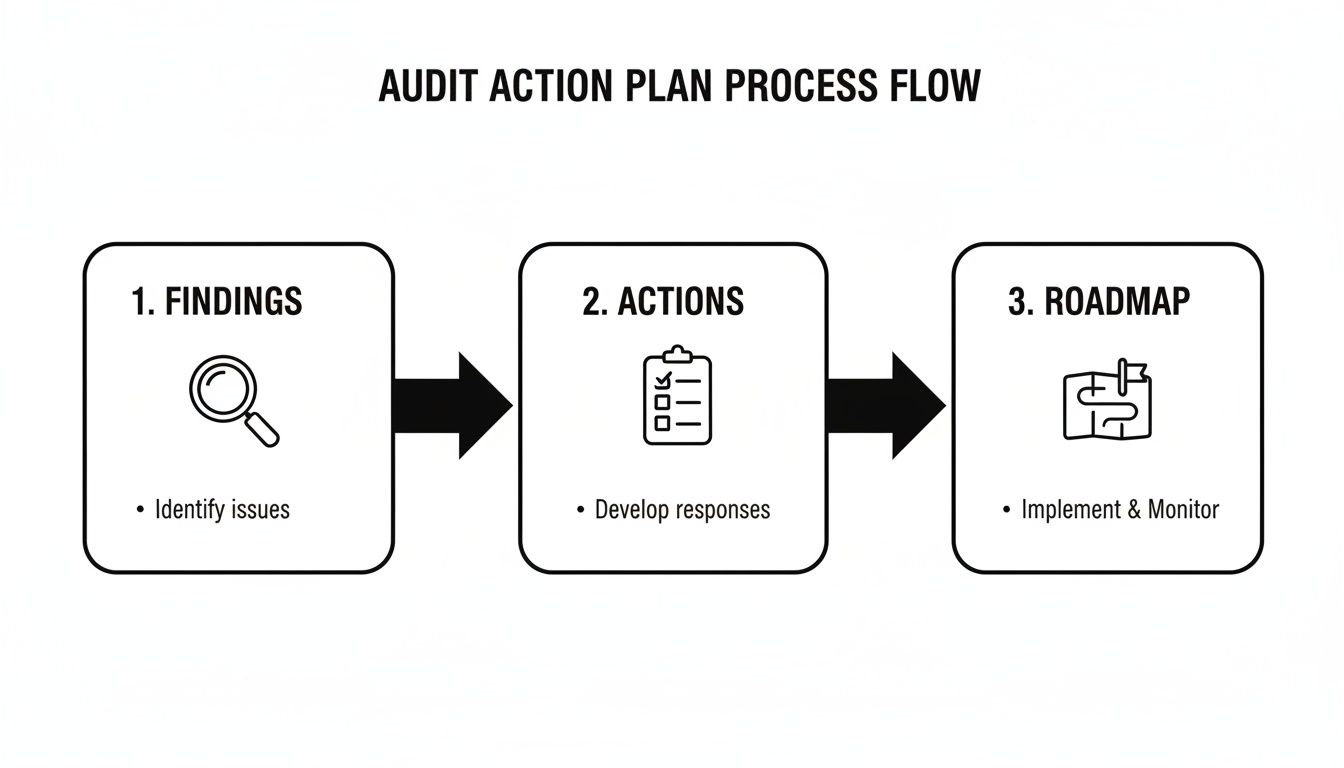
This process is simple: move from your Findings (the data) to your Actions (a prioritized to-do list) and finally to your Roadmap (the long-term strategy).
What If My Results Are… Bad?
It happens. And honestly, it’s not a bad thing. An audit that uncovers poor performance isn't a failure—it's a massive opportunity.
Think about it: you now have concrete proof of what isn't working. This is your permission slip to stop wasting time and money on tactics that don’t deliver and pivot to a strategy that actually moves the needle.
Ready to put your audit's insights on autopilot? EvergreenFeed automates the re-sharing of your best-performing content, keeping your social channels active with proven posts. Stop letting your best content get buried and start driving consistent engagement. Get started for free today at https://www.evergreenfeed.com.