James
James
When we talk about measuring social media ROI, we're really just asking a simple question: "Are we getting a worthwhile return for all the time, money, and effort we're pouring into our social channels?" It's the process of proving that your social strategy is a genuine business asset, not just a daily to-do list of posting and replying.
Decoding Your Social Media ROI Beyond Vanity Metrics
It's easy to get caught up chasing "vanity metrics"—things like likes, follower counts, and shares. While a jump in these numbers feels good and shows activity, they don't tell you anything about your business's health.
True social media ROI is about connecting the dots between a "like" on Instagram and a real-world sale. It’s about linking a comment on LinkedIn to a new qualified lead. To really get a handle on this, you first need to grasp the fundamental concept of Return on Investment in digital marketing.
Think of your social media strategy like a garden. Some of your efforts are like planting fast-growing vegetables—paid ads that give you quick, measurable results. Others, like building an authentic community, are more like enriching the soil. It's a slower, long-term play, but it’s what guarantees healthier growth season after season.
From Cost Center to Revenue Driver
Without solid proof, social media can feel like a "cost center"—just another expense on the balance sheet. The biggest headache for most marketers is trying to draw a straight line from a clever tweet to a customer hitting the "buy now" button. This is exactly why a structured measurement plan isn't just nice to have; it's essential.
Before we get into the nuts and bolts of the calculations, let's get our foundational concepts straight. Think of this table as your cheat sheet for the key terms we'll be using.
Core Concepts for Understanding Social Media ROI
A quick overview of the essential ideas you'll need before we dive into calculating your social media ROI.
| Concept | Brief Explanation | Why It Matters |
|---|---|---|
| Return | The total value generated from your social media activities (e.g., revenue, lead value). | This is the "what you got" part of the equation. Without it, you're just tracking costs. |
| Investment | The total cost of your social media efforts (e.g., ad spend, tools, team salaries). | This is the "what you spent" side. You need to know this to see if your return is profitable. |
| Vanity Metrics | Surface-level numbers like likes, shares, and followers. | They show activity but don't directly tie to business goals like sales or leads. |
| Actionable Metrics | Data that connects directly to business outcomes (e.g., conversions, click-through rates, cost per lead). | These are the metrics that actually inform your strategy and prove your value. |
| Attribution | The process of assigning credit to the touchpoints that led to a conversion. | It helps you understand which channels and posts are actually driving results. |
Getting these core ideas down is the first step. It shifts your entire perspective.
By focusing on outcome-based metrics instead of just activity, you start treating social media like a predictable growth engine. You're no longer just posting; you're investing in a tangible financial outcome.
This guide will show you how to build that bridge. We'll go beyond simply learning how to track social media engagement and get right to translating those interactions into hard numbers. By the time you're done, you'll be able to confidently prove the financial impact of your work.
Building a Framework to Measure What Matters
Before you can calculate anything, you need a blueprint. A solid framework is what separates guessing your social media ROI from actually proving it. Think of it as the plan that connects every post, comment, and ad you run directly to real business goals, not just online noise.
It all starts with one simple question: "What are we actually trying to achieve here?" Whether your goal is generating qualified leads, making customers feel loved so they stick around, or driving direct sales, that single objective shapes every move you make and every metric you track. Without it, you're just collecting data in the dark.
This is where you connect your efforts and investments to measurable results.
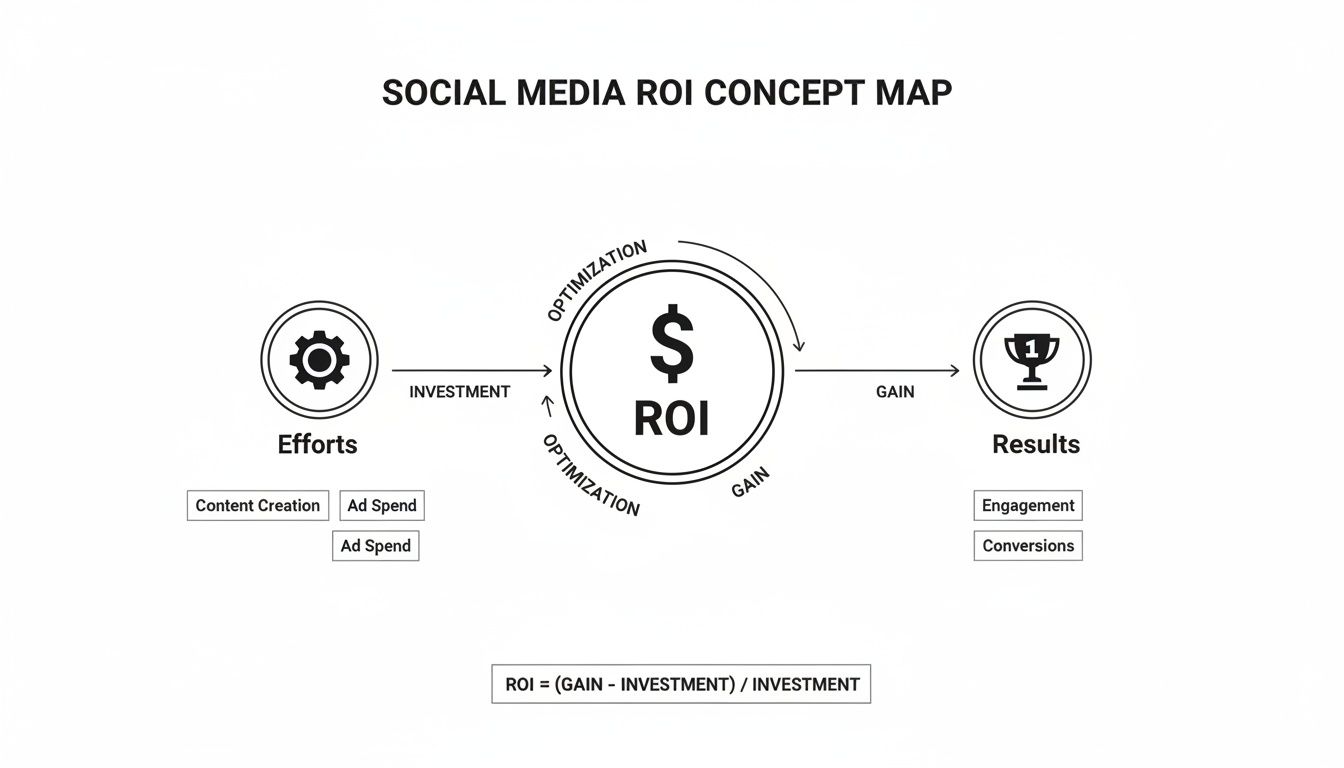
As you can see, ROI isn't some magic number. It's the logical outcome of a strategic process—from thoughtful effort to tangible financial gain.
Understanding Attribution Models
A huge piece of this framework is attribution. This is just the fancy term for giving credit to the marketing touchpoints that led someone to convert. Think of it like a team sport. Who gets the credit for a goal? The person who scored, the one who made the amazing pass, or everyone who helped move the ball down the field?
Different attribution models answer that question in different ways:
-
First-Touch Attribution: This model gives 100% of the credit to the very first time a customer ever interacted with your brand. Let's say someone first found you through a Facebook ad, browsed your site for a week, and then finally made a purchase. With this model, that initial Facebook ad gets all the glory. It's great for figuring out what first grabs people's attention.
-
Last-Touch Attribution: This is the most common and simplest model. It gives 100% of the credit to the final touchpoint right before the conversion. If a user clicked a promo link in one of your tweets and bought something right away, that single tweet gets all the credit, ignoring everything that came before. It’s easy to track but often tells an incomplete story.
Last-touch attribution is like giving all the praise to the striker who scored the winning goal, completely ignoring the midfielders and defenders who made it possible. You see the final result, but you miss the teamwork that led to the win.
Choosing the Right Model for You
For businesses with quick, simple sales cycles, First-Touch or Last-Touch models can work just fine. They are straightforward to set up and give you a basic pulse on what's working at the very beginning and end of the customer journey.
But if you want a truly accurate picture, you'll need a Multi-Touch Attribution model. This approach is much more sophisticated because it spreads the credit across multiple touchpoints. It recognizes that a customer's decision is usually the result of several interactions over time. This gives you a much clearer, more honest view of how your entire strategy is performing.
Ultimately, building a solid framework isn't just about crunching numbers. It's about creating a logical system for measuring social media success in a way that shows its true impact on your bottom line.
Tracking the Right Metrics and Benchmarks
Once you have a framework, it's time to get down to the numbers that actually matter. Proving social media ROI isn't about chasing every vanity metric under the sun. It’s about being ruthlessly focused on the specific data points that draw a straight line from your social efforts to your business goals.
To keep things simple, let's break the most important metrics down into four key categories. Think of these as the four legs of your ROI table—each one is essential for keeping your strategy stable and supported. They tell the complete story, from the first time someone sees your post to the moment they become a customer.

Core Metric Categories
-
Reach: This is all about top-of-funnel visibility. Put simply, how many unique sets of eyeballs are seeing your content? Key metrics here include impressions (the total number of times a post is shown) and your audience growth rate. These numbers don't directly translate to profit, but they represent the size of the pond you're fishing in.
-
Engagement: This category answers the question, "Is anyone actually listening?" It tells you who is interacting with your content and how they're doing it. We're talking about likes, comments, shares, and saves. High engagement is a fantastic leading indicator; it means your content is hitting the mark and building the kind of brand affinity that leads to future sales.
-
Conversion: Now we're getting to the heart of it. This is where your social media activity truly connects to ROI. Conversion metrics track the specific actions people take because of your social posts. This could be website clicks, lead form completions, newsletter sign-ups, or, of course, actual sales. These are your money metrics.
-
Cost: This is the "I" in ROI—the investment. It’s crucial to get this right. Don't just count your ad spend. You need to factor in the cost of social media tools, any expenses for content creation (like graphic design or video editing), and the salary costs associated with your team's time. A comprehensive view of costs is the only way to get a truly accurate ROI calculation.
Benchmarks and Tangible Value
Knowing your numbers is a great start, but context is everything. Are your metrics good? That's where industry benchmarks come in handy. For example, recent data shows the average ROI from paid social media advertising has climbed to an impressive $5.28 for every $1 spent. This makes a lot of sense when you see that global ad spend is approaching $247.3 billion. For marketers trying to make every dollar count, this kind of data is gold. You can find more insights on social media advertising statistics to see how you stack up.
The ultimate goal is to bridge the gap between vanity and value. A viral post with thousands of likes is great, but its real worth is measured by how many of those viewers clicked a link, signed up for a demo, or made a purchase.
Ultimately, tracking the right metrics is about telling a complete financial story. It allows you to graduate from saying, "Our post got a lot of shares," to confidently stating, "Our post generated 50 new leads valued at $5,000 for the business." That shift in conversation is how you prove the undeniable power of your social media strategy.
Your Step-by-Step Guide to Calculating Social media ROI
Alright, let's roll up our sleeves and get into the actual math. Now that we've covered the key metrics and models, it's time to connect the dots and calculate the ROI for your social media efforts. This isn't some complex financial wizardry; it's a straightforward process that anyone can follow.
Think of it less like advanced calculus and more like balancing a checkbook. You just need to know what came in and what went out. We'll break it down into a few simple steps to turn all that data into a single, powerful number that proves your value.
The Four Essential Steps
You can boil the entire process down to four core actions. Nail these, and you'll have a clear, defensible ROI figure for any campaign you run.
-
Define Your Objectives Clearly
First thing's first: what does "success" actually look like for this specific campaign? Are you trying to get sign-ups for a webinar? Drive sales for a new product launch? Capture leads with a free guide? You absolutely must decide on the goal before you start, and then assign a clear dollar value to that goal. -
Track All Associated Costs
Next, you need to add up the "Investment" part of the equation. This is where people often trip up by only counting ad spend. You have to think bigger. Include your software costs (scheduling tools, analytics platforms), any money spent on content creation (hiring a photographer or copywriter), and a realistic estimate for the time your team invested. Time is money, after all. -
Measure the Returns Accurately
With your goals set and costs tallied, it's time to track the results. How many sales did your campaign generate? How many leads did you capture? Now, multiply that number by the value you assigned back in step one. For example, if you generated 50 leads from your campaign and you know each qualified lead is worth about $100 to your business, your total return is $5,000. -
Apply the Simple ROI Formula
This is the easy part. Just plug your total return and your total investment into the classic ROI formula.
The ROI Formula:
(Return – Investment) / Investment x 100 = Social Media ROI %
Let's see it in action. Say your total investment (ads, tools, time) was $1,000, and the campaign generated that $5,000 return we just talked about.
($5,000 – $1,000) / $1,000 x 100 = 400% ROI
A 400% ROI is a fantastic result. It means that for every single dollar you put into the campaign, you got four dollars back. It’s that simple.
Simple Social Media ROI Calculator Example
Here’s a hypothetical breakdown to show how those numbers might look in a real-world scenario.
| Item | Cost/Value |
|---|---|
| INVESTMENT (Costs) | |
| Ad Spend | -$500 |
| Content Creation (Freelancer) | -$250 |
| Team Time (10 hrs @ $25/hr) | -$250 |
| Total Investment | -$1,000 |
| RETURN (Value Generated) | |
| Sales Revenue (10 sales @ $200) | +$2,000 |
| Leads Generated (25 leads @ $100) | +$2,500 |
| Total Return | +$4,500 |
| ROI CALCULATION | 350% |
This table clearly lays out all the moving parts. The final calculation—($4,500 – $1,000) / $1,000 x 100—gives you a solid 350% ROI.
This is the kind of clear, data-backed reporting that turns social media from a "nice-to-have" into a proven business driver. If you want to play around with your own numbers, check out our simple social media ROI calculator and see what's possible.
Proven Tactics to Dramatically Improve Your ROI
Figuring out your social media ROI is just the starting line. The real magic happens when you start to improve it. This isn't about throwing more hours at the problem; it's about being smarter with your organic and paid social media efforts. Let's look at how to turn those good results into great ones.
When it comes to your organic content, the bedrock of a strong ROI is simply creating stuff people actually want to see. Ditch the generic, cookie-cutter posts and start creating genuine value that hits home with your audience. Think about it: what are their biggest questions? What problems can you solve? Sparking real conversations is the goal.

This also means you have to stick around. Don't just post and ghost. Responding to comments, asking questions, and making people feel like they're part of something special is how you build a community. And an engaged community is a loyal one that eventually buys.
Optimizing Your Paid Campaigns
Precision is the name of the game with paid social media. Flinging ads out there hoping something sticks is a surefire way to burn through your budget with little to show for it. Instead, get obsessive about A/B testing every single part of your ads. We're talking headlines, images, copy, even the call-to-action button. Tiny changes can make a massive difference.
You also need to be constantly refining who you're talking to. Dig into the data your social platforms provide to build lookalike audiences from your best customers. Narrow your focus to the people most likely to convert. Remember, even the world's best ad will flop if you show it to the wrong people.
The journey doesn't end with a click. Your landing page needs to perfectly match the promise you made in your ad. Make sure it's:
- Mobile-friendly: This is non-negotiable. Most people are scrolling on their phones.
- Fast-loading: Every second of delay costs you conversions.
- Clear and concise: The visitor should immediately understand what you're offering and what to do next.
To really kick things up a notch, it’s crucial to understand how you can improve your ROI through paid advertising strategies that work hand-in-hand with your organic presence.
The High-Return Power of Influencers
If you're looking for an effective way to get more bang for your buck, strategic partnerships are hard to beat. Influencer marketing works so well because it leverages the trust and connection that creators have already built with their followers.
Influencer marketing delivers a stellar average ROI of $5.78 for every $1 invested, outpacing traditional digital ads as the industry swells to over $32 billion. An astonishing 49% of consumers make monthly purchases inspired by influencer posts, with TikTok and Instagram leading the charge. This boom ties directly to social ROI trends, where creators are driving real, measurable sales.
Finally, smart automation is what ties a high-ROI strategy together. Tools like EvergreenFeed can save you an incredible amount of time by automatically scheduling your best-performing content. This keeps your profiles active and ensures your top posts get seen again and again, all while freeing you up to focus on the human side of things—like community engagement and campaign strategy—that directly fatten your bottom line.
Got Questions About Social Media ROI? We've Got Answers.
Even with the formulas laid out, putting it all into practice can feel like a whole different ball game. It’s totally normal to hit a few snags when you're trying to measure the impact of your social media efforts, especially for goals that aren’t as clear-cut as a direct sale.
Let's walk through some of the most common questions and sticking points that pop up.
How Do You Measure the ROI of Brand Awareness?
This is the big one. How do you assign a dollar value to a feeling or a general awareness of your brand? You can’t, directly. But you can track the ripple effects.
Think of them as "proxy metrics"—they aren't the awareness itself, but they're strong signs that it's growing. Keep an eye on things like a jump in people searching for your brand name on Google, an increase in direct traffic to your website (people typing your URL right into their browser), and a rise in social media mentions. These are all clues that your brand is becoming more top-of-mind.
What’s a "Good" ROI for Social Media?
Everyone wants to know what number to aim for. While it definitely changes from industry to industry, a widely accepted benchmark is a 5:1 ratio—that’s $5 back for every $1 you put in.
But honestly, the most important benchmark is your own. Figure out where you're starting from today, and then focus on beating that number next month, and the month after that. Consistent improvement is the real win.
How Long Does It Take to See a Return?
Patience is key here, but the timeline really depends on your strategy.
- Paid Campaigns: With paid ads, you can often see a positive ROI in just a few days or weeks. You put money in, and you get data (and hopefully sales) back pretty quickly.
- Organic Efforts: Building an organic presence is a long-term play. It often takes 6-12 months of consistent, valuable content before you start seeing significant, measurable returns. It's a marathon, not a sprint.
So, which platform has the best ROI?
There’s no single right answer. While one survey found that about 28% of marketers see the best returns from Facebook, the real answer is much simpler: the best platform is wherever your audience hangs out. You’ll get the highest ROI by showing up where your customers already are and giving them content they actually care about.
Hopefully, tackling these common questions gives you a bit more confidence. It's all about turning those fuzzy goals into hard numbers that prove the real value social media brings to your business.
Ready to stop wasting time on manual scheduling and start improving your ROI? EvergreenFeed automates your best content, keeping your social profiles active and engaging your audience around the clock. Start your free trial today and see the difference!