James
James
Let's be honest, calculating the ROI of social media is really about one thing: figuring out if all the time, money, and effort you're pouring into your channels is actually paying off. It's the ultimate proof that your social strategy is a serious business asset and not just a fun, but expensive, side project.
It answers the one question that really matters: "Are we getting more money back than we're putting in?"
What Social Media ROI Really Means for Your Business

Think of your social media program like a garden. You invest your resources—time, ad spend, creative energy—which are your seeds, soil, and water. Measuring ROI is how you tally up the harvest at the end of the season. Without that count, you're just scattering seeds and hoping for the best.
When you truly understand your roi social media, it stops being a fuzzy "nice-to-have" expense and becomes a predictable engine for growth. This is how you graduate from tracking surface-level stats like likes and follower counts to connecting your daily activities to real, tangible business results.
From Vanity Metrics to Valuable Impact
It’s way too easy to get mesmerized by follower counts and engagement rates. And while those numbers can signal a vibrant community, they don't paint the full picture. Real ROI is all about how those clicks and comments actually convert into dollars and cents.
The whole point of calculating social media ROI is to defend your budget, sharpen your strategy, and prove that your work directly contributes to the company's financial success. It’s about making smart, data-backed decisions instead of just making noise.
Once you start tracking your return, you can confidently answer the tough questions your boss or clients are bound to ask:
- Which platforms are giving us the biggest bang for our buck?
- What kind of content is actually generating leads and sales?
- How should we shift our resources next quarter for better results?
The Role of Automation in Maximizing Returns
One of the biggest—and most frequently ignored—costs is the sheer amount of time your team spends on manual work. All those hours spent scheduling posts one by one, digging for content, and managing complex calendars are direct expenses that chip away at your profit. This is where smart automation completely changes the equation.
Tools like EvergreenFeed are built to slash that time investment. By automatically scheduling and re-sharing your best-performing evergreen content, you maintain a steady flow of valuable posts without the constant hands-on effort.
When you lower the "investment" side of the ROI formula, your return naturally goes up. Less time on repetitive chores frees your team up for what really matters: strategy, creative thinking, and analyzing what works.
Ultimately, getting a firm grip on measuring social media success gives you clarity and control. You can finally stop guessing and start building a social media machine that consistently delivers profitable, measurable outcomes for your business.
How to Set Up a Bulletproof Tracking System
To actually measure your social media ROI, you can’t just wing it. You need a reliable tracking system—think of it as the digital plumbing that connects your social media posts and ads to real business results. Without it, you’re basically flying blind, with no real way to know what’s working and what’s just wasting money.
This system really comes down to two things: setting clear, measurable goals and then using the right tech to track the customer’s journey. It’s the difference between knowing a post got 100 likes versus knowing it brought in three qualified leads worth $1,500.
First, Define Your Goals (Before You Track a Single Thing)
Before you touch a single pixel or look at an analytics dashboard, you have to define what success actually looks like. Fuzzy goals like "increase engagement" are a nightmare to measure. You need to get specific by setting SMART goals—that’s Specific, Measurable, Achievable, Relevant, and Time-bound.
This simple framework turns a vague wish into a concrete target. A weak goal is "get more leads." A SMART goal is "increase qualified leads from LinkedIn by 20% in the next quarter." See the difference?
Here’s how you can frame your own objectives for better tracking:
- Awareness Goal: Increase post reach on Instagram by 15% over the next 30 days.
- Engagement Goal: Hit an average click-through rate (CTR) of 2.5% on our Facebook ad campaigns this month.
- Conversion Goal: Generate 50 new e-book downloads from Twitter traffic by the end of Q2.
When you set targets this precise, your tracking efforts suddenly have a clear purpose. Every metric you watch should tie directly back to one of these goals.
Master UTM Parameters for Pinpoint Accuracy
Once your goals are in place, you need to follow the user from that first click on your social post all the way through to your website. The best tool for this job is the UTM parameter.
UTM parameters are just little bits of text you add to the end of a URL. They act like tiny GPS trackers that tell Google Analytics exactly where a visitor came from. Think of it like putting a unique barcode on every package that leaves your warehouse—you know precisely which shipment it belonged to and where it was headed.
A link without UTMs might tell you someone came from "social media." A link with UTMs tells you they came from your "Summer Sale" campaign, specifically the "July 4th Promo" ad you ran on Instagram Stories. That level of detail is everything when calculating an accurate social media ROI.
Here’s what Google's Campaign URL Builder looks like when you’re creating a tracked link.
This tool makes it foolproof. You just fill in the source, medium, and campaign name, and it generates a link that ensures every click is properly logged in your analytics reports. If you want to go deeper, we've got a complete guide on how to use Google Analytics UTM parameters.
Install Tracking Pixels to Capture What Happens Next
While UTMs track the journey to your site, tracking pixels record what happens once someone arrives. A pixel is a tiny snippet of code you install on your website. When someone who saw your social media ad visits your site and takes an important action—like buying a product or signing up for a newsletter—the pixel "fires" and reports that conversion back to the social media platform.
The most common pixels you'll encounter are:
- Meta Pixel (for Facebook and Instagram): Absolutely essential for tracking ad conversions, building audiences of website visitors, and letting the algorithm optimize your campaigns for you.
- LinkedIn Insight Tag: The go-to for B2B marketers. It helps track leads, see the professional demographics of your site visitors, and measure content downloads.
- TikTok Pixel: A must-have for e-commerce brands wanting to measure the direct sales impact of their video campaigns.
By combining clear goals, UTM parameters, and tracking pixels, you create a complete, closed-loop system. This setup ensures every click, lead, and sale gets credited to the right place, giving you the hard data you need to finally prove your social media ROI.
Calculating Social Media ROI Without the Headache
Putting a real number on your social media efforts starts with a surprisingly simple formula. While it looks basic on the surface, the real skill is in knowing what to plug into each part of the equation.
The classic formula for social media ROI is:
(Profit – Investment) / Investment * 100% = ROI
This gives you a straightforward percentage. A positive number means you're in the black, while a negative one shows you’re spending more than you’re bringing in. Let’s break down each component so you can calculate this with total confidence.
Defining Your Total Investment
First up, you need to tally every single cost associated with your social media marketing. So many marketers fall into the trap of only counting ad spend, but a true calculation goes much deeper than that.
To get an accurate figure, your total investment needs to include:
- Ad Spend: The obvious one. This is what you pay directly to platforms like Meta, TikTok, or LinkedIn to run your ads.
- Content Creation Costs: Think about fees for designers, copywriters, or videographers. If you handle content in-house, you have to account for the time your team sinks into it.
- Social Media Tools: Add up the subscriptions for all your scheduling, analytics, and social listening software.
- Team Time: This is the cost everyone forgets. Calculate the hourly wages of your team members and multiply that by the hours they dedicate to social media.
Adding all these up gives you the "Investment" side of the formula. It's the only way to measure against the true cost of running your social media program.
For a deeper dive, it’s helpful to understand the universal principles for measuring marketing ROI, as these fundamentals apply across all channels, not just social.
Assigning a Dollar Value to Profit
Next, it's time to figure out your profit—the "Return" on your investment. For an e-commerce store, this is often a straight line from a click to a sale. But what about the valuable actions that don't have an immediate price tag? You have to assign them one.
This means digging into your historical data to figure out what a specific action is actually worth to your business down the road.
For example, let's say you know that 1 in every 10 leads from your newsletter eventually becomes a customer who spends an average of $500. That means each email sign-up you get from social media is worth $50.
You can apply that same logic to just about any conversion goal. By analyzing your sales funnel, you can put a real dollar value on things like demo requests, e-book downloads, or free trial sign-ups. This is how you turn fuzzy engagement metrics into cold, hard cash figures.
This whole process relies on a solid tracking foundation. Setting up your goals, installing tracking pixels, and using UTM parameters is what makes accurate ROI calculation possible in the first place.
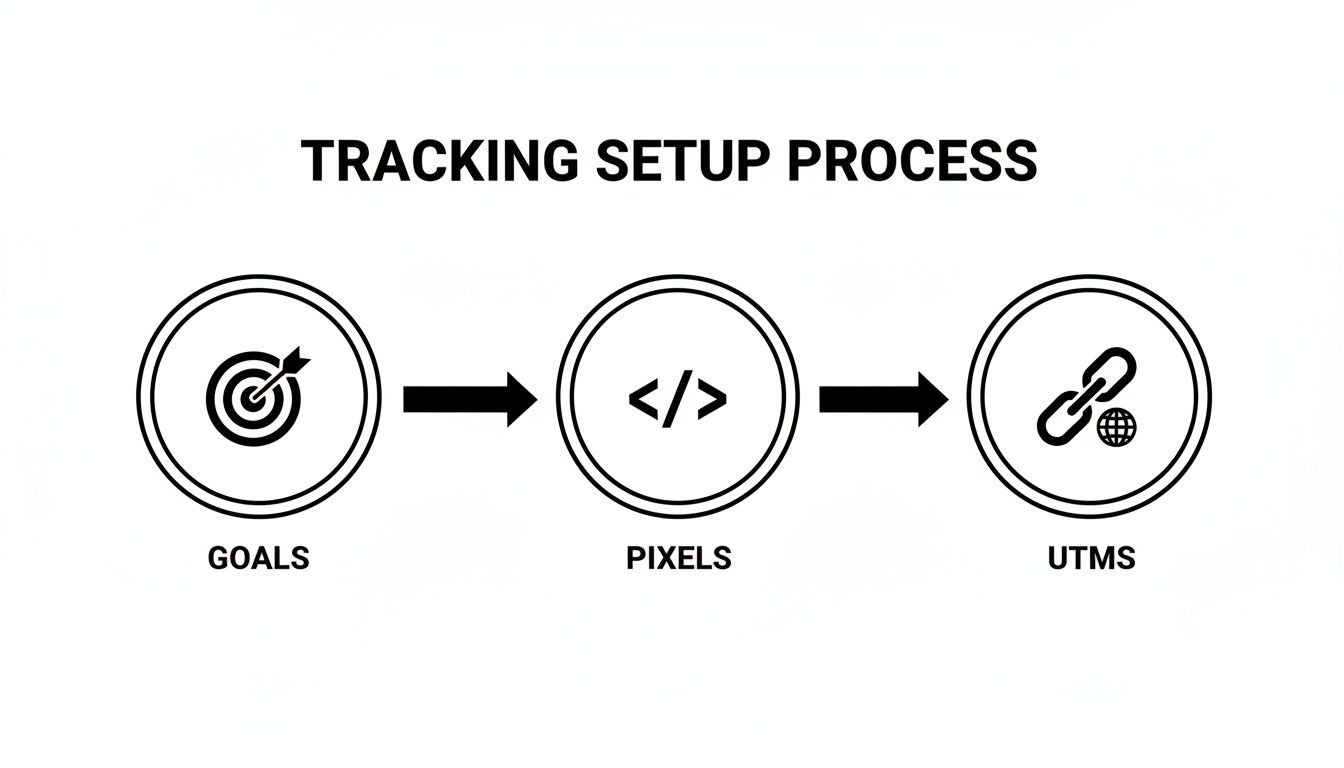
Without this kind of setup, you’re basically just guessing where your profits are coming from.
Putting It All Together: A Real-World Example
To show how this works in practice, here is a quick breakdown of a sample campaign. This example calculates the ROI for an online retailer that ran an Instagram campaign to launch a new product.
| Metric | Calculation/Value | Total |
|---|---|---|
| Profit (Return) | ||
| Direct Sales (150 units x $50 profit/unit) | $7,500 | |
| New Leads (100 leads x $10/lead value) | $1,000 | |
| Total Profit | $8,500 | |
| Investment (Costs) | ||
| Instagram Ad Spend | $2,000 | |
| Content Creation (Video Shoot) | $1,000 | |
| Team Time (20 hrs x $50/hr) | $1,000 | |
| Software Subscription (Prorated) | $100 | |
| Total Investment | $4,100 | |
| Social Media ROI Calculation | ($8,500 – $4,100) / $4,100 * 100% | 107.3% |
The campaign delivered a 107.3% ROI.
This number tells a powerful story. For every $1 the business invested, it got back that original dollar plus an additional $1.07 in pure profit. That's a clear, data-backed figure that proves the campaign was a success and justifies every penny of the budget.
Choosing the Right KPIs for Your Business Goals
Think of your final social media ROI number as the final score of a game. It tells you if you won or lost. But your Key Performance Indicators (KPIs) are the individual plays—the passes, the shots, the defensive stops—that actually led to that outcome. They’re the specific, measurable metrics you track daily to see how your efforts are contributing to your bigger business objectives.
It's incredibly easy to get lost in a sea of data. The real trick is focusing on the right KPIs. That's what separates a smart, focused strategy from one that just wastes time and money.
Aligning KPIs with the Marketing Funnel
To pick the right KPIs, you first need to know what you're trying to accomplish. Most social media goals fit neatly into three stages of the customer journey: Awareness, Engagement, and Conversion. Each stage has its own set of vital signs you need to monitor.
- Awareness KPIs (Top of Funnel): These metrics tell you how many people are seeing your content and discovering your brand for the first time. The main goal here is just getting noticed.
- Engagement KPIs (Middle of Funnel): This group of metrics shows who is actually interacting with your content. It’s proof that you’re not just shouting into the void—you're genuinely connecting with people.
- Conversion KPIs (Bottom of Funnel): These are the money metrics. They track who is taking a valuable action, turning followers into leads and, eventually, paying customers.
Framing your metrics this way helps you tell a clear story of how someone goes from a complete stranger to a loyal customer. For a much deeper dive, check out our guide on the most essential social media key performance indicators to track.
KPIs for Brand Awareness
When your main objective is to expand your reach and get your brand in front of fresh eyes, you need to be laser-focused on metrics that measure exposure and visibility.
Your most important awareness KPIs include:
- Reach: The total count of unique people who saw your post. This is the bedrock metric for understanding your audience size.
- Impressions: The total number of times your post was shown to users. One person can see the same post multiple times, so impressions are always higher than reach.
- Audience Growth Rate: A simple but powerful metric showing how quickly your follower count is increasing. It’s a great indicator of your brand's growing appeal.
- Social Share of Voice (SOV): This measures how many people are talking about your brand online compared to your direct competitors.
These metrics are the foundation of everything else. Without a strong awareness game, you simply won't have an audience to engage or convert down the line.
KPIs for Audience Engagement
Once people know you exist, the next big question is: do they care? Engagement KPIs measure the quality of the interactions your content gets, which tells you if your message is actually hitting home with your audience.
Key engagement KPIs to keep an eye on are:
- Likes, Comments, and Shares: The classic trio. While all are good, shares are especially valuable because they're a form of personal endorsement.
- Click-Through Rate (CTR): The percentage of people who saw your post and were compelled enough to click a link in it. This is absolutely critical for driving traffic.
- Applause Rate: The number of "approval" actions (like likes or favorites) a post gets relative to your total number of followers.
A high engagement rate is a powerful sign that you're building a real community, not just collecting a passive audience. It shows your content is providing genuine value, which is the secret ingredient for driving conversions later.
KPIs for Conversions
Alright, this is where the rubber meets the road. Conversion KPIs are what directly connect your social media activity to real, tangible business results. They form the "Profit" side of your roi social media calculation.
The most critical conversion KPIs are:
- Conversion Rate: The percentage of people who take a specific, desired action (like making a purchase or signing up for a newsletter) after clicking a link from your social post.
- Cost Per Click (CPC): For paid ads, this is simply the amount you pay for each individual click. Driving this number down is a quick way to improve your ROI.
- Cost Per Acquisition (CPA): The total cost it takes to get one new customer through a specific social media campaign.
- Leads Generated: The number of new contacts you capture through things like webinar sign-ups, ebook downloads, or contact forms linked from your social channels.
Ultimately, the KPIs you prioritize will depend entirely on your business. A B2B software company on LinkedIn will care far more about webinar sign-ups (Leads) than post likes. Meanwhile, a direct-to-consumer brand on TikTok will live and die by its sales Conversion Rate. Choosing the right KPIs ensures you’re measuring what actually matters to your bottom line.
Finding Your High-ROI Platforms for Maximum Growth
Not all social media platforms are created equal, especially when it comes to your return on investment. Spreading your budget thinly across every channel is a classic mistake. It's like trying to water an entire garden with a tiny watering can—you just end up with a lot of damp spots and no real growth.
The real key to maximizing your social media ROI is to get strategic. You have to pinpoint the profit powerhouses for your specific industry and audience, then double down on what works. For many businesses, one platform consistently rises above the rest.
If you've ever poured money into social ads and wondered if it was actually paying off, you're not alone. But the data shows that for many marketers, Facebook is still the undisputed king of ROI. A staggering 28% of global marketers point to Facebook as the platform that delivers the highest return, leaving its competitors in the dust. You can dig into more social media marketing statistics to see how the other platforms stack up.
Facebook: The Consistent ROI Leader
So, what's Facebook's secret? It's all about its incredibly powerful and granular ad-targeting tools. The platform lets you zero in on your ideal customers with a level of precision that’s tough to find anywhere else.
You can build audiences based on pretty much anything:
- Demographics: Age, gender, location, language, and even relationship status.
- Interests: Hobbies, pages they follow, and the topics they actually engage with.
- Behaviors: Past purchase activity, the devices they use, and even their travel habits.
This kind of deep targeting means your ad spend gets put in front of the people most likely to actually buy from you. That drastically cuts down on wasted impressions and drives up your return. When you pair that with its massive user base, Facebook creates a reliable environment for generating predictable and scalable results.
For businesses focused on steady, long-term growth, Facebook’s sophisticated advertising ecosystem provides a rock-solid foundation. Its ability to guide potential customers through the entire marketing funnel makes it a cornerstone for any high-ROI social media strategy.
TikTok: The High-Velocity Growth Engine
On the flip side, you have TikTok, which is all about explosive, short-term ROI. While Facebook is a marathon, TikTok is a sprint—a rocket ship for brands looking to capture lightning in a bottle, especially with younger audiences.
The platform’s algorithm is legendary for a reason. It can take a single piece of content and push it to viral status almost overnight, generating massive reach and engagement out of thin air. For e-commerce brands in fashion, beauty, or food, a trending video can spark a sales surge within hours.
But succeeding on TikTok requires a completely different playbook:
- Be Authentic: Polished, corporate content usually bombs. Users want genuine, creative, and entertaining videos that feel like they belong there.
- Ride the Trends: Hopping on trending challenges, sounds, and meme formats is essential for getting discovered.
- Encourage User-Generated Content (UGC): Run a contest or create a branded hashtag that inspires users to make their own videos. It can amplify your message like nothing else.
Tailoring Your Strategy for Niche Platforms
Beyond the two giants, other platforms can deliver an amazing ROI when you play to their strengths. A tailored approach ensures you’re not just on a platform, but you’re actually using it to drive results.
- Instagram for Visual Brands: Lean into user-generated content. Encourage customers to share photos with your product, then repost the best ones to your feed. It’s authentic social proof that can seriously boost conversions with very little investment.
- LinkedIn for B2B Leadership: Here, the goal isn't direct sales; it's about generating high-value leads. Focus on creating in-depth articles, case studies, and webinar content that cements your company as an industry authority. This builds trust and attracts qualified decision-makers, leading to a huge return on the time you put into creating quality content.
By strategically picking your platforms and tailoring your approach to what makes each one unique, you can put your budget and effort where they’ll make the biggest difference. That's the secret to turning social media from a daily chore into a powerful, profit-generating machine.
Actionable Strategies to Boost Your Social Media ROI

Knowing your numbers is one thing, but making them better is where the real growth happens. Boosting your social media ROI means shifting from simply watching the data to actively using it. It's all about making smart, deliberate tweaks to your campaigns to squeeze more value from every dollar and minute you put in.
The good news? You don't have to tear up your entire strategy and start from scratch. A few focused, high-impact tactics can make a huge difference. By methodically testing your creative, zeroing in on your audience, and getting smarter with automation, you can turn a good ROI into a great one.
Relentlessly A/B Test Your Creative
One of the quickest ways to improve performance is to stop guessing what your audience wants and start testing. A/B testing is simple: you run two slightly different versions of an ad to see which one gets better results. Even tiny changes can lead to surprisingly big wins.
Here are a few key elements you should always be testing:
- Headlines: Does a question grab more attention than a bold statement? Test it.
- Ad Copy: Try pitting long, storytelling copy against short, punchy, benefit-focused text.
- Visuals: How does a polished, professional photo stack up against a more authentic user-generated shot? Or a static image against a short video?
- Call to Action (CTA): Find out if "Shop Now" drives more valuable clicks than "Learn More."
The goal here is to find the winning ingredients you can use across all your campaigns. Over time, this systematically raises the bar for all your marketing efforts.
Refine and Segment Your Audience Targeting
You could have the most brilliant ad in the world, but if it’s shown to the wrong people, it’s going to fall flat. Hyper-specific audience targeting is the secret weapon for a killer social media ROI. Stop blasting your message to a broad demographic and start drilling down to find your exact customer.
Think way beyond basic age and location. Use the platform's tools to build lookalike audiences based on your best current customers, or retarget people who visited your site and left without buying. The more relevant an ad feels to the person seeing it, the more likely they are to convert.
Getting this right is a core part of any modern B2B social media strategy. For example, platforms you might overlook, like TikTok, can be serious ROI drivers. Research shows TikTok can deliver a short-term ROI of 11.8x, with its ads hitting an average ROAS of 2.4x the median benchmark—all thanks to its powerful algorithm.
Automate Your Evergreen Content
One of the biggest hidden costs that quietly kills your ROI is the time your team spends on repetitive, manual tasks. If someone is manually reposting your best content over and over, that's a massive time sink. This is where automating your evergreen content is a total game-changer.
Use a scheduling tool to create a library of your top-performing posts—think helpful tips, cornerstone blog articles, and powerful case studies. This creates an automated content machine that continuously shares proven winners, keeping your profiles active and driving traffic without someone having to press "post" all day.
This approach gives your ROI a direct boost in two key ways:
- It Cuts Your Investment: You slash the hours your team spends on manual scheduling, which directly lowers the "Investment" part of the ROI calculation.
- It Maximizes Your Return: Your best content is always out there working for you, engaging your audience and generating leads or sales 24/7.
Got Questions About Social Media ROI? We've Got Answers.
It's one thing to talk about social media ROI, but it's another to actually nail down the numbers. It's a process that brings up a lot of common (and totally valid) questions for marketers. Let's clear up some of the most frequent hurdles you might face when connecting your social media work to real business results.
How Often Should I Be Calculating Social Media ROI?
Think of it in two different buckets: your everyday presence and your special campaigns.
For your ongoing, day-to-day social media management, checking in monthly or quarterly is the sweet spot. This gives you enough data to see real trends and make smart tweaks without getting bogged down in tiny, meaningless fluctuations.
But for a specific, timed campaign—like a Black Friday sale or a new feature launch—you’ll want to calculate the ROI right after it wraps up. This gives you a clear, focused picture of how that one initiative performed and gives you immediate lessons for the next one.
Is It Even Possible to Measure ROI for Organic Social Media?
Yes, absolutely. It's a common misconception that "free" posts don't have an ROI. While you're not paying for ads, you're definitely still investing.
Your "Investment" here includes the cost of your team's time spent creating content, replying to comments, and managing your accounts. Don't forget to factor in the cost of any tools or software you use, too.
The "Return" comes from tracking conversions that start with your organic content. The secret weapon here is using UTM codes on the links you share in your posts or your bio. This is how you prove that your community-building efforts are directly leading to website visits, new leads, and even sales.
What's a good ROI to aim for? Many marketers shoot for a 5:1 ratio, which means earning $5 for every $1 you put in. But honestly, the best goal is to figure out your own baseline and then focus on beating it month after month. That's how ROI becomes your personal roadmap for growth.
Ready to shrink the "Investment" part of your ROI equation? EvergreenFeed puts your content scheduling on autopilot, saving you a ton of time every single week. Sign up for free and see how easy it is to improve your returns.