James
James
So, what exactly is organic social media?
Think of it as all the free content you share on your social channels—the posts, photos, videos, and Stories you publish without putting any ad money behind them. It’s the art of building a genuine community and earning your audience's attention by consistently showing up with great content, rather than paying to interrupt their feed.
What Is Organic Social Media Really About

Imagine your brand is a regular at your favorite neighborhood coffee shop. You wouldn't just burst in, yell about your latest sale, and then walk out, right? Of course not. You’d become part of the scene. You’d get to know the barista by name, chat with other regulars, and maybe even share a useful tip or two.
Before long, people would start to recognize you, trust your opinion, and actually look forward to seeing you. That’s organic social media in a nutshell. It’s the daily, non-promoted work of sharing valuable stuff, jumping into conversations, and building real connections. This is how you turn a simple social media page into a lively hub for your community.
The Core Purpose of Organic Efforts
Paid social media is a sprint—it’s built for immediate, targeted results. Organic social, on the other hand, is a marathon. It’s all about the long game. The main goal isn't just to snag a quick sale; it's to create an environment where people want to buy from you because they trust and like your brand.
It really boils down to a few key objectives:
- Building Brand Authenticity: This is where you show off your company’s personality, its values, and the real people who make it all happen.
- Fostering Community: It’s not a monologue; it's a conversation. You listen, you respond, and you make your audience feel like they're a part of something.
- Providing Value: Your content should educate, entertain, or inspire your followers—often with no immediate strings attached.
- Nurturing Customer Relationships: It’s about supporting the customers you already have and gently guiding potential ones with helpful, no-pressure information.
Organic social is where your voice, values, and vibe come through. It’s where your audience says, ‘I like how this brand thinks.’ It creates that layer of trust that paid ads alone cannot replicate.
Think of it this way: every organic post is another brick you lay in the foundation of your brand's reputation. Paid ads are like renting an audience for a short time. A strong organic presence is about building an asset you actually own—a loyal, engaged community that sticks with you.
It's the slow-burn strategy that pays dividends over time, building a resilient brand that isn’t at the mercy of every algorithm change. This is your brand's digital handshake, its friendly conversation, and its helpful advice, all in one.
Organic Social Media vs Paid Social Media At a Glance
To make the distinction crystal clear, it helps to see organic and paid strategies side-by-side. While they work best together, they play very different roles in your overall marketing plan.
| Attribute | Organic Social Media | Paid Social Media |
|---|---|---|
| Primary Goal | Build community, brand loyalty, and trust | Drive immediate conversions, leads, and website traffic |
| Cost | No direct media spend, but requires time and resources | Direct ad spend required; can be costly to scale |
| Speed of Results | Slow and steady; a long-term investment | Fast and immediate; results seen within hours or days |
| Longevity | Content has a long shelf life and builds lasting value | Visibility stops the moment you stop paying for ads |
Ultimately, organic social is the bedrock of your brand's presence, establishing the credibility and trust that makes your paid efforts far more effective.
Why Organic Social Is a Non-Negotiable Asset
In a world flooded with sponsored posts and ads, organic social media is the bedrock of brand authenticity. While paid ads are great for a quick burst of attention, it's your organic strategy that builds real, lasting trust and turns casual followers into die-hard fans. It’s the difference between shouting from a billboard and having a genuine conversation.
Think of it like this: paid social is like asking someone on a first date—it gets you in the door. Organic social is the relationship you build afterward by sharing stories, listening, and just showing up consistently. That steady effort is what makes your brand feel human, proving you're in it for more than just the sale.
Building Real Connections and Trust
The whole point of organic social is to build a genuine rapport with your audience. This is your space to let your brand’s personality shine, share your values, and post those behind-the-scenes moments that a polished ad could never capture. This consistent, value-first approach is what creates a sense of community that money can't buy.
When people see you actually responding to comments, sharing content from your own followers, and offering helpful advice without a sales pitch attached, they start to trust you. That trust is gold. It creates a space where your audience isn't just open to what you have to say—they actively look for it.
Organic social media is where your voice, values, and vibe come through. It’s where your audience says, ‘I like how this brand thinks.’ It creates that layer of trust that paid ads simply cannot buy.
This authentic connection is a massive competitive advantage. Algorithms change and ad costs will climb, but the brand equity you build through genuine community engagement is an asset that sticks around for the long haul.
Supporting Your Entire Marketing Funnel
A strong organic social presence doesn't exist in a vacuum; it lifts up all your other marketing channels. The content you share and the community you nurture create a powerful feedback loop that benefits your entire strategy.
Here’s how it works in practice:
- Warming Up Paid Audiences: Ads perform so much better when they’re shown to people who already know and like you. A consistent organic presence builds this "warm" audience, making them way more likely to convert when they finally see a paid promotion.
- Fueling Your SEO: Social media activity sends good signals to search engines. Every share, like, and comment can boost your content's visibility, driving referral traffic to your website and improving your search rankings over time.
- Gathering Invaluable Insights: Your community is a direct line to customer feedback. By tuning into the conversation, you can figure out what your audience loves, what they need, and how you can serve them better. This intel can inform everything from product development to your next blog post.
Organic social is competing in the most crowded attention economy ever. With an estimated 5.42 billion social media users worldwide, brands simply can't afford to be quiet. In fact, 90% of consumers use social platforms to keep up with trends, proving a steady organic presence is essential for staying relevant. You can explore more social media usage statistics and what they mean for brands. This steady engagement isn't just a "free" tactic; it’s a non-negotiable part of a modern marketing strategy.
The Four Pillars of a Winning Organic Strategy
A great organic social media presence doesn't just happen. It's built, piece by piece, on a solid foundation of smart, consistent habits. Forget throwing content at the wall and hoping something sticks. A winning strategy really boils down to four key pillars that work together to build momentum and grow a real community.
Think of these pillars like the legs of a table. If one is shaky or missing entirely, the whole thing gets wobbly. To build something that lasts—something that can weather algorithm changes and keep your audience truly engaged—you need to give all four equal attention.
Let’s get practical and break down exactly what those are.
Pillar 1: High-Value Content Creation
At the end of the day, organic social media is all about the content. It’s the absolute heart of your strategy. To earn people's attention in a crowded feed, your posts have to give them something genuinely valuable. That means every single thing you post should aim to educate, entertain, or inspire your audience, not just sell to them.
High-value content is what convinces a casual scroller to hit that "follow" button. It’s the reason people stick around. So before you post, always ask yourself, "What does my audience actually need or want to see?"
A smart way to organize your efforts is by creating core content themes. If you want to go deeper on this, our guide on what are content pillars will help you turn your ideas into a repeatable system.
Here are a few formats that almost always work:
- Educational Posts: Share quick tips, tutorials, or industry insights that solve a real problem for your audience. For example, a software company could post a short video showing off a cool, little-known feature.
- Behind-the-Scenes Stories: Show the real people and messy processes behind your brand. It makes you relatable. A local coffee shop could share a video of their baristas dialing in the espresso machine first thing in the morning.
- User-Generated Content (UGC): Reshare photos, reviews, or videos from your actual customers. It’s powerful social proof, and it makes your community feel like they're a part of the story.
Pillar 2: Consistent Posting Cadence
Consistency is the engine of organic growth. When you post on a regular schedule, you’re sending a strong signal to both the algorithms and your audience that you’re active, reliable, and here to stay. A feed that’s updated sporadically feels abandoned.
When your followers know they can count on you for great content regularly, they’re far more likely to tune in. Even better, the algorithms tend to favor accounts that show up consistently, which can boost your organic reach over time.
A consistent cadence doesn't mean you have to post five times a day. It means picking a realistic schedule—whether it's three times a week or once a day—and actually sticking to it. Predictability builds trust.
This simple act of showing up keeps your brand top-of-mind, making sure you’re right there when your followers need you.
Pillar 3: Proactive Community Engagement
Social media is a conversation, not a monologue. If you're just blasting out content without ever interacting, you're missing the entire point. Proactive engagement turns your profile from a digital billboard into a lively community hub.
This means you have to get in there and talk to people. It’s way more than just "liking" a few comments. Real engagement is about building actual relationships and making your followers feel heard.
Here’s how to do it right:
- Respond to Comments and DMs: Try to reply to every single comment and direct message. A thoughtful response shows you’re paying attention and that you care.
- Ask Questions: Don't just make statements. End your posts with a question to get the conversation started.
- Engage with Other Accounts: Don't just stay on your own page! Go comment on posts from other brands, creators, and even your own followers. It gets more eyes on your profile and helps you build a network.
Pillar 4: Social SEO and Discoverability
You can create the best content in the world, but it won't matter if no one can find it. That’s where social SEO comes in. Just like with Google, you need to optimize your profiles and posts to show up when people search on social platforms.
Increasingly, people are using Instagram, TikTok, and even LinkedIn as search engines to find products, tips, and services. If you're not optimized for this, you're invisible. For a deeper look at this, check out these tips on how to gain more real followers on Instagram through organic discovery.
Here are the key things to focus on:
- Profile Optimization: Make sure your bio clearly explains what you do and includes keywords people would use to find you.
- Keyword-Rich Captions: Write your captions like a human, but naturally weave in the search terms your ideal customer is using.
- Strategic Hashtags: Use a mix of popular, niche, and branded hashtags to help your content reach the right people.
- Alt Text: Always add descriptive alt text to your images. It’s great for accessibility and gives the algorithms more context about what your post is about.
Master these four pillars, and you'll build an organic social media strategy that doesn't just attract followers—it builds a genuine, loyal community around your brand.
How to Overcome Declining Organic Reach
If you've been in the social media trenches for a while, you've probably felt it: your posts just aren't hitting like they used to. That feeling of shouting into the void? It's not in your head, and it's not your fault. It's the new reality for almost every business out there.
The game has changed. Social media platforms are businesses, and their business models now heavily favor paid content and posts from people we actually know—friends and family. This shift has pushed brand content way down the feed, making it incredibly tough to get eyeballs without opening your wallet.
It's easy to see those shrinking numbers and get discouraged. But this isn't the end of the road. It’s a signal that we need a smarter strategy, because the old playbook simply doesn't work anymore.
Why Your Reach Is Shrinking
So what's really going on? It all boils down to the algorithms. Platforms like Facebook and Instagram are constantly fine-tuning their code to keep users scrolling. That usually means showing people more of what they already engage with: content from their inner circle or hyper-targeted ads.
That leaves precious little space for your company's latest update.
Even with billions of people on these platforms, the slice of the pie for any single organic post has become razor-thin. We're talking an average organic reach on Facebook of just 1.65%, and around 3.5% on Instagram. To pour a little salt in the wound, Instagram's organic reach dropped by about 12% in the last year alone. For a closer look at the numbers, you can find more details about the decline of organic reach on social media at addictivedigital.co.uk.
This isn't a glitch in the system; it's the system working as designed. The algorithms are built to prioritize:
- Paid Placements: Ads get first-class tickets to the top of the feed.
- Recommended Content: Posts from accounts you don't even follow but might find interesting.
- High-Engagement Posts: Content that triggers a flood of immediate likes, comments, and shares.
Your standard business post? It gets lost in the noise.
The Strategic Shift from Posting Less to Posting Smarter
Confronted with these stats, many marketers make a classic mistake. They pull back and post less, banking everything on "quality over quantity." While high-quality content is non-negotiable, cutting back on your posts just makes you even more invisible.
Think about it: if each post reaches a smaller and smaller sliver of your audience, the logical solution is to create more opportunities to connect. The answer isn't posting less—it's having a smarter system to post high-quality content more consistently.
The modern antidote to algorithmic suppression isn’t to retreat—it’s to create a reliable, consistent stream of value that gives you more opportunities to connect with your audience. Strategic consistency is your new secret weapon.
This is where evergreen content recycling completely changes the game. Instead of sprinting on the content creation hamster wheel forever, you build a library of your best, most timeless content and let automation handle the rest. We break this down further in our guide on 3 simple tips to increase your Facebook organic reach with smart consistency.
By using simple automation to re-share your proven winners, you tackle the reach problem head-on. This strategy turns a frustrating challenge into a huge opportunity, letting you squeeze every drop of value from the great content you've already created while keeping your brand consistently visible.
Turn Your Social Media From a Daily Grind to a Smart, Sustainable System
This is where your organic social media strategy gets a serious upgrade. The answer to declining reach isn't just churning out more and more new content; it’s about getting more mileage from the incredible stuff you’ve already created. This is where evergreen content becomes your most valuable player.
So, what exactly is evergreen content? Think of it as your brand's "greatest hits" album. It’s the high-value, foundational content that stays relevant and useful long after you first hit publish. Unlike breaking news or seasonal promotions, these pieces have a long shelf life and can deliver value to your audience for months—or even years.
The whole point is to have a smart, strategic answer to the constant challenge of social media algorithms.
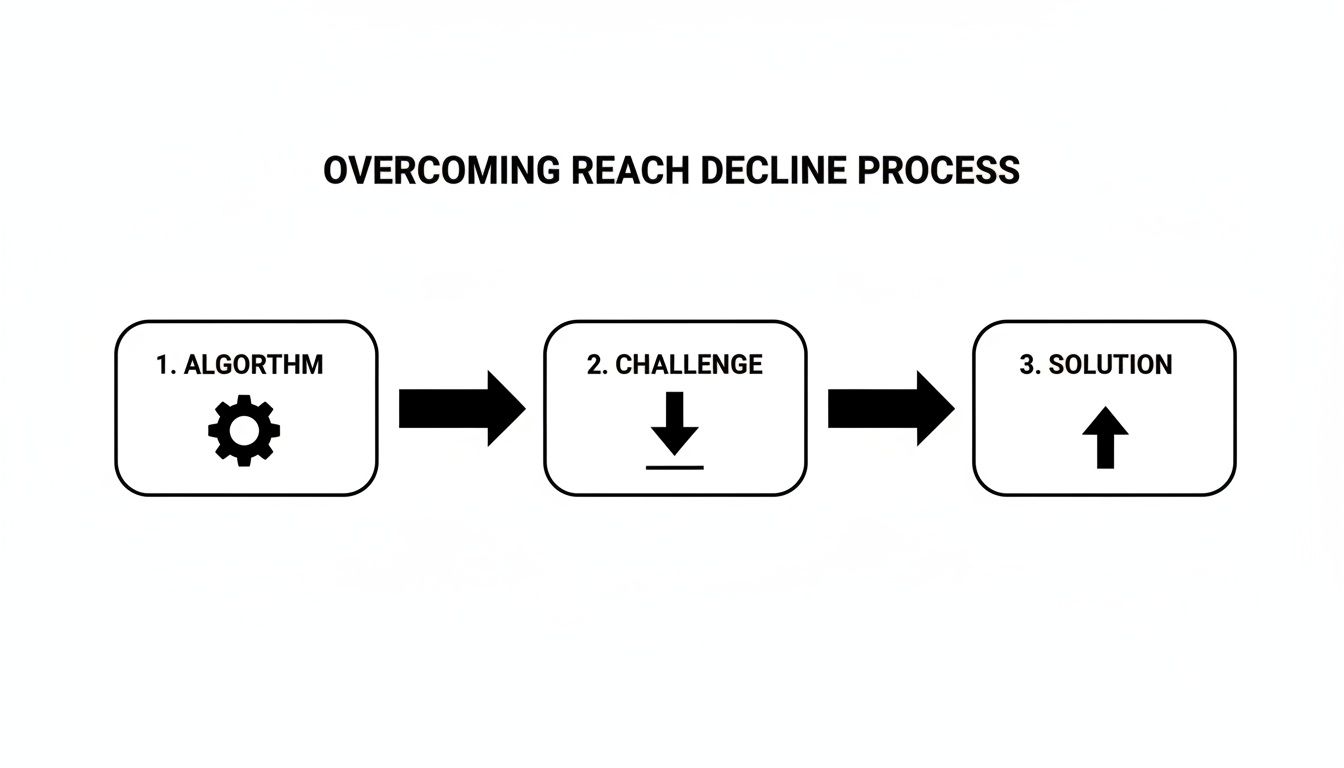
While algorithms constantly push your visibility down, a system built on evergreen content gives you the upward push needed to stay consistently in front of your audience. Let's break down how to build that system.
Step 1: Find Your Evergreen Gold
Before you can automate a single post, you need to know what you're working with. It’s time to go on a treasure hunt through your existing content. You’re looking for the timeless, foundational gems that are always valuable to your audience.
Comb through your blog posts, videos, and old social media updates. Pull out anything that isn’t tied to a specific date, a past event, or a fleeting trend.
What does this "gold" look like?
- Fundamental "How-To" Guides: Articles that teach a core skill in your industry.
- Deep-Dive FAQs: Detailed answers to the most common questions you get from customers.
- Timeless Tips & Best Practices: Actionable advice that never really goes out of style.
- Powerful Case Studies: Real-world stories showing how your product or service delivers results.
- Brand Mission & Values Posts: Content that tells people who you are and what you believe in.
Once you’ve rounded up these assets, you have the raw material for your automation engine. If you want to build a more formal framework around this, it's worth exploring a complete https://www.evergreenfeed.com/blog/evergreen-content-strategy/ to get the full picture.
Step 2: Organize Your Content into Thematic Buckets
Now that you have your collection of evergreen content, the next step is to get organized. Just dumping everything into one giant library will lead to a repetitive and boring feed. Nobody wants that.
Instead, start sorting your content into thematic "buckets" based on the topic or format.
This simple act of organization is crucial. It ensures your automated feed has variety and balance, so you’re not posting three blog post promos in a row. By separating content into buckets, you can build a schedule that pulls from different themes, keeping your feed fresh and genuinely interesting.
Your content buckets might look something like this:
- How-To Guides
- Company Culture & Behind-the-Scenes
- Inspirational Quotes
- Product Tips & Tricks
- Customer Testimonials
This structure is the backbone of a smart automation system. It puts you in complete control of the content mix your audience sees.
By organizing your best content into buckets, you’re not just archiving it; you’re creating a strategic library that an automation tool can use to build a diverse and consistently valuable social media feed.
Step 3: Set Up Your Automation System
This is where the magic happens and you win back hours of your time. Using a tool built specifically for evergreen automation, you can create a system that continuously recycles your best content. Your social media profiles will never go silent again.
The process is pretty straightforward. First, you connect your social media accounts. Next, you add all that great evergreen content into the buckets you just created. Finally, you create a posting schedule that tells the system which buckets to pull from, on which days, and at what times.
For instance, you might schedule a post from your "How-To Guide" bucket every Monday morning and one from your "Customer Testimonial" bucket every Friday afternoon. And to keep your visuals fresh without spending hours in a design tool, you can even lean on AI Image Generators to create compelling graphics for your posts.
Once it's all set up, the tool does the heavy lifting for you. It automatically picks a piece of content from the right bucket and posts it according to your schedule. This creates a constant stream of high-value content, filling the gaps between your brand-new posts and guaranteeing you stay active and visible. It's a direct solution to the reach problem—you're increasing the number of quality touchpoints with your audience and getting the maximum possible impact from your best work.
How to Measure Your Organic Social Media ROI
Measuring the return on your organic social media can feel a bit like trying to catch smoke. Sure, likes and follower counts are nice little ego boosts, but they don't exactly pay the bills. The real trick is to draw a clear line from your social media activity to actual business results, proving that all that time and effort are actually worth something.
To make that happen, you have to look past the vanity metrics. It’s time to focus on Key Performance Indicators (KPIs) that really mean something to your business goals. Think of it this way: you’re not just counting the size of the crowd, you’re tracking how many people in that crowd actually do something valuable.
Tying Metrics to Business Goals
Every metric you track should answer a real question about your business. Instead of trying to measure everything under the sun, it’s much smarter to organize your KPIs around three core objectives that directly impact your bottom line. This keeps your reporting clean, focused, and actually useful.
Here's a simple framework to get started:
-
Brand Awareness: How many new, relevant people are finding out you exist? The big metrics here are Reach (the unique number of people who see your content) and Impressions (how many times your content was shown). This tells you if you're successfully expanding your footprint.
-
Audience Engagement: Are people actually interacting with your posts in a meaningful way? Don't just stop at likes. Dig deeper into Comments, Shares, and especially Saves. When someone saves your post, it's a powerful signal that they found it so valuable they plan to come back to it.
-
Conversions: Is your social media actually driving actions that make you money? This is where the ROI really comes into play. You need to be tracking Website Clicks from your bio link and posts, Leads Generated from special landing pages, and the Referral Traffic flowing into your website analytics.
Connecting Social Activity to Website Traffic
For the full picture, you can't just stay inside the social media apps. You need to see what happens after someone clicks. This is where tools like Google Analytics become your best friend, showing you how your organic social efforts turn into real website visitors who could become customers. In your analytics dashboard, you can see exactly which social networks are sending you traffic.
And this referral traffic is a bigger deal than ever. A recent study showed that global traffic from social media jumped from 14.24% to 16.32% in just eight months. At the same time, the share of traffic from organic search actually went down, which tells us that social is quietly becoming a much more important discovery channel. You can read up on these trends in website traffic sources on seranking.com.
By tracking referral traffic, you can directly connect website sessions, new leads, and even sales back to your organic social media presence. This is how you stop treating social as a "nice-to-have" and start proving it's a revenue-driving machine.
Common Questions About Organic Social Media
Getting an organic social media strategy off the ground always brings up a few key questions. Let's tackle some of the most common ones that marketers and founders run into.
What's the Right Posting Frequency?
There's no magic number here. The real key is consistency, not just raw volume. You want to create a rhythm your audience can rely on, which keeps your brand in their mind without overwhelming them.
A great starting point for platforms like Instagram and Facebook is posting 3-5 times a week. For a more professional audience on LinkedIn, you might find that 2-4 high-quality posts per week is the sweet spot. The main thing is to avoid long, silent gaps. This is where automating your evergreen content really shines—it fills in those empty spaces between your new, timely posts, ensuring your feed never looks abandoned.
Does Organic Social Media Actually Lead to Sales?
Yes, it absolutely does, but it works in a couple of different ways. First, there's the indirect path. By consistently showing up and sharing valuable content, you build trust and establish yourself as an authority. This "warms up" your audience, so when they are ready to buy, you're the first one they think of.
Then there's the direct route. You can drive people who are ready to act straight to your product pages or email sign-ups using links in your bio, stories, and posts. Think of it this way: the value you provide for free earns you the right to make an offer. Over time, that trust directly translates into conversions. You can even see this in action by tracking website clicks from your social channels in your analytics.
It’s far better to truly own one or two platforms where your ideal customers hang out than to have a weak, scattered presence everywhere. Deep, quality engagement on the right channels will always beat a shallow effort across the board.
Once you have a solid system in place for your main channels—especially if automation is handling your evergreen content—then you can start thinking about expanding to other networks without letting your quality slip.
Ready to stop the daily grind and put your best content to work? EvergreenFeed automates your social media schedule, ensuring your profiles are always active with high-value content. Sign up for free and start saving hours today.