James
James
At its core, an integrated marketing campaign is a strategy that gets all your marketing channels singing from the same hymn sheet. Instead of running a jumble of disconnected promotions, this approach makes sure everything—from your social media and email blasts to your blog posts and press releases—works together to tell a single, powerful story.
Why Siloed Marketing Fails and Integration Wins

Think of your marketing like an orchestra. If the violins are playing Beethoven while the trumpets are blasting jazz, all you get is chaos. But when a conductor unifies them with a single piece of music, you create a symphony. That’s exactly what integrated marketing does for your brand.
So many businesses accidentally fall into the "siloed marketing" trap. The social media team has its own goals, the email team is focused on its own metrics, and the content team is off creating articles with no real connection to the other activities. This disjointed approach doesn't just waste effort; it confuses your customers and muddies your brand's message.
An integrated approach turns scattered marketing tactics into a unified force. It creates a seamless customer journey where every interaction reinforces the same core message, building brand recognition and trust with each touchpoint.
This kind of cohesive experience isn't just a "nice to have" anymore. It’s what today's customers expect. They don't see your brand in separate channels; they just see your brand. When your messaging is consistent everywhere they look, it builds a sense of reliability and professionalism. This alignment is a non-negotiable part of any solid digital marketing strategy for small businesses and global giants alike.
Integrated vs Siloed Marketing At a Glance
To really see the difference, a side-by-side comparison makes it crystal clear. Here’s a quick breakdown of how these two approaches stack up.
| Aspect | Integrated Marketing | Siloed Marketing |
|---|---|---|
| Messaging | Consistent & unified across all channels | Inconsistent & fragmented |
| Customer Experience | Seamless & cohesive journey | Disjointed & confusing |
| Team Collaboration | Cross-functional & aligned | Isolated & independent |
| Brand Perception | Strong, trustworthy, & reliable | Weak, confusing, & unprofessional |
| Efficiency | High (resources are pooled) | Low (efforts are duplicated) |
| Overall Impact | Amplified & memorable | Diluted & forgettable |
As you can see, the integrated model is designed to multiply your impact, while the siloed approach often ends up dividing it.
The Power of a Unified Message
The main idea behind integrated marketing is to craft a single, compelling narrative that runs through every platform you use. This doesn't mean you just copy and paste the same ad everywhere. It means you adapt your core message to fit the unique style and audience of each channel, whether it's a witty tweet, an in-depth blog post, or a visually stunning Instagram story.
When you get this right, the benefits are huge:
- Amplified Impact: Each channel builds on the momentum of the others. It’s a snowball effect that makes your entire campaign far more memorable.
- Increased Brand Trust: Consistency is key. When people see the same core message reinforced everywhere, it strengthens their confidence in who you are and what you stand for.
- Improved Efficiency: By coordinating your efforts, you stop wasting time on redundant tasks. Everyone is pulling in the same direction, which means a much better return on your marketing spend.
- Enhanced Customer Experience: A smooth journey from one touchpoint to the next removes friction and makes it incredibly easy for customers to engage with you.
The Growing Importance of Integration
This shift toward integrated strategies isn't just a fleeting trend; it's a fundamental change in how great brands are built. The Global Integrated Marketing Communication (IMC) market hit a staggering USD 2.8 billion in 2023, a clear signal of how critical this approach has become.
What this number really shows is a massive wake-up call in the business world: disconnected marketing just doesn't cut it anymore. You can read the full research about the IMC market to dig deeper. The growth is undeniable—blending digital, social, and traditional channels is now essential for building a brand that can truly make an impact and stand the test of time.
The Building Blocks of a Powerful Campaign
Every knockout integrated marketing campaign is built on the same handful of core principles. These aren't just abstract theories; they’re the practical, foundational elements that give your strategy focus, consistency, and the punch it needs to actually connect with people.
Think of it like building a house. You can't just start throwing up walls. You need a solid blueprint, a strong foundation, and a clear idea of who you're building it for. A marketing campaign is the exact same—it needs a solid plan and the right materials to stand tall. Let's break down the four essential pillars.
The Big Idea: Your Campaign's North Star
At the heart of every great campaign is the Big Idea. This is the creative, emotional core—the single, compelling thought that ties every ad, email, and social post together. It’s more than a catchy tagline; it’s the central theme of your brand's story for this specific moment.
A good analogy is a movie. A film like Inception has a simple, powerful Big Idea: "What if you could enter someone's dreams?" Every scene and line of dialogue serves that one concept. Your campaign's Big Idea does the same job, making sure every piece of content works together to tell one cohesive, memorable story.
Deeply Understanding Your Audience Personas
You could have the most brilliant idea in the world, but if it doesn't land with the right people, it’s dead on arrival. This is where audience personas come into play. These aren't just vague demographic sketches; they are detailed, semi-fictional profiles of your ideal customer, pieced together from real data and market research.
A truly useful persona goes way beyond age and location. It digs into their motivations, their biggest challenges, their daily habits, and where they hang out online. Knowing these details is the difference between shouting into a crowded room and having a genuine one-on-one conversation.
Crafting Consistent and Cohesive Messaging
Once you have your Big Idea and you know exactly who you're talking to, the next pillar is consistent messaging. This is all about making sure the tone, voice, and key message of your campaign feel the same across every single touchpoint. Consistency is what builds brand recognition and, more importantly, trust.
This doesn’t mean you just copy and paste the same text everywhere. It's about adapting the core message to feel native to each channel:
- LinkedIn: Your message might be a professional, data-backed post about industry impact.
- Instagram: It could be a visually striking Reel that tells the emotional side of the story.
- Email: A more personal note that speaks directly to a subscriber’s problems.
- Blog: A deep-dive article that explores the Big Idea from every angle.
The underlying theme never changes, creating a seamless experience that reinforces your brand at every turn. Building out this kind of solid messaging is a huge part of what makes content pillars so effective in any marketing strategy.
Strategic Channel Selection
Finally, no integrated campaign gets off the ground without strategic channel selection. The goal isn't to be everywhere—it's to be everywhere your audience is. Your persona research is your roadmap here. If your ideal customer is a B2B decision-maker, then LinkedIn and niche industry forums are going to be far more valuable than a channel like TikTok.
A common mistake is spreading a campaign too thin across a dozen channels. It’s far more effective to dominate the few places where your audience is most active. That’s how you break through the noise.
Choosing the right channels focuses your budget and energy where they'll deliver the biggest impact. It’s this focused approach that lets you execute campaigns that feel both personal and powerful. Master these four building blocks, and you'll have a foundation strong enough to support any marketing goal you can dream up.
Your Step-by-Step Campaign Planning Blueprint
Okay, you’ve got the foundational concepts down. Now it’s time to roll up our sleeves and actually build the plan. A truly effective integrated marketing campaign never just happens. It’s the direct result of a methodical, almost obsessive, planning process. This blueprint will walk you through turning those abstract goals into a concrete strategy where every single moving part has a job to do.
Think of it like planning a cross-country road trip. You wouldn't just get in the car and hope for the best, right? You'd pick a destination (your goals), check the map (your research), plot your route (the customer journey), and highlight the cool stops you want to make along the way (your messaging). It’s this kind of systematic approach that makes sure you actually get where you’re going.
Establish SMART Campaign Goals
Before you write a single line of copy or design a single graphic, you have to define what victory looks like. And I mean really define it. Fuzzy goals like “boost brand awareness” or “get more leads” just don't cut it. Your goals need to be SMART: Specific, Measurable, Achievable, Relevant, and Time-bound.
This framework isn't just business jargon; it forces you to be brutally honest and gives your entire team a single, unified target to aim for.
- Specific: Don't say "more traffic." Say "increase organic blog traffic from female entrepreneurs between 25 and 40."
- Measurable: Slap a number on it. For example, "increase organic blog traffic by 20%."
- Achievable: Be real. Is a 20% jump possible with your current team and budget? Set goals that stretch you, but don't break you.
- Relevant: Does this goal actually matter? If your main business objective is selling a new online course, then yes, increasing blog traffic is highly relevant.
- Time-bound: Give yourself a deadline. "Increase organic blog traffic by 20% over the next 90 days."
Once you have a SMART goal, every decision you make—from which channels to use to how much you spend—can be measured against it. No more guesswork.
Conduct Deep Audience and Market Research
So, you know your destination. Now you need to understand the terrain. This is where you put on your detective hat and dig deep for the insights that will shape your entire campaign. You have to get past basic demographics and dive into the psychographics—what your audience truly values, what keeps them up at night, and where they go for information.
Start asking the tough questions:
- Where does my ideal customer actually hang out online? (Hint: it might not be where you think.)
- What kind of content makes them stop scrolling and pay attention?
- Who are the influencers, bloggers, or publications they genuinely trust?
- What are my competitors up to, and more importantly, what are they missing?
The answers you find here are your secret weapon. They stop you from throwing money away on platforms your audience ignores and help you craft a message that hits home. A solid social media marketing strategy playbook is a great resource here, as it can help you get inside your audience's head on the platforms that matter most.
Planning isn't just about deciding what to do. It's about having the confidence to decide what not to do. Good research tells you where to focus your fire for the biggest impact.
This groundwork is absolutely non-negotiable. The insights you pull from this stage will directly inform your core message and channel strategy, making sure they’re perfectly in sync with your audience’s world.
Define Your Core Message and Creative Hook
With a clear goal in one hand and deep audience insights in the other, you’re ready to craft your central campaign message. This is your "Big Idea" in action—that single, compelling story that will be the common thread woven through all your channels. It needs to be simple, memorable, and speak directly to a pain point or desire you uncovered in your research.
A powerful core message is the emotional heartbeat of your campaign. It’s what connects with people on a human level. Once you nail this down, it becomes the creative filter for everything you produce, from a 280-character tweet to a five-minute video.
Even when the economy gets tight, smart marketers know that integrated campaigns are the right move. In 2023, while 64% of marketers globally were hoping for budget increases, a whopping 69% said economic pressures were impacting their plans. And yet, they still prioritized integrated campaigns to get better ROI across different media. Why? Because a unified plan finds and closes performance gaps. For example, simply optimizing investment in an underused channel like digital video can boost ROI by a median of 51%.
Map the Customer Journey
Finally, it's time to visualize the exact path you want your audience to take. A customer journey map is an outline of every single touchpoint someone could have with your campaign, from the first moment they hear about you to the point they become a loyal fan. This step is critical for ensuring the experience feels seamless and intuitive as people move from one channel to the next.
Mapping the journey helps you figure out the logistics:
- Awareness: How will people find out about this in the first place? A targeted social media ad? A blog post that ranks on Google?
- Consideration: Once they're interested, what content will you give them to build trust? A deep-dive webinar? A helpful email series?
- Conversion: What’s the final action you want them to take? Is it signing up for a free trial or making a direct purchase?
- Loyalty: After they convert, how do you keep them engaged? A private customer community? Exclusive follow-up content?
By carefully planning this flow, you eliminate dead ends and confusing handoffs. You create a smooth, cohesive experience that gently guides your audience right to your campaign's goal.
Executing and Coordinating Your Marketing Channels
You've got the blueprint. Now, it's time to bring your integrated marketing campaign to life. This is where the rubber meets the road—the execution phase, where careful coordination turns a solid plan into a flawless real-world launch. Success at this stage hinges on getting every team member and every piece of content moving in perfect sync.
The nerve center of this whole operation is a master content calendar. Think of it as the campaign's mission control. It’s the single source of truth that maps out every email, blog post, social media update, and press release, ensuring your core message stays consistent while being perfectly adapted for each platform.
This is the fundamental process that gets you to a smooth, coordinated execution.
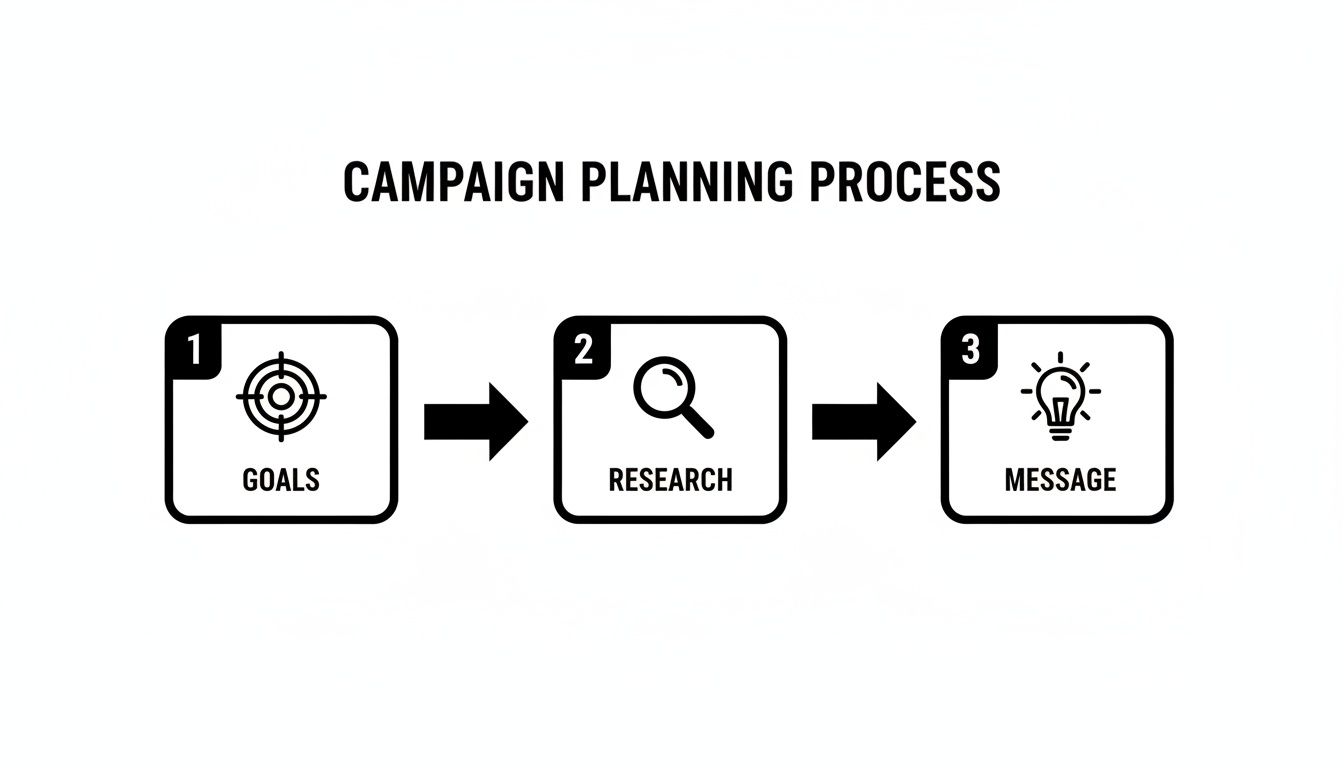
Starting with clear goals, moving into deep research, and landing on a unified message—this flow shows why a strong plan is the bedrock of any successful launch.
Tailoring Your Message for Each Platform
Consistency is crucial, but it doesn't mean copy-pasting the same message everywhere. A great integrated campaign delivers the same core idea in different packages, each one custom-fit to the audience and format of the channel. Your master calendar is what helps you orchestrate this dance.
- LinkedIn: This is where you put on your professional hat. Think data-driven articles, sharp industry analysis, or a peek behind the curtain at your company's expertise.
- Instagram: It's all about visual storytelling here. Use high-quality images, snappy Reels, and interactive Stories to tap into the emotional side of your campaign.
- Email: This is your direct line. Use it to send personalized, high-value content to your subscribers, nurturing them with messages that speak directly to their problems.
- Public Relations (PR): Unlike paid ads, PR is all about earned media, which builds serious credibility. Timing your press releases and media outreach to your campaign's key moments can amplify your message through trusted, independent voices.
The magic really happens when a customer reads a professional article from you on LinkedIn, then later sees a compelling visual on Instagram, and it all clicks. Each piece reinforces the other, creating a powerful and memorable brand experience.
This multi-channel harmony is what separates a truly integrated campaign from a bunch of disconnected promotions. It ensures every touchpoint tells a piece of the same larger story.
Using Technology to Keep Things Running Smoothly
Juggling multiple channels can feel like a herculean task, but technology is your best friend here. Modern marketing tools can automate repetitive work, offer up powerful insights, and help your team work together without stepping on each other's toes. From project management software to analytics dashboards, the right tech stack keeps your campaign on track.
One of the smartest ways to use technology is for social media automation. While your big campaign has a clear beginning and end, social media is a 24/7 job. This is where automating your evergreen content—your timeless, high-value posts—is an absolute game-changer. It keeps the lights on and your audience engaged, even when you're focused elsewhere.
Automating Evergreen Social Content
Tools like EvergreenFeed integrate with platforms like Buffer to create a perpetual content engine that supports your campaign goals without needing constant manual input. The setup is surprisingly simple for how effective it is.
- Create Content Buckets: First, you organize your evergreen posts into different categories, or "buckets." You might create buckets for "Blog Posts," "Industry Tips," "Quotes," or "Case Studies."
- Set a Schedule: Next, you decide on a posting schedule for each social account. For example, you could tell the system to share something from your "Blog Posts" bucket every Monday and a post from your "Quotes" bucket every Friday.
- Automate and Forget: The tool then automatically pulls content from the right bucket and posts it on schedule. Your profiles stay active with great content, keeping your audience engaged between your major campaign pushes.
By automating your baseline social activity, you free up your team to focus on the more creative and time-sensitive parts of your integrated campaign. It's a perfect example of working smarter, not harder, to maintain momentum.
How to Measure Campaign Success and True ROI
Launching a brilliant integrated marketing campaign is only half the battle. If you can’t measure its impact, you’re just flying blind. You have no way to prove its value, and you’re essentially guessing what to do next.
Success isn't about chasing vanity metrics like likes and shares. It’s about tying every single action back to real business outcomes. This means you need solid methods for measuring marketing campaign effectiveness and figuring out your true return on investment.
Moving Beyond Vanity Metrics
It's tempting to get caught up in numbers that look impressive but don't actually mean anything for the business. A huge spike in website traffic feels great, but if none of those visitors ever buy anything, it didn’t really help your bottom line.
True measurement means focusing on the metrics that are directly connected to revenue and growth. Here are the core KPIs you should be tracking:
- Customer Acquisition Cost (CAC): How much does it cost you to get a new customer? This is your total marketing and sales spend divided by the number of new customers you brought in. A low CAC is a sign of an efficient campaign.
- Customer Lifetime Value (LTV): This is a forecast of the total revenue you can expect from a single customer over their entire relationship with your brand. The goal is simple: your LTV should be much, much higher than your CAC.
- Conversion Rate: What percentage of people are taking the action you want them to take, whether that’s buying a product or signing up for a newsletter? You should be tracking this for every channel to see which ones are pulling their weight.
- Return on Investment (ROI): This is the ultimate test. Are you making more money than you're spending? For a closer look, check out our guide on how to calculate your content marketing ROI to see these principles in action.
Understanding Attribution Modeling
In a modern campaign, customers rarely interact with you just once before they convert. They might see a social media ad, read a blog post you wrote, and then finally click a link in an email. So, who gets the credit?
That’s where attribution modeling comes in. It’s the rulebook you use to assign credit to each of these touchpoints, helping you figure out which channels are actually moving the needle.
Attribution isn't about finding a single "hero" channel. It's about understanding how your channels work together to guide a customer from awareness to action.
Different models work in different ways. A first-touch attribution model gives 100% of the credit to the very first channel a customer encountered. In contrast, a last-touch model gives all the credit to the final touchpoint before the sale. More sophisticated models, like linear or time-decay, spread the credit more fairly across the entire customer journey.
Building a Unified Dashboard
To really see what’s going on, you need a single source of truth. You can’t be jumping between a dozen different platforms to piece the story together.
Tools like Google Analytics 4 (GA4) are perfect for this. They let you build a unified dashboard that pulls in data from all your different channels, giving you a clear, visual map of the entire customer journey.
By tracking the right KPIs and using a smart attribution model, you can stop guessing and start making decisions based on cold, hard data. This is how you optimize your budget, prove your worth, and make every campaign more successful than the last.
Inspiring Examples of Campaigns That Nailed It
Theory is great, but seeing integrated marketing campaigns work in the real world is where the magic really happens. When a brand gets it right—weaving all its channels around one powerful idea—the results can be legendary. These examples prove that a truly unified strategy does more than drive sales; it creates cultural moments.
One of the most powerful examples has to be Dove’s "Real Beauty" campaign. The core idea was simple but hit a nerve: to challenge the narrow, often unattainable standards of beauty we see everywhere. But this wasn’t just a single TV ad. It was a complete narrative that played out across every single touchpoint.
Print ads showcased real women, not supermodels, instantly sparking conversation. Online, viral videos and interactive forums invited participation, while a smart PR push landed features in major publications. By consistently hitting this one powerful theme from every angle, Dove didn't just sell soap—it started a global movement and cemented its brand as a champion for authenticity.
Domino’s AnyWare: A Lesson in Convenience
Another fantastic case study in seamless integration comes from Domino’s with its "AnyWare" campaign. Domino's zeroed in on a very real customer frustration: ordering should be dead simple. Their big idea? Let people order pizza from literally anywhere, using whatever device was most convenient for them.
Launched back in 2015, this initiative was a masterclass in omnichannel strategy. You could order by tweeting a pizza emoji, sending a simple text, or even talking to your Ford Sync system, smartwatch, or smart TV. This wasn't just a gimmick; it was a bold strategy that tore down every barrier to ordering. By tying together social media, innovative tech, and traditional advertising, Domino's made convenience the absolute core of its brand experience. You can find more insights about this and other powerful examples of integrated marketing communications to see exactly how they pulled it off.
The most effective campaigns don't just sell a product; they solve a problem or tap into a cultural conversation. Their genius lies in making a complex, multi-channel execution feel simple and intuitive for the customer.
What can we learn from all this? The biggest takeaway is that success isn't just about being on every channel. It’s about using the right channels to tell one consistent, compelling story. Whether you’re challenging conventions like Dove or redefining convenience like Domino's, these brands prove that when you get integration right, you don't just see growth—you build unshakeable brand loyalty.
Common Questions About Integrated Campaigns
Even with the best game plan, some questions always come up when you start putting theory into practice. Let's tackle a few of the most common ones I hear about building and running integrated marketing campaigns. Getting these sorted will help you clear any hurdles and move forward with confidence.
What Makes an Integrated Campaign Different?
The real difference comes down to unity versus isolation. Think about a standard campaign—it might just be a singular push on social media for a new product, kind of existing in its own little world. An integrated marketing campaign, on the other hand, is a complete strategy that weaves together multiple channels—like social, email, PR, and content—all around one, single-minded message.
It’s the difference between a soloist playing a tune and a full orchestra playing a symphony. The goal is to create a seamless, connected experience for your customer, no matter where they bump into your brand. Every interaction reinforces the message, making the total impact way bigger than what any single channel could do on its own.
How Can a Small Business Get Started?
You really don't need a huge budget to pull this off. The trick is to start small and stay focused. First, get crystal clear on who you're talking to—your ideal customer—and then nail down your core message.
From there, just pick two or three channels where you know your audience hangs out. Maybe that's your blog, an email list, and one social media platform you know you can manage well. The key is making sure your branding, your voice, and your call-to-action are exactly the same across all of them. Simple tools, like a social media scheduler, can be a lifesaver here, helping you maintain that consistent presence without eating up all your time.
A common trap for small businesses is trying to be everywhere at once. It's so much more powerful to dominate a few key channels than to spread yourself thin with a weak presence across a dozen.
This focused approach lets your efforts build on each other, creating real momentum without overstretching your team or your budget.
How Do You Stay Consistent Without Being Repetitive?
This is such an important distinction. Consistency is all about the core message and your brand's identity, not about copy-pasting the exact same words and images everywhere. The real art is learning how to adapt your central theme to fit the unique format and audience of each channel.
This is how you create a richer, more interesting experience for your audience. For example, the same campaign idea could look like:
- A professional, data-driven article on LinkedIn.
- A stunning infographic or a quick Reel on Instagram.
- A short, snappy video series on TikTok.
- A deep-dive case study with customer stories on your blog.
Each piece of content feels native and fresh to its platform, but they all point back to the same big idea. This keeps your audience engaged while you build a powerful, unified story about your brand in their minds.
Ready to stop juggling and start automating your social media presence? With EvergreenFeed, you can set up your best content to post automatically, keeping your audience engaged while you focus on the bigger picture. Start automating your evergreen social content for free.