James
James
Writing truly engaging content isn't about clever wordsmithing or finding the perfect hashtag. It starts long before your fingers hit the keyboard. The real secret is building a genuine connection with your audience by deeply understanding their world—their problems, their goals, and the exact language they use.
This is the make-or-break step. It’s what separates content that gets scrolled past from content that feels like it was written just for them.
What It Really Takes to Create Engaging Content

Before a single word is written, you have to know who you’re talking to. And I don’t mean just slapping together a generic “buyer persona” filled with vague demographics. True engagement is born from empathy. It comes from knowing the real-world challenges your audience faces, what they dream of achieving, and the specific phrases they use to talk about it all.
Skipping this research phase is like trying to navigate without a map. You're just guessing, and your content will almost certainly miss the mark.
Uncovering Audience Pain Points
The best way to understand your audience? Shut up and listen. Seriously. Move beyond your analytics dashboards and immerse yourself in the online communities where they hang out. That's where you'll find the raw, unfiltered truth.
Here are a few of my go-to methods for this:
- Social Listening: Keep an eye on hashtags, keywords, and what people are saying about your competitors on platforms like X (formerly Twitter), LinkedIn, and Reddit. The questions people ask and the frustrations they vent are pure gold.
- Review Mining: Dig through the customer reviews for your products and services, but don't stop there—check out your competitors' reviews, too. The language people use in their 1-star and 5-star reviews tells you everything about their biggest problems and their ideal solutions.
- Customer Conversations: Your sales and support teams are on the front lines. They talk to customers all day, every day. A quick 15-minute chat with them can uncover more killer content ideas than a week of brainstorming on your own.
This research isn't just about collecting data points; it's about building the entire foundation for your content strategy. For a deeper dive into these core principles, check out these content marketing best practices that consistently drive results.
Your goal is to go from a blurry concept of an "audience" to a razor-sharp image of a single person. When you write for that one person, your message suddenly becomes specific, personal, and a thousand times more powerful.
Mapping the Customer Journey
Once you know who you're talking to, you need to figure out where they are in their journey with you. Someone who is just now realizing they have a problem needs a completely different kind of content than someone who is comparing options and ready to buy. This is a fundamental concept we break down in our guide explaining https://www.evergreenfeed.com/blog/what-is-content-marketing/.
Mapping out this journey allows you to create the right content for the right moment, guiding them forward. It helps you see exactly where your content can step in and be the solution they're looking for.
Think about it: a beginner might be Googling "how to start a social media calendar," while a pro is searching for "best social media automation tools." By creating content that speaks to both, you serve your entire audience, meeting them exactly where they are. This targeted approach ensures every article, post, and video has a clear purpose.
Crafting Headlines and Hooks That Stop the Scroll

Let's be honest. Your headline and first sentence are your entire sales pitch. In the endless river of content we all scroll through, you've got about three seconds to give someone a reason to pause. If you fail, the rest of your brilliant content might as well not exist.
This isn't about writing clickbait. It’s about making a crystal-clear promise to your reader. A great headline’s job is to signal value and spark just enough curiosity to earn that click. The opening hook then has to immediately prove that the click was worth it, pulling them deeper into your story. Getting this one-two punch right is the first, and most important, step to writing truly engaging content.
Beyond the Basic Formulas
Sure, headline formulas can be a helpful starting point, but leaning on them too much is a recipe for sounding generic. The real magic happens when you move beyond the templates and blend proven psychological triggers with a genuine understanding of what your audience actually cares about.
Instead of just plugging in keywords, try one of these approaches:
- Ask a Provocative Question: A good question forces the reader to engage. Instead of "How to Improve Team Productivity," what if you asked, "Is Your Team Really Productive, Or Just Busy?" This reframe makes the problem personal and urgent.
- Use Surprising Statistics: Numbers grab attention and build instant authority. A headline like, "Why 85% of Content Marketing Fails (And How to Be in the Top 15%)" is far more powerful than a vague promise.
- Promise a Clear Outcome: People are looking for solutions. Be explicit about the benefit you offer. "The 5-Minute Morning Routine That Will Double Your Focus" promises a specific, highly desirable result.
If you really want to dig into the mechanics of this, we've got a whole guide on how to write perfect headlines for your blog posts.
A great headline doesn't just describe what the article is about; it sells the value of reading it. It answers the reader’s unspoken question: “What’s in it for me?”
The Art of the Opening Hook
Okay, you got the click. Now what? Your opening paragraph has to deliver on that headline's promise and create immediate momentum. This is your chance to connect with their emotions, show them you understand their problems, and confirm they've come to the right place.
Your opening hook needs to accomplish one of these things in the first couple of sentences:
- Start with a Bold Statement: Challenge a common belief right out of the gate. Something like, "Most of the productivity advice you’ve read is just plain wrong."
- Paint a Relatable Scenario: Describe a specific pain point your reader will recognize instantly. This builds immediate rapport.
- Lead with a Compelling Fact: Just like with headlines, a shocking statistic can be an incredibly effective way to pull a reader in.
This all comes down to understanding human behavior. After all, research shows that 82% of consumers feel more positive about a brand after reading content that feels tailored to them. That connection begins the very second they start reading, which makes your hook absolutely critical.
Ultimately, writing engaging content is about respecting your reader's time. A powerful headline and a sharp hook are the ultimate signs of that respect—it shows them you have something valuable to say and you won't waste a second of their attention.
Choosing Your Format and Narrative Framework
So, you’ve nailed down who you’re talking to and how to get their attention. The next critical question is, what’s the best way to actually deliver your message?
The format you pick isn’t just a container for your ideas—it fundamentally shapes how your audience will experience them. I’ve seen it happen time and time again: a powerful idea gets stuffed into the wrong format and completely falls flat. It’s a waste of a great concept.
Choosing the right format is a strategic move. It's a balancing act between what your audience actually wants, the message you need to convey, and the resources you have on hand. Learning how to write engaging content often boils down to this: matching the story you want to tell with the medium that tells it best.
For instance, if you're diving into a complex, data-heavy topic, an in-depth blog post or a detailed whitepaper makes perfect sense. But if you have an emotional customer success story? That will hit much harder as a short, compelling video.
Selecting the Right Content Format
The format you choose has to align with where your audience spends their time and how they like to consume information. A busy executive might only have time for a quick, scannable listicle, while a researcher is probably looking for a long-form article they can really sink their teeth into.
Understanding the unique strengths of different formats is everything. In fact, by 2025, video is expected to be king, with 45% of marketers globally calling it the most effective format. Short-form articles aren't far behind at 31%, and success stories hold strong at 28%, proving that both brevity and real-world proof are incredibly valuable.
And don't sleep on interactive content like quizzes—they can actually double engagement rates compared to static posts. You can find more of these content marketing statistics to see how different formats are performing across the board.
Here’s a quick breakdown to help you decide:
- Blog Posts & Articles: These are your SEO workhorses. They're perfect for in-depth how-to guides, establishing your expertise, and tackling complex subjects.
- Video Content: Nothing beats video for storytelling and creating a genuine human connection. Use it for tutorials, behind-the-scenes glimpses, customer testimonials, and product demos.
- Case Studies: This is your ultimate tool for social proof. Case studies walk a prospect through a real customer’s problem and show them exactly how you solved it. It’s tangible evidence.
- Interactive Quizzes & Polls: If you want to drive direct engagement and gather useful audience data, this is your go-to. They turn passive scrolling into an active experience.
Content Format Engagement Potential
Different formats serve different purposes and connect with audiences in unique ways. Some are quick hits designed for social media, while others are built for deep dives and establishing authority. This table breaks down some of the most popular formats to help you decide which one fits your specific goal.
| Content Format | Primary Channel | Engagement Potential | Best For |
|---|---|---|---|
| Short-Form Video | TikTok, Instagram Reels, YouTube Shorts | Very High | Grabbing attention, showing personality, viral trends |
| Blog Posts/Articles | Website/Blog, LinkedIn, Email | Medium to High | SEO, in-depth education, thought leadership |
| Infographics | Pinterest, Blog Posts, LinkedIn | High | Simplifying complex data, shareable stats |
| Case Studies | Website, LinkedIn, Email | High | Building trust, demonstrating value, closing deals |
| Interactive Quizzes | Social Media, Website | Very High | Audience interaction, lead generation, data collection |
| Live Video/Webinars | Facebook, LinkedIn, YouTube | High | Community building, direct Q&A, product launches |
Choosing the right format isn't about picking the most popular one; it's about selecting the one that best serves your message and resonates with the audience you're trying to reach. A well-rounded strategy often uses a mix of these.
The most engaging content strategies don't just stick to one format. They use a smart mix, with each piece of content chosen for a specific purpose and a specific audience segment.
Using Narrative Frameworks to Structure Your Ideas
A great format is only half the battle. To really pull your audience in, you need a solid narrative structure—a proven framework that gives your content a logical and emotional flow. Think of these as the blueprints for your story.
One of the most effective and straightforward frameworks I always come back to is the Problem-Agitate-Solve (PAS) model. It’s so powerful because it taps directly into your audience's deepest pain points.
Here’s how it works:
- Problem: Start by calling out a specific pain point your reader is dealing with. This immediately shows you get it. You understand their world.
- Example: "Struggling to keep your social media feeds consistently active?"
- Agitate: Don’t just state the problem—twist the knife a little. Describe the frustrations and consequences. Make them feel the pain of it.
- Example: "You spend hours on the perfect post, only for it to get buried in a day. Your channels go quiet, engagement tanks, and you feel like you're always one step behind."
- Solve: Now, you swoop in. Introduce your solution as the clear, obvious answer to that agitated problem. This is where you position your product or advice as the way out.
- Example: "That's exactly why we built EvergreenFeed. It automates your evergreen content, so your social channels are always buzzing with your best posts, driving engagement while you focus on what matters."
This simple three-act structure creates a compelling arc that takes your reader from a place of frustration to a feeling of hope. It’s a foundational technique for writing content that doesn’t just get read—it gets results. When you combine the right format with a proven framework like PAS, you create something that truly connects.
Writing Techniques That Keep Readers Hooked

So, you’ve picked the perfect format for your message. Now for the fun part: filling it with words that people actually want to read. This is where the real craft comes in, blending a bit of old-school psychology with some modern-day help.
These days, you’ve got a powerful ally in AI. It can be a fantastic co-pilot for brainstorming ideas, sketching out an outline, or just getting you past that intimidating blank page. But a tool is just a tool. It won't make your writing compelling on its own. To really connect with someone on the other side of the screen, you need to lean on the writing fundamentals that have always worked.
Using AI as Your Creative Partner
Let’s get one thing straight: using AI isn’t about outsourcing your creativity. It’s about amplifying it. Think of it as a way to bust through writer's block and handle the initial grunt work, freeing you up to focus on what really matters—your unique perspective, your stories, and your personality.
There's a reason AI adoption is skyrocketing. Projections show that by 2025, a whopping 90% of content marketers will be using AI, a huge leap from just 64.7% in 2023. They’re finding it most useful for creating outlines (71.7%), brainstorming ideas (68%), and knocking out first drafts (57.4%). It's all about working smarter, not harder. If you're curious, you can dig deeper into how AI is shaping content marketing strategies.
Here are a few practical prompts to get the ball rolling:
- Brainstorming: "Act as a social media expert for a SaaS company. Give me 5 surprising angles for a blog post about the future of remote work."
- Outlining: "Create a detailed outline for a how-to guide called 'How to Write Engaging Content.' Include sections on audience research, writing hooks, choosing formats, and storytelling."
- Rewriting for Clarity: "Rewrite this paragraph to be more direct and use an active voice: [Paste your paragraph here]."
Treat AI like an endlessly patient brainstorming partner. It can spit out dozens of ideas in seconds, but it’s up to you to cherry-pick the gems and polish them with your authentic voice.
Timeless Techniques for Powerful Writing
While AI can give you a running start, the techniques that truly capture and hold attention are deeply human. These are the small but powerful details that make your writing not just informative, but genuinely enjoyable and easy to follow.
Your job is simple: make it effortless for your reader to keep going. Every sentence, paragraph, and formatting choice should be a gentle nudge inviting them to read the next line.
To pull this off, you only need to master a few key principles that always deliver.
Keep It Clear and Active
Great writing is almost always clear and direct. One of the fastest ways to get there is by favoring the active voice over the passive voice. It instantly makes your sentences shorter, punchier, and easier to digest.
- Passive: "The blog post was written by our team."
- Active: "Our team wrote the blog post."
See the difference? The active version feels more confident and gets straight to the point. As you edit, hunt down phrases like "was done by" or "is being considered" and flip them into active statements.
Make Your Content Scannable
Let's be real: people don't read online—they scan. In fact, most online readers only absorb about 20% of the text on any given page. If you want to create engaging content, you have to design it for scanners.
Here’s how you do it:
- Short Paragraphs: Stick to a three-sentence maximum per paragraph. This is a non-negotiable rule for online content, especially on mobile, where big blocks of text are a total turn-off.
- Subheadings: Use clear, descriptive subheadings to break up your content. They act as signposts, guiding readers through your main ideas.
- Bullet Points & Lists: Whenever you have a string of related points, turn them into a list. It gives the reader’s eyes a break and makes key takeaways easy to spot.
- Strategic Bold Text: Use bolding to make important terms, statistics, or conclusions pop off the page. It helps scanners quickly grasp the essence of your message.
Embracing white space isn't just about aesthetics; it's about psychology. By breaking up your text, you make your content look less intimidating and far more inviting, which has a huge impact on how long people will stick around.
Editing: Where Good Content Becomes Great
Getting that first draft done feels fantastic, but let’s be honest—it’s just the starting point. The real work, the part that turns a decent idea into something people actually want to read and share, happens in the edit.
This isn’t about chasing some mythical idea of perfection. It’s about empathy. Your job now is to step out of your own head and into your reader's. You need to look at every sentence, every paragraph, and ask, "Is this as clear and compelling as it can possibly be?"
Put on Your Reader Goggles
The most powerful shift you can make during editing is to stop thinking like the writer. You know the material inside and out. Your reader doesn't. They’re busy, they're probably skeptical, and they have a dozen other tabs open.
One of the oldest tricks in the book is still one of the best: read your draft out loud. Seriously. You’ll immediately hear the clunky phrases and the sentences that ramble on forever. If you trip over your own words, you can bet your reader will get lost.
The goal here is simple: eliminate friction. Every confusing sentence, every bit of jargon, every unnecessary word is a little roadblock. Enough roadblocks, and your reader will just leave.
It's time to be ruthless. If a sentence doesn't add value or move the story forward, kill it. Be merciless. Your readers will thank you for it.
My Go-To Editing Checklist
Winging it is a recipe for missing things. I find it’s always better to edit in layers, focusing on one thing at a time. It’s less overwhelming and leads to a much cleaner final product.
Here’s a simple checklist that I run through with every piece of content:
- Slash the Fluff: I go on a hunt for weak "filler" words. Think "in order to," "that being said," or "for all intents and purposes." Almost every time, you can chop these out for tighter, more direct sentences.
- Simplify, Simplify, Simplify: Are you using a ten-dollar word when a one-dollar word will do? Swap it. Your goal isn't to show off your vocabulary; it's to communicate an idea clearly.
- Keep Your Tone Consistent: If you start out conversational and friendly, don’t suddenly drop into a formal, academic tone halfway through. It’s jarring for the reader.
- Back Up Your Claims: I always double-check any big statements I've made. Can I strengthen this with a statistic? A link to a solid source? A quick, real-world example? This is how you build trust.
The Final SEO Polish
Okay, the content now reads beautifully for a human. The last step is a quick pass to make sure search engines can understand it, too. This isn't about keyword stuffing—that’s an old-school tactic that doesn’t work anymore. It's about a few small, smart tweaks.
- Check Your Keywords (Naturally): Read it one last time. Does your main keyword, say, "how to write engaging content," show up in the intro, a subheading or two, and maybe near the end? It should feel like it belongs there, not like it was shoehorned in.
- Optimize Your Images: Every single image needs descriptive alt text. Don't just label it "chart.png." Write what it is: "Bar chart showing social media engagement rates by platform." This is huge for both accessibility and getting your content to show up in image searches.
- Link Internally: Find a couple of spots to link to other relevant articles on your own site. This is a win-win: it gives your readers more valuable information and shows search engines that you're an authority on the topic by connecting related content.
Measuring Success and Automating Your Reach
You've done the hard part—you've created a fantastic piece of content. But hitting "publish" isn't the finish line. Honestly, it's just the halfway point. If your entire strategy is to publish and pray, you're leaving a massive amount of impact (and traffic) on the table.
To really level up, you need to know what's working, figure out why it's working, and then build a system to get your best content in front of more people, again and again. This is what separates the pros from the hobbyists—shifting from just making content to strategically measuring and distributing it.
Identifying Engagement Metrics That Actually Matter
Let's be real: not all metrics are created equal. It's easy to get caught up chasing vanity numbers like page views, but if no one is actually reading what you wrote, what's the point? You need to track metrics that reflect genuine human interest.
Here are the key indicators I always keep a close eye on:
- Time on Page: This is a big one. It tells you how long people are actually sticking around. A high time on page is a clear signal that your content is doing its job and holding their attention.
- Scroll Depth: How far down the page are people getting? If most of your visitors are bouncing after the first few paragraphs, it's a good sign that your hook or intro needs some work.
- Social Shares: When someone shares your content, they're essentially giving it their personal endorsement. It's one of the most powerful votes of confidence you can get.
- Comments and Replies: Real conversations in the comments section are gold. It means you've struck a chord and sparked a genuine reaction. Plus, it's a treasure trove of audience feedback.
Keeping tabs on these numbers gives you a real, actionable picture of what resonates with your audience. For a more detailed breakdown, our guide on how to measure content performance goes even deeper into this data-driven approach.
This isn't just about creating reports; it's about building a roadmap for your next big piece of content.
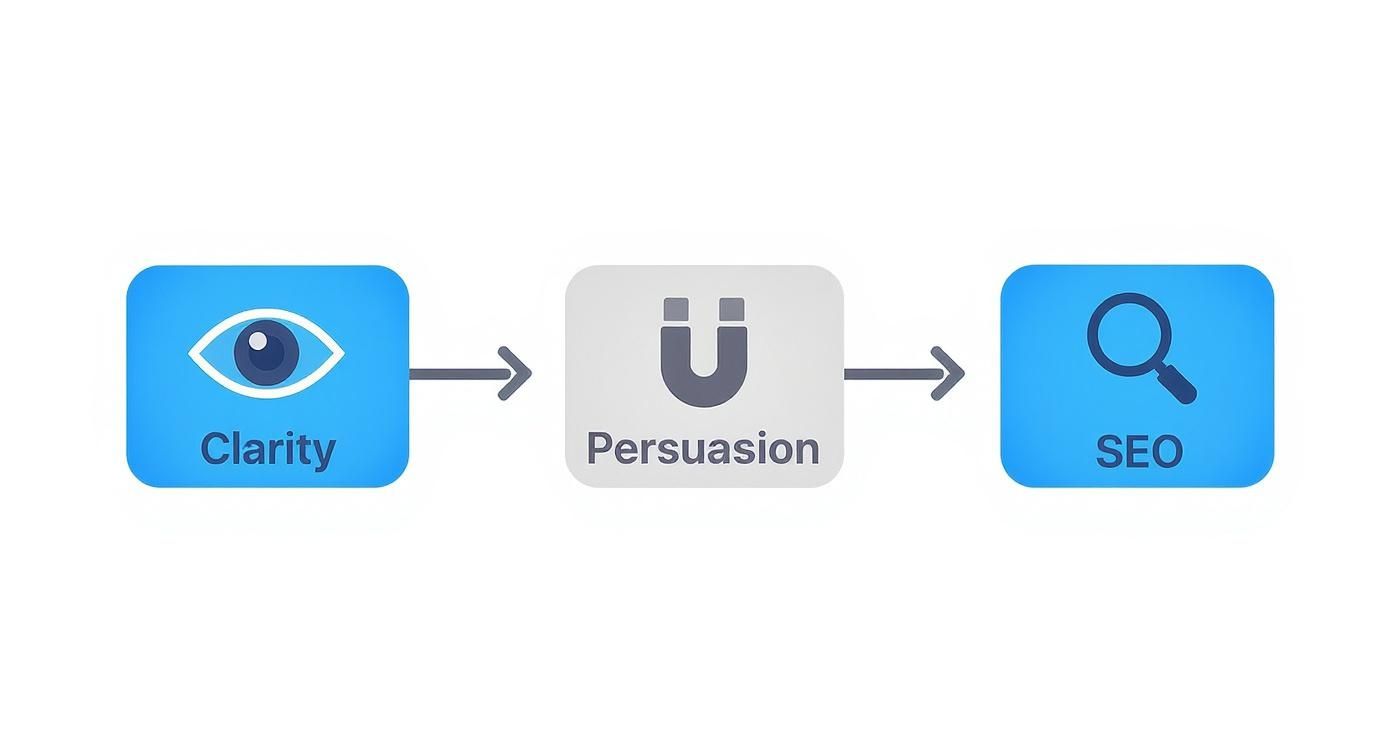
As you can see, it's a natural progression: you start with Clarity, make your points Persuasive, and then dial in the SEO so people can find it.
Automating Your Evergreen Content Distribution
Once you’ve found your greatest hits—the posts that consistently pull in shares, comments, and high time-on-page—it’s an absolute waste to let them get buried in your blog archives. This is your evergreen content, and it deserves to be a permanent part of your distribution strategy.
The key to scaling your reach without burning yourself out is automation. Forget manually posting every single day. It's time to build a system that works for you 24/7.
Your best content shouldn't have a short shelf life. Automation transforms it from a single firework into a constantly burning flame, driving traffic and engagement long after you've moved on to the next project.
This is where a smart content scheduler becomes your new best friend. By creating a library of your proven winners, you can keep your social channels consistently active with high-quality posts that you know people love.
Building Your Content Buckets
The most effective way I've found to organize an evergreen library is with a "bucket" strategy. Instead of just having a chaotic feed of random posts, you categorize everything into distinct themes. This makes it so much easier to create a balanced and interesting schedule.
For example, your buckets could look something like this:
- Blog Posts: Links to your most helpful how-to guides and in-depth articles.
- Quotes & Insights: Shareable graphics with quick, punchy quotes from your content.
- Questions & Prompts: Posts designed specifically to start a conversation with your community.
- Promotional Content: Gentle nudges towards your products, services, or email list.
By pulling from different buckets on different days, you avoid sounding like a broken record and can tailor your content mix for each platform.
A great way to fill these buckets without creating a ton of new content is to repurpose what you already have. For instance, you can use YouTube transcript tools to turn a video into a full blog post, a series of quote graphics, and a handful of insightful tips. That's a ton of mileage from a single piece of content.
Ready to stop the manual scheduling grind? With EvergreenFeed, you can build your content buckets, set a schedule once, and let our platform automatically keep your social media feeds active with your best content. Start automating your evergreen content for free.