James
James
Before you even think about brainstorming blog topics or outlining a video script, you have to nail down the fundamentals. A successful content strategy is built on a solid foundation: knowing why you're creating content in the first place and exactly who you're creating it for. Get this right, and every piece you publish will have a clear purpose and a much higher chance of hitting its mark.
Defining Your North Star Goals and Audience
Jumping into content creation without a plan is a recipe for wasted effort. It’s like setting off on a road trip with no destination in mind—you’ll burn a lot of fuel and end up nowhere. The first real move is to define your "North Star" goals. I'm not talking about vague wishes like "get more traffic." We need specific, measurable outcomes that tie directly back to your business's bottom line.
Start With Why Before What
Your content has to do a job for your business. What is that job? Are you trying to generate more qualified leads for the sales team? Maybe the goal is to boost customer retention by becoming their go-to resource for education and support. Or perhaps you're playing the long game, aiming to establish your brand as the undeniable thought leader in your niche.
Nailing down these goals early on acts as a filter for every content idea you'll have later. For a modern take on this, it's worth seeing how an AI Content Strategy can help sharpen these foundational elements from the very beginning.
Don't just keep this plan in your head, either. The data shows a huge difference between teams that formalize their strategy and those who don't. A shocking 40% of content marketers have a documented content strategy, which means the majority are just winging it. That's a problem, because brands with a documented distribution plan are 3x more likely to report strong results than those who just publish and pray.
Get to Know Your Audience Deeply
Once you know what you want to achieve, you have to figure out who you’re talking to. Generic content that tries to speak to everyone ends up resonating with no one. This is why building out detailed buyer personas is a non-negotiable step in my book. A buyer persona isn't just a caricature; it's a semi-fictional profile of your ideal customer, pieced together from real data and solid market research.
A truly useful persona goes way beyond basic demographics. You need to dig into what makes them tick:
- Pain Points: What are the real-world professional or personal challenges that keep them up at night?
- Motivations: What are their aspirations? What does a "win" look like for them?
- Watering Holes: Where do they actually hang out online? Are they scrolling LinkedIn, active in niche subreddits, or engaging in specific industry forums?
- Content Preferences: Do they binge-watch short video tutorials, or would they rather sink their teeth into a data-heavy case study?
To build these, you have to get out of your own head. Talk to your customers. Interview them. Sit down with your sales and support teams—they're on the front lines every single day and have a goldmine of insights. If you need a more detailed walkthrough, we've put together a guide on how to define a buyer persona for your content strategy.
This whole foundational process is a logical flow, moving from your high-level business goals to a deep understanding of your audience and the competitive landscape.
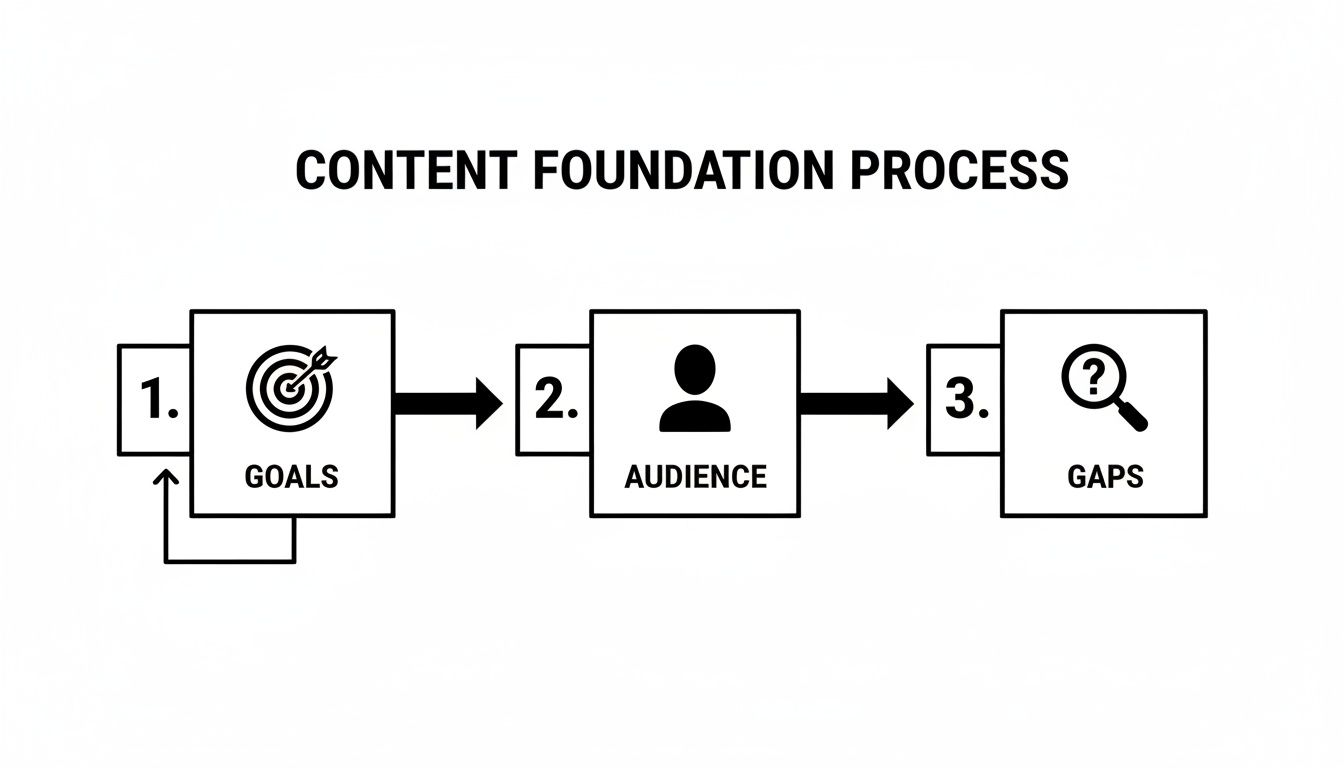
As you can see, it's about building one layer on top of the other—from your "why" to your "who" and, finally, to your "where" you can win.
Core Components of a Content Strategy Foundation
To make this even more concrete, here's a quick breakdown of the essential questions you need to answer at this stage.
| Component | Key Question to Answer | Example |
|---|---|---|
| Business Goal | What specific business outcome will this content drive? | "Increase marketing qualified leads (MQLs) by 25% in the next 6 months." |
| Audience | Who is the ideal person we are trying to reach? | "Marketing managers at mid-sized SaaS companies struggling with lead generation." |
| Audience Pain | What is their most pressing problem we can solve? | "They lack the time and expertise to create a consistent pipeline of high-quality blog content." |
| Content's Job | How will our content specifically help them with that pain? | "Provide actionable templates and step-by-step guides to build an efficient content calendar." |
| Content Gap | What are competitors missing or only covering superficially? | "Competitors offer generic advice, but none provide a downloadable '12-Month Content Plan' template." |
Thinking through these components ensures you're not just creating content for the sake of it, but are building a strategic asset that serves both your audience and your business.
Find the Gaps in Your Competitors' Content
With your goals and audience locked in, the final piece of the foundation is a good old-fashioned competitive analysis. The point here isn't to copy what everyone else is doing. It's to find the openings they've left for you. Start by identifying the main players in your space and doing a deep dive into their content libraries.
Look for the questions they aren't answering. Search for the topics they've only covered superficially. These gaps represent your biggest opportunities to create content that is genuinely unique and more valuable than what's already out there.
Building Your Core Content Pillars
Now that you have a solid grasp on your goals and who you're talking to, it's time to build the foundation of your entire content strategy. I'm talking about your content pillars.
Think of these as the three to five big, essential topics your brand will own. This is how you stop chasing random keywords or fleeting trends. Instead, you'll anchor everything you create in the subjects that matter most to your audience—and where you have real expertise.
The mental shift is simple but powerful. You go from asking, "What should I post this week?" to "How can I explore our 'Productivity Workflows' pillar in a new way this month?" That's how you build a real content engine that has staying power.
Identifying Your Pillar Topics
The strongest content pillars aren't just picked out of a hat. They live in that perfect sweet spot where your audience's biggest problems intersect with your brand's unique strengths.

Get your team together and start brainstorming. No idea is too small at this stage. Just get it all down.
- What are the top 10 questions your sales team gets on every demo call?
- What problems keep popping up in your customer support tickets?
- Look at what your competitors are talking about. Where are the gaps you can fill?
- If you could only advise your ideal customer on five core subjects for the rest of time, what would they be?
Let's say you run a project management software company. Your brainstorm might churn out ideas like "Gantt charts," "team comms," "budgeting," and "client reports." The next step is to cluster these specific topics into bigger, more strategic themes. "Gantt charts" and "budgeting" could easily roll up into a pillar like Project Planning and Execution. "Team comms" and "client reports" could form another one called Stakeholder Collaboration.
Pro Tip: Your pillars need to be broad enough to fuel dozens of smaller content ideas but specific enough that they clearly define your niche. "Marketing" is way too broad. "B2B SaaS Content Strategy" is a much more powerful and defensible pillar.
If you want to go even deeper on this, our guide on what content pillars are breaks down the entire process with more examples.
Matching Formats to Your Pillars and Audience
Okay, you've got your pillars. Now, how are you going to talk about them? You don't need to be everywhere at once. The key is to be strategic, not exhaustive. Pick your formats based on what makes the most sense for the topic and your audience.
What does your audience actually consume? And what's the best way to explain the topic?
- For a technical pillar like "Advanced Data Analytics": You'll need formats that can handle complexity. Think long-form blog posts, detailed white papers, or an in-depth webinar series.
- For a visual pillar like "Interior Design Principles": Text-heavy content will fall flat. You’d get much more traction with Instagram Reels, Pinterest boards, and video walk-throughs.
- For a business strategy pillar like "Scaling a Remote Team": Build authority with a podcast where you interview industry leaders, or offer downloadable case studies that show real-world results.
Your goal is to choose formats that serve the content and the consumer. Just because 17% of marketers report strong results from short-form video doesn't mean you have to make TikToks. If your audience of CFOs lives on LinkedIn and reads industry reports, meet them there.
Mapping Content to the Buyer's Journey
To really make your content work for you, every piece needs a purpose. You need the right content for people at every stage of their decision-making process. A simple content matrix is a fantastic tool for this. It helps you map your pillars and formats across the classic buyer's journey: Awareness, Consideration, and Decision.
Here's a quick look at how our project management software company might map content for its "Project Planning" pillar:
| Funnel Stage | Content Goal | Example Content Format |
|---|---|---|
| Awareness | Attract people struggling with project management. | Blog Post: "5 Signs Your Team Has Outgrown Spreadsheets" |
| Consideration | Show them a better way to solve their problem. | Webinar: "How to Build a Foolproof Project Plan" |
| Decision | Prove your software is the best tool for the job. | Case Study: "How Company X Boosted Efficiency by 40%" |
When you map your content this way, you stop creating one-off assets. Instead, you're building an interconnected system that guides people from their first inkling of a problem straight to your solution. Your pillars become the consistent, trustworthy thread that ties their entire journey together.
Building a Powerful Distribution System
Look, even the most brilliant piece of content is useless if nobody sees it. This is where so many content strategies completely fall flat—not in the creation, but in the distribution. It's time to finally kill the "publish and pray" mindset and start acting like a media company by building a real system to get your work in front of the right eyeballs.

This requires a total shift in thinking. The job isn't over when you hit publish. Honestly, that’s when the real work begins. You need a deliberate, multi-channel plan to push your content where your ideal audience already hangs out.
Pinpointing Your Core Channels
First things first: you need to identify the digital "watering holes" where your audience actually lives. Stop assuming they're on every major platform. Go back to your persona research and find their specific hangouts.
Are they deep in niche LinkedIn groups for their industry? Do they swap advice and memes in specific subreddits? Maybe they religiously read a handful of industry newsletters. Your job is to find these spots and make them central to your distribution plan.
For instance, a company selling developer tools will get a hundred times more traction sharing a technical tutorial on Hacker News or a relevant Discord server than just tossing it onto their generic Facebook page. It’s all about context.
Your content's success is determined not just by its quality, but by its placement. The right message in the wrong place is just noise. Focus on channels where your content adds real value to an existing conversation.
Blending Owned, Earned, and Paid Media
A killer distribution system never relies on a single channel. The magic happens when you blend owned, earned, and paid media into a cohesive engine that works together to amplify your reach. Each one has a distinct, complementary role.
- Owned Media: This is your home turf—the channels you control completely. Think your blog, email newsletter, and your own social media profiles. This is the foundation, your direct line to your most loyal followers.
- Earned Media: This is the digital word-of-mouth you get from having great content and building relationships. It’s PR mentions, guest posts, features in other people's newsletters, and organic shares from influencers.
- Paid Media: This is where you pay to play. We're talking social media ads, search engine marketing (SEM), and sponsored content. Paid channels are fantastic for guaranteeing reach and zeroing in on highly specific audiences you couldn't otherwise touch.
A solid strategy uses owned media to nurture a loyal base, earned media to build authority, and paid media to pour fuel on the fire and target key demographics with precision. To really kick it up a notch, you could even translate videos and reach a global audience to expand your footprint.
The Power of Content Repurposing
Creating a high-quality pillar piece takes a ton of time and energy, so you have to squeeze every last drop of value out of it. Content repurposing is your secret weapon for this—it lets you amplify your reach without burning out your team.
The concept is simple: take one big piece of content and chop it up into dozens of smaller "micro-assets" tailored for different channels. I've found this to be one of the single most effective content distribution strategies for maximizing your return on effort.
Let's walk through an example. Say you just published a massive guide, "The Ultimate Guide to Remote Team Management." Here’s how you could spin it into gold:
- Blog Post to Video: Turn the key sections into a punchy, 5-minute YouTube video.
- Key Statistics to Infographic: Pull the most compelling data points and design a sharp, shareable infographic for Pinterest and LinkedIn.
- Actionable Tips to Twitter Thread: Extract the top 10 tips and format them as a value-packed Twitter thread.
- Expert Quotes to Image Cards: Grab insightful quotes from the post and create branded image cards for Instagram and Facebook.
- In-Depth Section to Email Newsletter: Dedicate an entire weekly newsletter to a deep dive on just one chapter from the guide.
- Full Guide to PDF Checklist: Create a downloadable checklist that summarizes the guide's action items and use it as a lead magnet.
When you start thinking this way, one major content effort can fuel your entire calendar for weeks. You're not just creating more content; you're creating smarter content and giving it the audience it deserves.
Nailing Your Production Workflow and Calendar
A brilliant strategy document is just a piece of paper until you put it into action. This is where your plans stop being ideas and become a real, functioning system that gets high-quality content out the door, week after week. Think of your production workflow and editorial calendar as the engine room of your content operation—they turn potential chaos into a predictable, manageable rhythm.
The goal here isn't to create some ridiculously complex spreadsheet that everyone on the team dreads opening. It's about building a simple, powerful framework that keeps everyone in sync, your content pipeline full, and your publishing schedule rock-solid. This is how you shift from scrambling to create content to proactively running a well-oiled machine.
Building a Production Workflow That Actually Works
Before a single word gets written, you need a map. A production workflow is that map, showing the exact journey each piece of content takes from a spark of an idea to a fully published and promoted asset. When you define this path clearly, you eliminate bottlenecks and the dreaded "I thought you were doing that" moments.
It's really just like an assembly line. Every piece of content, whether it’s a blog post, a podcast episode, or a YouTube video, moves through a similar set of stages.
- Ideation: This is ground zero. Where do ideas come from? Maybe it's a shared Trello board, a monthly team brainstorm, or a dedicated Slack channel for random flashes of brilliance.
- Briefing: Once an idea gets the green light, the creator gets a detailed content brief. This should spell out the goal, audience, target keywords, and the core message you’re trying to get across.
- Creation: The writer, designer, or video producer gets to work on the first draft.
- Editing & Review: The draft then passes through an editing cycle. This is for checking clarity, tone of voice, and accuracy. You might have a subject matter expert review it, followed by a copyeditor for polish.
- Final Approval: A key stakeholder gives the final sign-off before it goes live.
- Promotion Prep: While the content is being finalized, the marketing team can get a head start on writing social media copy, email announcements, or ad creative.
The most critical part? Assigning clear roles. Who is the writer? Who is the editor? Is there a separate designer for the graphics? Who is the one person ultimately responsible for hitting "publish"? Getting these answers locked down from the start saves so much confusion down the road.
Choosing the Right Tool for Your Editorial Calendar
Your editorial calendar is your single source of truth. It’s where your workflow, topics, deadlines, and promotion plans all come together in one place. You can start with a simple spreadsheet, but as you scale, dedicated project management tools are a game-changer for keeping all the moving parts straight.
Tools like Asana or the aforementioned Trello are fantastic for this. They let you build a visual pipeline where each piece of content is a "card" that you can literally drag and drop through the stages of your workflow (e.g., "Ideas," "In Progress," "Editing," "Ready to Publish").
A great editorial calendar does way more than just track publish dates. It gives everyone on the team total transparency into the entire production process. Anyone can see the status of any project at a glance, which is absolutely essential for keeping up momentum and holding people accountable.
At a minimum, your calendar should track this information for every single content piece:
- Title/Topic: A clear working title.
- Content Pillar: Which of your core topics does this piece support?
- Format: Blog post, video, case study, etc.
- Author/Creator: Who is the owner of this piece?
- Status: Where is it in your production workflow? (e.g., Writing, In Review)
- Key Dates: Draft due date, final due date, and publish date.
- Target Keywords: The primary and secondary keywords for SEO.
This kind of detail ensures every piece of content has a purpose and is moving through the pipeline smoothly.
Put Your Social Promotion on Autopilot
Let’s be honest: creating amazing content is only half the job. If nobody sees it, it doesn't matter. But manually posting across all your social channels every single day is a huge time-suck and makes it easy to be inconsistent. This is where scheduling and automation tools become your best friends.
Platforms like Buffer let you schedule your social media promotions weeks, or even months, in advance. This means your content gets the consistent visibility it needs without you having to be chained to your desk. It turns social promotion from a reactive daily chore into a strategic, set-it-and-forget-it activity.
This screenshot shows how you can organize and schedule a backlog of content right inside Buffer's library.
You can see all your upcoming posts at a glance, making sure you have a good mix of content going out across all your channels without any gaps.
If you want to take it a step further, you can integrate a tool like our own EvergreenFeed with Buffer for a truly hands-off approach. You create categorized buckets of your best evergreen content—think timeless blog posts, helpful tips, and great quotes. EvergreenFeed then automatically pulls from these buckets to keep your Buffer queue topped up. This guarantees your social feeds are always active with high-value content, even when you're focused on creating the next big thing. It's an incredible way to get more mileage out of every piece you create while winning back your time.
Measuring Performance and Optimizing for Growth
Let’s be honest: a content strategy isn't a "set it and forget it" kind of thing. If you create a plan and then just file it away, you're missing the most important part. The real magic happens when you treat it like a living, breathing framework that evolves based on what the data is telling you. This is the crucial final loop in your strategy—turning performance metrics into a continuous cycle of improvement.
This is where so many well-intentioned strategies fall flat. There's a massive gap between planning and actually seeing results. While an incredible 96% of tech marketers say they have a content strategy, only a meager 29% feel it’s actually effective. That means seven out of ten teams are churning out content without hitting their goals. As you can see in this SaaS marketing statistics report, measurement and optimization are what separate a good plan from a truly great one.

Without measurement, you’re just guessing. You won't know which articles are bringing in qualified leads, which videos are building brand loyalty, or which topics are falling completely flat. You're flying blind.
Connecting Metrics to Your Original Goals
First things first, you have to connect your analytics back to those "North Star" goals you set at the very beginning. The data you track should be a direct reflection of the business outcomes you’re aiming for. It’s easy to get distracted by vanity metrics like page views, but unless they directly tie to a tangible goal, they're just noise.
Instead, draw a clear, straight line from your objectives to your Key Performance Indicators (KPIs).
- Goal: Brand Awareness? Your KPIs should be things like organic traffic, keyword rankings for your core terms, and social media reach. The core question is: are more people finding you?
- Goal: Lead Generation? Now you're looking at the conversion rate on your content offers, the number of marketing qualified leads (MQLs) coming from your blog, and your cost per lead. Is your content actually turning visitors into potential customers?
- Goal: Customer Engagement? Here, you’ll want to track time on page, comments, social shares, and email newsletter open/click rates. Is your content actually holding people's attention and sparking a conversation?
This direct link is what keeps you from drowning in data. It forces you to focus on the metrics that actually matter for growth.
A great content marketing dashboard isn't about tracking every metric under the sun. It's about creating a focused view of the handful of KPIs that tell you if your strategy is on track to hit its business objectives.
Building Your Content Performance Dashboard
You don’t need to rush out and buy expensive software to get started. A simple dashboard built in Google Analytics 4 (GA4) or even just a well-organized spreadsheet can give you a surprisingly powerful look at your content's return on investment (ROI).
Your dashboard should give you at-a-glance answers to a few key questions:
- Which articles, videos, or posts are driving the most traffic?
- Which topics are generating the most qualified leads?
- Which channels are sending us the highest-quality visitors?
- How is our organic visibility for our core keywords changing over time?
By reviewing this focused dataset regularly, you can move from guessing to knowing. This is the foundation of a truly agile and responsive content operation.
Translating Insights into Actionable Improvements
The last—and most important—piece of the puzzle is turning your data into real-world actions. This is how your strategy gets smarter over time. Your regular analysis should lead to a clear, actionable to-do list for optimization.
Here’s a simple framework I use for turning data into decisions:
| Data Insight | Potential Action to Take |
|---|---|
| High Traffic, Low Conversions | A blog post gets thousands of views but few leads. Time to optimize the call-to-action (CTA) or add a more relevant lead magnet. |
| Low Traffic, High Engagement | An article has fantastic time on page but not enough eyeballs. Relaunch a promotion campaign for it or improve its on-page SEO. |
| Specific Topic Cluster Drives Leads | Your posts on "team productivity" are converting like crazy. Double down on this pillar and create more in-depth content. |
| Competitor Ranks for a Target Keyword | A competitor is outranking you for a keyword you want. Analyze their content and figure out how to create a more comprehensive, valuable resource. |
This process transforms measurement from a boring reporting task into an active, strategic driver of your business. You're no longer just creating content; you're systematically identifying your winners, fixing the underperformers, and uncovering new opportunities for growth. This is the engine that will power your content strategy for years to come.
Frequently Asked Questions
As you start to put the pieces of your content strategy together, you're bound to have some questions. Let's tackle a few of the most common ones I hear from people just getting started.
How Often Should I Update My Content Strategy?
Your content strategy shouldn't be a "set it and forget it" document. The market shifts, your audience evolves, and your own business goals will change. Think of it as a living, breathing guide for your content.
For a deep dive, plan on a full-scale review annually. This is where you'll want to take a hard look at your big-picture items—your core business objectives, buyer personas, and main content pillars—to make sure everything is still pointing in the right direction.
But don't wait a whole year to check in. I strongly recommend a quarterly review. This is the perfect time to dig into your performance data, see what's resonating, and make adjustments to your editorial calendar and distribution tactics. You might find a certain topic is taking off or a new social channel is driving unexpected traffic, and you'll want to lean into that sooner rather than later.
What’s the Difference Between Content Strategy and Content Marketing?
This is a classic—and it's a really important distinction to understand. They’re two sides of the same coin, but they are not interchangeable.
-
Content Strategy is your high-level why. It’s the foundational plan that dictates what you’re trying to achieve, who you’re talking to, and what your unique voice and perspective will be. It's all about the master plan and the principles guiding your decisions.
-
Content Marketing is the tactical how and what. This is the execution—the actual writing of blog posts, filming of videos, designing of infographics, and publishing of social media updates that bring your strategy to life.
I like to explain it this way: Content strategy is the blueprint for the house. Content marketing is the crew showing up every day to pour the foundation, frame the walls, and hang the drywall. You can’t build a solid house without a good blueprint.
How Much Should I Spend on Content Creation?
There’s no one-size-fits-all answer here, as it really depends on your industry, business size, and how aggressive your goals are.
That said, a common benchmark you'll see is around 25-30% of the total marketing budget being allocated to content.
But instead of getting hung up on a specific number, I’d suggest you think about resource allocation. If you’re a lean startup, maybe your budget only allows for one incredibly well-researched blog post a week, which you then slice and dice into a dozen social media posts. A bigger company, on the other hand, might invest in a high-production video podcast series.
The trick is to start with what you can realistically manage, measure the impact relentlessly, and then scale what's working. Once you can show that your content is driving real traffic, leads, and sales, it becomes much easier to make the case for a bigger investment.
Ready to put your social media promotion on autopilot and save hours every week? EvergreenFeed helps you automatically schedule your best evergreen content, keeping your social feeds active and engaging without the manual grind. Start your free trial today!