James
James
It's easy to confuse a communication strategy with a communication plan, but they're two very different things. Think of it this way: your strategy is the long-term vision—the why behind your messaging. Your plan is the tactical roadmap that brings that vision to life—the how, when, and where.
You absolutely have to get the strategy right first. A great plan built on a weak strategy is like trying to build a house on a foundation of sand. It just won't work.
Here’s a quick breakdown to keep the two straight.
Strategy vs Plan Key Differences
| Component | Communication Strategy (The Why) | Communication Plan (The How) |
|---|---|---|
| Focus | Long-term vision and guiding principles. | Day-to-day actions and specific deliverables. |
| Timeframe | Annual, multi-year. | Weekly, monthly, quarterly. |
| Key Questions | Why are we communicating? Who are we talking to? What do we want them to think/feel/do? | How will we reach them? What will we post? When will we post it? |
| Output | A guiding document with goals, audience personas, core messaging, and channel choices. | A content calendar, posting schedule, KPI dashboard, and specific campaign briefs. |
This table clarifies that while they're interconnected, they serve distinct purposes. You need the big-picture "why" before you can effectively tackle the on-the-ground "how."
Defining Your North Star: Your Communication Strategy

Before you even think about drafting a single post, you need a solid foundation. This is your "North Star"—the core idea that ensures every piece of content, every tweet, and every email has a clear purpose and actually connects with the right people.
Without this guiding principle, you're just making noise.
So many businesses make the mistake of jumping straight into tactics. They get bogged down in post frequency and hashtags, and then wonder why they're burned out and seeing inconsistent results. It’s because they skipped the most important part. A well-defined strategy grounds all your actions in real, business-oriented objectives.
Start with Sharp Business Objectives
Let's be blunt: goals like "increase engagement" are wishes, not objectives. To build a strategy that actually moves the needle, your communication goals have to be tied directly to tangible business outcomes.
Instead of vague aims, you need to set S.M.A.R.T. goals:
- Specific: What, exactly, do you want to achieve? (e.g., Increase qualified leads from LinkedIn.)
- Measurable: How will you track it? (e.g., Generate 50 demo requests per month.)
- Achievable: Is this realistic with your team and budget?
- Relevant: Does this support a bigger business objective, like sales growth?
- Time-bound: What's the deadline? (e.g., Within the next quarter.)
Here’s a real-world example: A software company might set a goal to "Increase webinar sign-ups from our target audience of marketing managers by 20% in Q3 by promoting expert-led content on LinkedIn and Twitter." Now that's a goal you can build a solid plan around.
Know Your Audience Deeply
You can't talk to everyone. If you try, you'll end up connecting with no one. Generic audience profiles just won't cut it anymore. You need to build out detailed personas based on real data, getting inside their heads to understand what motivates them, what their biggest headaches are, and where they hang out online.
Your audience doesn't care about your product; they care about their problems. Your strategy must focus on how you can solve those problems, making their lives easier or better. This is the core of resonant communication.
Take a B2B tech company targeting small business owners. A shallow profile just lists their job title and company size. A deep persona dives into their real-world challenges (juggling a million tasks, tight budgets), where they go for advice (specific industry blogs, niche LinkedIn groups), and the content they truly value (quick tips, real-world case studies, tool comparisons).
This level of detail is gold. It informs every single message you create. To see this in action, check out these powerful https://www.evergreenfeed.com/blog/communication-strategy-examples/.
Craft Your Core Message and Voice
Your core message is the one consistent idea you want to own in your audience's mind. It's the common thread that ties all your content together. For a company like EvergreenFeed, a core message could be: "Save hours on social media without sacrificing consistency." Simple, powerful, and memorable.
Your brand voice is the personality that delivers that message. Are you the authoritative expert? The witty, informal friend? The helpful guide? Whatever you choose, it has to be consistent across every single platform to build recognition and trust.
And as you define your strategy, think about how different formats can bring that voice to life. For instance, exploring a modern video content marketing strategy can be a fantastic way to captivate your audience and showcase your brand’s personality through a distinct visual style.
This consistency is more important than ever. With the market for social media automation tools expected to hit USD 12.8 billion by 2033 and 83% of marketing teams already automating posts, a strong strategic foundation is what separates effective automation from robotic spam.
Turning Your Strategy Into a Real-World Action Plan
You've got the big picture—your North Star. Now it's time to build the engine that actually gets you there. This is where we translate that high-level vision into a day-to-day, week-to-week roadmap that delivers real results.
Think of it this way: your strategy is the destination, but the plan is the GPS. It gives you the turn-by-turn directions for every post, story, and email, making sure you're always moving forward. Without it, you're just driving blind.
Figure Out Where You'll Show Up
First things first: decide where you’re going to talk to people. One of the most common mistakes I see is trying to be on every single platform at once. This just stretches your team thin and results in bland, forgettable content everywhere.
Instead, go back to those audience personas you built. If you're selling to B2B tech leaders, LinkedIn is probably your non-negotiable. If you're a direct-to-consumer brand targeting Gen Z, Instagram and TikTok are likely where you need to live. The goal is quality over quantity—it's far better to dominate one or two key channels than to be a ghost on five.
Once you’ve picked your platforms, give your profiles a serious audit. Make sure your branding is consistent, your bio tells people exactly what you do and why it matters, and you have a clear call-to-action sending them where you want them to go next.
Nail Down Your Content Pillars
Content pillars are the handful of core topics or themes you'll talk about over and over again. They're your guardrails, ensuring everything you create is on-brand, relevant, and valuable to your audience. This simple framework is the ultimate cure for the dreaded "what on earth do I post today?" panic.
For a B2B software company, your pillars might look something like this:
- Expert Insights: Breaking down industry trends, sharing original data, and offering a strong point of view.
- Product in Action: Real-world case studies and success stories that show, not just tell.
- Behind the Scenes: Highlighting your company culture, the people on your team, and how you build things.
- Community Spotlight: Celebrating your customers, sharing their wins, and featuring user-generated content.
Strong content pillars build a reliable narrative. Your audience starts to understand what they can expect from you, which builds trust and keeps them coming back. It’s how you turn a random feed into a must-follow resource.
This approach makes brainstorming a breeze. Every new idea can be slotted into a pillar, helping you build a balanced and genuinely interesting content mix. If you need a solid starting point, this strategic communications plan template is a great way to structure your thinking.
Create a Realistic Content Calendar
Your content calendar is your command center. It maps out what gets posted, where it gets posted, and when. But this isn't just about scheduling—it’s about being strategic with your timing and the flow of your messaging.
Start by setting a realistic posting cadence. How often can you actually post on each channel without sacrificing quality? For example, you might land on:
- LinkedIn: 3 times per week (Monday, Wednesday, Friday)
- Instagram: 4 times per week (Tuesday, Thursday, Saturday, Sunday)
- Twitter/X: 1-2 times daily
The key word here is sustainable. It’s much better to post three fantastic pieces of content every week like clockwork than to post daily for two weeks and then burn out completely. You can use a simple spreadsheet or a dedicated tool to get everything organized.
Assign Clear Roles and Responsibilities
This step is crucial, even if you’re a team of one. You need to be crystal clear on who does what. Who comes up with the ideas? Who writes the copy? Who creates the graphics or shoots the video? And who is responsible for scheduling, publishing, and engaging with comments?
When you assign these tasks clearly, you eliminate bottlenecks and create accountability. For bigger teams, a simple RACI chart (Responsible, Accountable, Consulted, Informed) can work wonders for clarifying everyone's role in the content process.
When everyone knows their part, the entire machine just runs smoother. This frees up the creative energy you need to make great content instead of wasting it on managing a chaotic workflow. That operational clarity is the final piece of a plan that actually works.
Putting Your Evergreen Content Engine on Autopilot
Once you have a solid communication plan mapped out, it's time to talk about getting your most valuable asset back: your time. This is where automation, especially for your evergreen content, is an absolute game-changer. It’s all about building a system that keeps your brand visible and engaging 24/7, without you having to manually push a button every single time.
Think about all your best, most timeless content—the blog posts, in-depth guides, glowing testimonials, and killer tips that stay relevant for months or even years. Instead of letting that gold get buried in your archives, you can put it on a continuous loop. This isn't about being lazy; it's about being incredibly smart with your resources and making sure your best work gets the consistent attention it deserves.
A well-oiled automation system takes your communication plan from a daily to-do list and turns it into a self-sustaining engine that drives results.
Building Your Personal Automation Workflow
The core idea here is brilliantly simple: pair a scheduling tool like Buffer with an automation layer like EvergreenFeed. This dynamic duo lets you upload your best content once, sort it into logical categories, and then let the system handle the rest. It's a true set-it-and-forget-it approach that guarantees a steady stream of quality posts across your social channels.
This process ensures the content you worked so hard to create continues generating value indefinitely.
Here’s a simple way to visualize how automation fits into your overall plan.
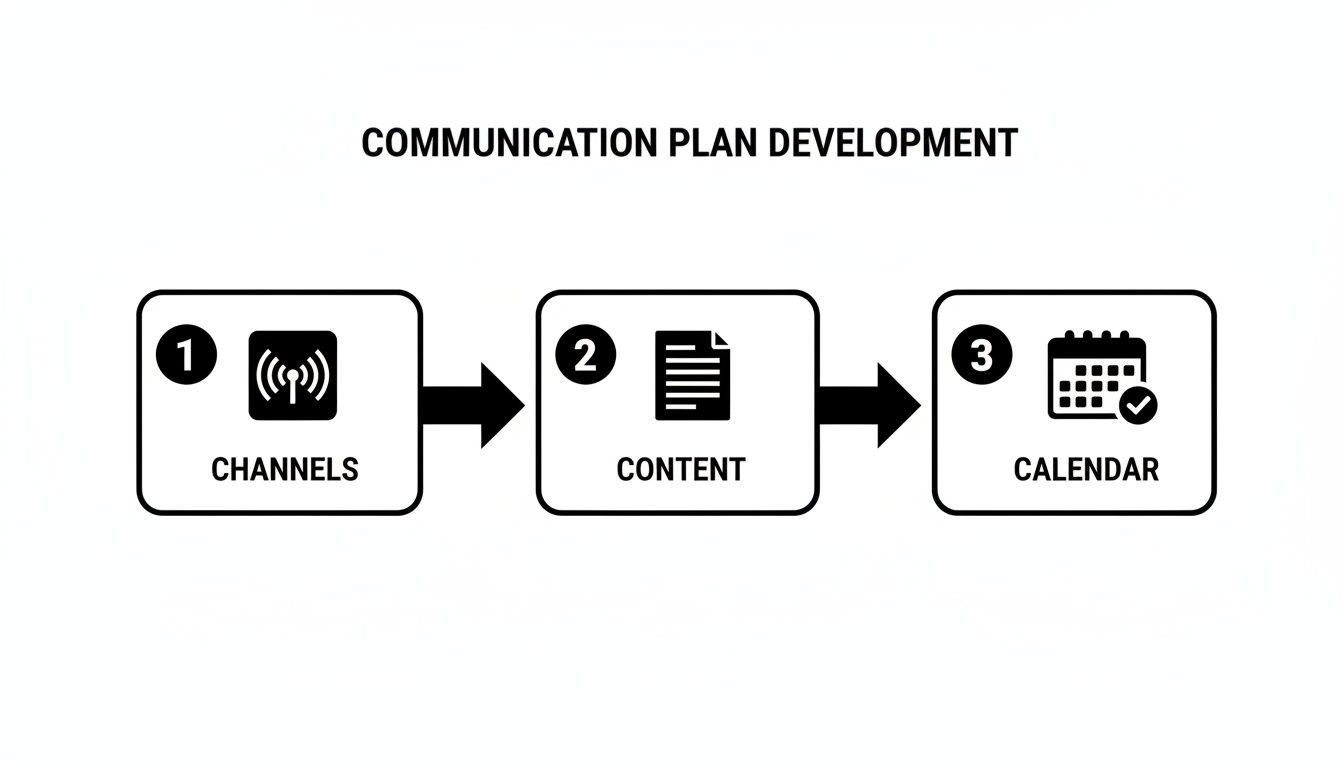
This workflow—moving from channels to content to the calendar—is what automation absolutely perfects.
The real win here is consistency. An active social media presence builds trust and keeps your brand top-of-mind, but who has time to be "on" all the time? Automation ensures you never go dark, even on your busiest days. It frees you up to focus on the high-impact stuff, like jumping into conversations and strategic planning, instead of the repetitive grind of filling a content calendar.
Organizing Content into Evergreen Buckets
The real magic behind this kind of automation is categorization. Instead of dealing with a messy spreadsheet of old post links, you organize your content into distinct "buckets." This not only keeps your library tidy but also gives you total control over the mix and frequency of what you share.
Here’s what these buckets might look like for a digital marketing agency:
- Blog Posts: Links to your most insightful articles and how-to guides.
- Pro Tips: Quick, actionable advice shared as text or simple graphics.
- Client Love: Powerful quotes and testimonials from happy customers.
- Case Studies: Links to success stories that show your results in action.
- Service Spotlight: Gentle reminders about your services or special offers.
Sorting your content into buckets is the key to making sure your feed feels balanced and varied. It’s how you prevent your automation from looking robotic. The system naturally mixes educational content with social proof and promotional messages, just like a human social media manager would.
I've put together a table to give you a clearer idea of how you can structure your own content library for maximum impact.
Sample Evergreen Content Buckets
| Content Bucket | Description | Example Post |
|---|---|---|
| Industry Insights | Sharing trends, news, and expert analysis relevant to your audience. | "Just read a fascinating report on the future of AI in marketing. Here are the 3 key takeaways you need to know: [Link]" |
| Behind-the-Scenes | Giving your audience a glimpse into your company culture, team, or process. | "Meet Sarah, our lead designer! Here she is sketching out concepts for our next big project. #TeamCulture" |
| Pro Tips & How-Tos | Short, actionable advice that solves a specific problem for your audience. | "Struggling with low open rates? Try this A/B test on your next email subject line: Question vs. Statement. #EmailMarketing" |
| Testimonials & Social Proof | Highlighting positive feedback and success stories from clients or customers. | "We love hearing from our customers! 'Their platform doubled our productivity in just one month.' – John D., CEO" |
| Educational Resources | Linking to your most valuable long-form content like guides, whitepapers, or webinars. | "Ready to master your content strategy? Our ultimate guide has everything you need to get started. [Link to Guide]" |
Once your buckets are full, you create a schedule. You might tell the system to post one "Pro Tip" every morning and one "Educational Resource" every afternoon. The tool then randomly selects a piece of content from the right bucket and sends it to your Buffer queue for publishing. This built-in randomization is crucial—it ensures your feed feels fresh and prevents followers from seeing the same posts in the same order. For a deeper dive into setting this up, check out this guide on how to automate social media posts.
The results of integrating automation into your communication strategy and plan are hard to ignore. Industry-wide, 80% of marketing automation users see an increase in their lead generation, and 77% report higher conversion rates. With a platform like EvergreenFeed, you upload your content once and let the system guarantee constant activity—no daily logins required. It's one of the smartest ways to get a measurable ROI from your social media efforts.
Putting AI to Work in Your Communication Plan
Artificial intelligence isn't some far-off concept anymore. It's a real, practical co-pilot that can make your entire communication workflow smarter and a whole lot more efficient. When you start weaving AI into your daily tasks, you can finally shift from constantly reacting to proactively leading with a data-informed approach.
Think of AI as your tireless brainstorming partner. It can sift through industry trends, see what your competitors are up to, and pitch fresh angles for your content pillars. You’ll never stare at a blank screen wondering what to post again. Honestly, this is becoming a cornerstone of any modern communication strategy and plan.
This isn't just a niche trend, either. It's rapidly becoming the standard. A recent report found that 56% of marketers are already using AI in their day-to-day, with another 36% planning to jump in within the next year. In fact, daily AI use among marketers has shot up to 60%, and 84% say they're relying on these tools more than they did last year. You can see how other marketers are using AI to get a leg up.
Create Content Smarter, Not Harder
The most obvious place you'll feel AI's impact is in the actual drafting and editing process. It can spin up multiple versions of a social media post in seconds, help you craft hooks that actually grab attention, and even A/B test headlines before you ever hit "publish." This isn't about replacing your creativity; it's about giving it a massive boost.
For example, I'll often drop a link to a new blog post into an AI tool and ask it for five unique tweets, three solid LinkedIn posts, and a quick script for an Instagram Reel. Just like that, one big piece of content becomes a full week's worth of social media updates. That's hours of manual work gone.
This frees up your team from the grind of content creation so they can focus on what people do best: actually engaging with comments, building a real community, and thinking about the big-picture strategy.
AI should handle the repetition so you can handle the relationships. Let it execute the tactical parts of your plan with speed and precision, freeing you up for strategic thinking and genuine audience interaction.
This is where you'll see the biggest wins. When you divide the labor this way—letting the tech handle the "how" so you can focus on the "why"—your productivity and performance will thank you for it.
Let AI Find Your Perfect Posting Times
Beyond just writing, AI is a wizard at spotting patterns in performance data that a human might miss. Many social media management tools now have AI features that analyze your past engagement to tell you the absolute best times to post for your specific audience. The guesswork is officially over.
Instead of trusting those generic "best times to post" articles, you get personalized recommendations based on when your followers are actually scrolling and ready to engage. This data-driven scheduling alone can dramatically lift the reach and impact of every single thing you post.
You see this same smart approach in tools like EvergreenFeed. Its randomization feature pulls from your different content buckets to create a feed that feels varied and natural, not like a robot is just checking boxes. It’s designed to mimic the authentic, non-repetitive flow you'd create yourself, ensuring your automated content never feels, well, automated.
Here are a few practical ways I've seen AI directly support a communication plan:
- Brainstorming Content: It can generate topic ideas based on trending keywords and what your audience is actually searching for.
- Drafting and Copywriting: Use it to create first drafts for posts, emails, and even ad copy.
- Analyzing Performance: It quickly identifies your top-performing content, so you know exactly what to create more of.
- Audience Insights: It can analyze engagement data to help you build out and refine your customer personas.
By making these capabilities a core part of your workflow, AI becomes an absolutely essential partner. It empowers you to run a more sophisticated and effective communication plan—often with the same or even fewer resources—giving you a serious edge.
Measuring What Matters and Refining Your Plan

Here's the thing about a great communication plan: it's never really "done." You don't just build it, file it away, and hope for the best. The most effective plans are living documents, constantly evolving based on real-world feedback.
The only way to guide that evolution is to measure what’s working, what’s falling flat, and then use that data to make smart adjustments. This feedback loop is what separates the pros from the amateurs, ensuring your time and effort are always pushing you toward your biggest goals.
Don't Get Fooled by Vanity Metrics
It's so easy to fall into the trap of chasing numbers that feel good but mean very little for your actual business. We call these vanity metrics. A post that gets a thousand likes or a sudden jump in followers is exciting, but if those likes don't lead to a single click and those new followers never interact with you again, did it really move the needle?
To build a communication strategy and plan that lasts, you have to look deeper. The goal is to tie your efforts to key performance indicators (KPIs) that actually reflect growth and tell a true story about your impact.
Here are the metrics I always keep an eye on:
- Engagement Rate: Forget just raw follower counts. This metric tells you what percentage of your audience is actually interacting with your content through likes, comments, shares, and saves. It’s the true health score of your community.
- Click-Through Rate (CTR): This is your reality check. Out of everyone who saw your post, how many were compelled enough to actually click your link? A high CTR means your message and call-to-action are hitting the mark.
- Conversion Rate: This is the big one. Of the people who clicked, how many followed through and did the thing you wanted them to do—like sign up for your newsletter, download an ebook, or buy a product? This metric connects your communication directly to business results.
- Reach and Impressions: While they can be vanity metrics alone, reach (how many unique people see your content) and impressions (the total number of times it was seen) are crucial for gauging brand awareness. They tell you how far your message is traveling.
Most social media platforms have their own analytics, and tools like Buffer offer fantastic, in-depth reports. Make it a habit to dive into these dashboards and get familiar with the numbers that matter to your goals.
Find Your Review Rhythm
Collecting data is pointless if you never use it to make decisions. The secret is to build a simple, consistent review process right into your workflow. You don't need to overcomplicate it; a monthly or quarterly check-in is usually perfect for spotting trends and making necessary pivots.
This turns measurement from a reactive report card into a proactive part of your strategy.
Think of your analytics as your audience telling you exactly what they want to see more of. Listening is the fastest way to improve your communication and deliver real value.
During your review, put on your detective hat. Are there patterns in your best-performing content? Maybe a specific format, like video, always outperforms static images. Or perhaps posts published in the morning consistently get more traction.
Let's look at a real-world example. Say a small e-commerce brand reviews its Instagram data and makes a key discovery. Their polished, professional product shots get decent likes, but the behind-the-scenes Reels showing how their items are made have three times the engagement rate and a much higher CTR to their product pages.
What do they do? They adjust. For the next quarter, they might scale back on the studio photos and double down on creating that authentic, process-driven video content.
That's the feedback loop in action: Measure, Learn, Adjust, Repeat. It’s how you stop guessing and start building a communication plan that gets better and better over time.
Answering Your Top Communication Strategy Questions
Even with the best guide in hand, questions are going to come up. That’s a good thing—it means you’re digging in and thinking critically about how to build your brand’s voice. Let's walk through some of the most common questions I get asked when people are putting together a communication strategy and plan.
Getting these fundamentals straight will clear up a ton of confusion and give you the confidence to move forward.
How Often Should I Revise My Communication Plan?
This is a fantastic question because it gets right to the heart of being agile. Your high-level strategy is like your constitution—it defines your core mission, audience, and voice. It's built to last. I’d recommend revisiting that document annually, or whenever your business makes a major shift, like a rebrand or launching into a new market.
Your communication plan, on the other hand, is the tactical map you're using day-to-day. It has to be more flexible.
I’ve found that a thorough review every quarter is the sweet spot. This timing is perfect for digging into the performance data, seeing what actually resonated, and tweaking your content pillars or channel focus based on real results. Of course, smaller adjustments—like shifting your posting times or changing up the content mix—can happen much more often, say, on a monthly basis, as you spot trends in your analytics.
What Is The Difference Between A Communication Strategy And A Marketing Strategy?
Ah, the classic question. It’s a common point of confusion, but the distinction is really important for getting your team aligned.
Your marketing strategy is the entire game plan for how you’ll win in the market. It’s the big picture, often built around the traditional "4 Ps"—Product, Price, Place, and Promotion. It answers the fundamental question: "How will we get our product into the hands of customers and succeed?"
Your communication strategy is a crucial piece of that puzzle, focusing almost entirely on the "Promotion" part. It’s the playbook for your messaging.
A communication strategy gets specific about:
- Your core message and what makes you different.
- Your brand voice and personality.
- Who you’re talking to (your target audience) and what they care about.
- Where you’ll talk to them (the channels you’ll use).
Basically, the marketing strategy covers everything from product development to pricing. The communication strategy is the dedicated playbook for how you talk to people within that larger framework. They have to work in lockstep, but they operate at different altitudes.
A great marketing strategy can fall flat if its communication is muddy or inconsistent. Your communication strategy gives your marketing plan its voice, ensuring every single message is sharp, on-brand, and effective.
I like to use a house-building analogy. The marketing strategy is the complete architectural blueprint—foundation, walls, roof, the works. The communication strategy is the interior design plan—the colors, textures, and style that make the house actually feel like a home.
How Do I Choose The Right KPIs For My Social Media?
Here’s the most important rule to remember: your goals dictate your KPIs. The metrics you track must connect directly to what you're trying to accomplish. It’s so easy to get caught up in "vanity metrics" like follower count, which feel good but often tell you very little about actual business outcomes.
First, get crystal clear on your primary objective for social media. Is it brand awareness? Engagement? Lead generation? Customer support? Once you have that answer, you can pick the 3-5 core KPIs that truly measure your success.
Here's a simple way to think about it, based on common goals:
- Goal: Brand Awareness → Track Reach (how many unique people see your content) and Impressions (total views). This tells you how far your message is spreading.
- Goal: Engagement → Focus on Engagement Rate (likes, comments, shares, and saves as a percentage of your audience). This shows you if your content is actually resonating with people.
- Goal: Lead Generation → The money metrics are Click-Through Rate (CTR) and Conversions. These directly tie your social media activity to tangible business results.
Start with a focused set of KPIs. You can always expand your dashboard later, but always make sure every number you track tells you something meaningful about your progress toward a specific goal.
Ready to build an evergreen content engine that works for you 24/7? With EvergreenFeed, you can automate your best content, save hours of manual work, and keep your social media channels consistently active. Sign up for free and start automating today!